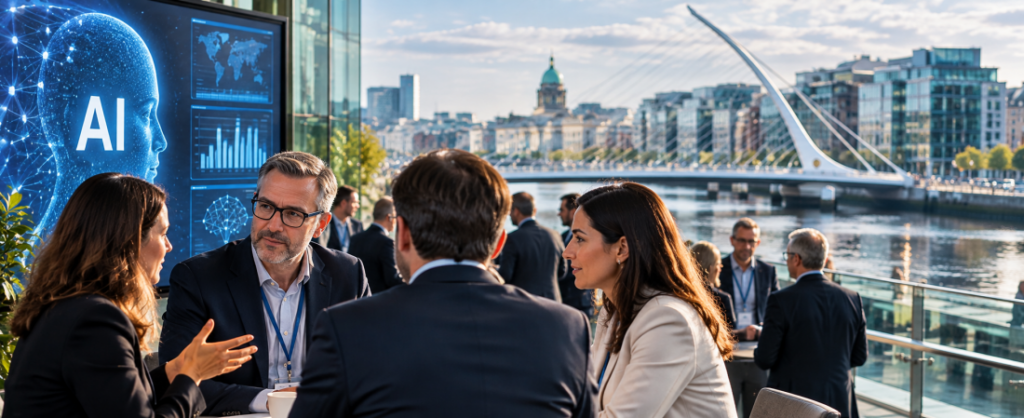
Dublin has become a focal point of Europe’s artificial intelligence debate as global technology executives, policymakers and investors gather for the International AI Summit on 14 October 2026. For international entrepreneurs and companies considering Ireland as a European business base, the significance extends beyond the conference itself. The central question is whether Ireland can translate its established technology presence into a competitive environment for developing, adopting and commercialising artificial intelligence.
A Global AI Summit Places Ireland at the Centre of Europe’s Technology Debate
An RTÉ News report published on 14 October highlighted the International AI Summit at Dublin’s Royal Dublin Society (RDS), where approximately 1,500 participants were expected to discuss AI innovation, security and regulation.
The event forms part of Ireland’s 2026 Presidency of the Council of the European Union and officially launches European AI Innovation Month.
RTÉ
+1
This development prompted Ireland Journal to examine a broader economic question: Does Ireland’s growing role in European AI policy create meaningful opportunities for international businesses, or is the country’s position primarily a reflection of its existing multinational technology sector?
The distinction matters. Hosting influential technology executives demonstrates international connectivity, but long-term competitiveness depends on investment, skills, infrastructure, regulatory clarity and the ability of businesses to turn technology into commercial value.
Why the World’s AI Leaders Are Meeting in Dublin
The summit brings together senior representatives from Microsoft, Google DeepMind, OpenAI, Stripe, Anthropic and other international technology companies.
Speakers announced by the Irish Government include Microsoft’s Brad Smith, Google DeepMind’s Demis Hassabis, OpenAI Chief Financial Officer Sarah Friar and Stripe executive Eileen O’Mara.
The official programme concentrates on three strategic areas: practical AI applications across industries, the infrastructure required to support European AI development, and emerging technologies that could transform future business models.
DETE
+1
Ireland is particularly relevant to these discussions because of its established concentration of international technology operations, its English-speaking business environment and its position within the European Union.
However, the presence of multinational technology companies does not automatically guarantee that Irish-owned enterprises or new international entrants will benefit equally from AI investment.
That requires a wider ecosystem capable of supporting smaller businesses, emerging technology companies and established enterprises outside the major technology clusters.
From AI Innovation to Commercial Application
One of the most important developments reflected in the summit agenda is the shift from AI experimentation towards practical business implementation.
Artificial intelligence is increasingly being considered for applications in manufacturing, financial services, healthcare, agriculture, logistics and public administration.
For companies operating in Ireland, the commercial opportunities extend beyond developing sophisticated AI models.
Businesses may find opportunities in specialised software, process automation, compliance services, data management, cybersecurity, AI integration and industry-specific applications.
An international entrepreneur establishing an Irish company does not necessarily need to compete directly with global AI developers.
A more realistic opportunity may involve identifying a particular industry problem and applying existing AI technology to solve it efficiently, securely and profitably.
For example, a business serving European manufacturers could develop AI-supported quality-control systems, while a professional-services company might specialise in helping smaller enterprises integrate AI into existing operations.
These are potential commercial applications rather than confirmed outcomes of the summit. Their viability depends on customer demand, implementation costs, technical reliability and measurable productivity improvements.
AI Regulation: A Competitive Advantage or an Additional Cost?
The summit also highlights a fundamental challenge facing European policymakers: encouraging innovation while maintaining appropriate safeguards.
Speaking at the Dublin event, Google DeepMind’s Demis Hassabis warned about emerging AI-related security threats and called for stronger international safety standards.
Microsoft’s Brad Smith similarly emphasised the importance of effective regulation as AI capabilities develop.
Reuters
For businesses considering Ireland, the regulatory environment deserves particular attention.
Ireland operates within the European Union’s legal framework, including the EU AI Act and existing data-protection requirements.
Companies developing or deploying AI systems must assess their specific regulatory obligations rather than assuming that every AI application is subject to identical requirements.
Compliance can increase development and operating costs. Nevertheless, companies capable of demonstrating trustworthy AI practices may also strengthen their position when serving regulated industries or customers requiring robust governance.
Ireland’s opportunity is therefore not simply to attract AI investment, but to develop an environment where innovation and regulatory compliance can coexist commercially.
What International Entrepreneurs and Investors Should Consider
For international businesses evaluating Ireland as a potential European headquarters, technology-development centre or investment destination, several practical considerations emerge.
Market access and company establishment: Ireland offers access to the EU Single Market, although establishing an Irish company does not automatically resolve every licensing, tax or cross-border regulatory requirement.
Talent and research: Ireland’s universities, research institutions and established technology employers provide an important foundation. However, companies must assess recruitment costs, specialist skills availability and competition for experienced personnel.
Infrastructure and operating costs: Reliable electricity, computing resources, digital connectivity and suitable commercial premises are increasingly important for AI-intensive businesses. Infrastructure constraints should be examined before committing substantial investment.
Financial incentives: Research and development tax relief, enterprise supports and innovation programmes may be relevant, but eligibility depends on the activities undertaken and the applicable conditions.
Regional opportunities: Dublin is the principal technology centre, but businesses should also investigate regional locations where operating costs, university connections or industry specialisation may better suit their commercial model.
The appropriate location and corporate structure will ultimately depend on the business rather than the visibility of any individual technology event.
Beyond Dublin: Can AI Benefit the Wider Irish Economy?
A particularly important issue is whether AI adoption can extend beyond multinational corporations and technology-focused start-ups.
Ireland’s smaller businesses, regional manufacturers, agricultural enterprises and service providers could benefit from practical automation and improved access to specialised digital tools.
Yet successful adoption requires more than purchasing software.
Businesses need reliable data, appropriately trained employees, cybersecurity safeguards and a clear understanding of the economic return on investment.
The wider economic benefits will depend on whether productivity improvements become accessible across the Irish enterprise sector, including companies operating outside Dublin.
This is where Ireland’s AI ambitions will face their most meaningful commercial test.
Conclusion: An Important Signal, but Business Fundamentals Still Matter
The International AI Summit demonstrates Ireland’s ability to bring together influential participants in global technology, European policymaking and business innovation.
For international entrepreneurs and investors, the event reinforces Ireland’s relevance as a potential European base for AI-related business activity.
However, a successful investment decision requires more than a favourable technology narrative.
Businesses should examine customer demand, talent availability, infrastructure, regulatory exposure, operating costs and access to appropriate support.
Ireland’s long-term AI opportunity will be measured not by the number of global technology leaders visiting Dublin, but by how effectively businesses across the country can convert artificial intelligence into sustainable economic value.
That is the development international investors and entrepreneurs should follow beyond the summit itself.
Research Sources
The article is based on independent examination of contemporary Irish reporting, government announcements and European regulatory information.