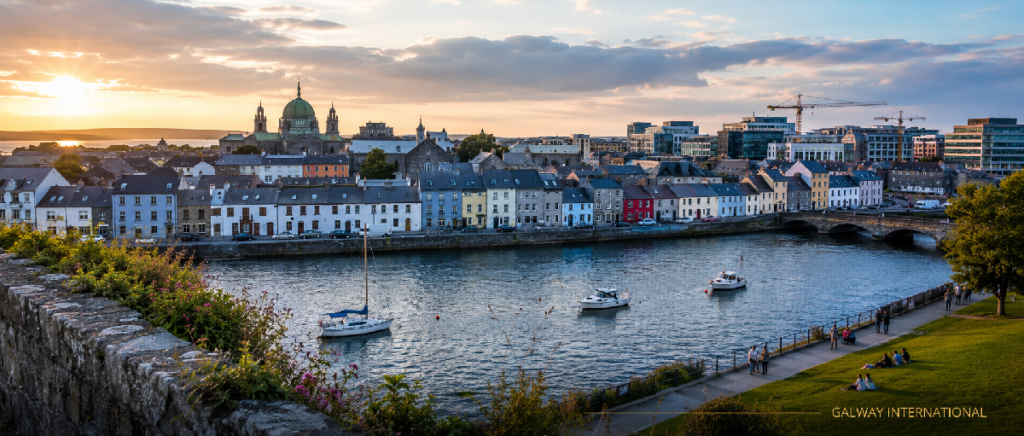
€30 Million for the Cultural Capital of the West: Galway Paves the Way for 12,500 New Housing Units.
Galway is Ireland’s cultural capital of the West, not officially but in global perception. The city attracts artists, technologists, writers, and digital nomads like nowhere else in Ireland except Dublin. Now this global appeal finally gets structural backing. Galway City Council has secured a €30 million HIIF financial injection, and this will be systematically deployed to ultimately create space for over 12,500 new residential units. This isn’t just a number, it’s a transformation announcement.
The €30 million is strategically allocated across three areas. Northeastern expansion receives €12 million for new road connections and infrastructure for building land reserves north of Galway City toward Tuam Road with a goal of 3,500 new units in 36 months. Southern corridors receive €10 million for development and modernization of roads and utilities in southern Galway suburbs around Oranmore and Athenry with a goal of 5,000 new units. Tech hub infrastructure receives €8 million for fiber-optic, power, and water infrastructure for designated innovation zones in Galway, keeping the location attractive for digital nomads and tech companies.
What distinguishes Galway from other Irish cities includes its art scene with high-caliber theaters, museums, galleries like Druid Theatre and Galway Arts Centre. Its festival ecosystem includes Galway International Arts Festival, Galway Film Fleadh, and Galway Oyster Festival. Its tech presence includes Microsoft, Cisco, Digital Think, and HubSpot having offices or operations. Its literary heritage includes being the former home to Oscar Wilde and William Butler Yeats, providing cultural depth. For international professionals, Galway is therefore not just an Irish city but a global culture-and-tech epicenter.
June 2026 was meteorologically exceptional with a rare mini-tornado spotted near Athenry, just outside Galway. Spectacular but also symbolically important: Galway and surroundings showed resilience. Infrastructure held, populations acted calmly, and no significant damage resulted. That says something about the region: it’s robust, cohesive, and extreme weather is part of reality, not a surprise. Galway increasingly attracts international expats for clear reasons: quality of life, cultural offerings, tech jobs, lower living costs than Dublin, and immediate proximity to Atlantic nature.
With 12,500 new residential units, Galway becomes competitive with Dublin at a quality of life Dublin cannot match. The practical relocation roadmap for international candidates starts with phase one in June through August 2026 by renting an apartment in central Galway for three months for a get-to-know phase. Phase two from September to December 2026 involves buying if it fits, before the infrastructure boost when prices rise from Q1 2027. Phase three from 2027 onwards involves new homes hitting the market with wider selection and fair prices. From 2026 to 2031 will be Galway’s transformation decade. Population grows from approximately 80,000 to 105,000 or more.
New cultural institutions emerge with modernized art halls planned. Tech industry expands with at least five new tech firms yearly expected. Housing supply finally normalizes. The new Galway will be urban enough to be globally relevant, small enough to retain soul, and tech-modern enough to attract talent. With €30 million HIIF investment and 12,500 new units announced, Galway will become the top alternative to Dublin for international talent over the next three to five years. For investors, anyone entering Galway real estate now benefits from infrastructure-driven appreciation, relocation boom with demand explosion, and cultural network effects where it remains attractive and doesn’t become a bedroom community. The time for Galway is now. In three years, it will be too late.