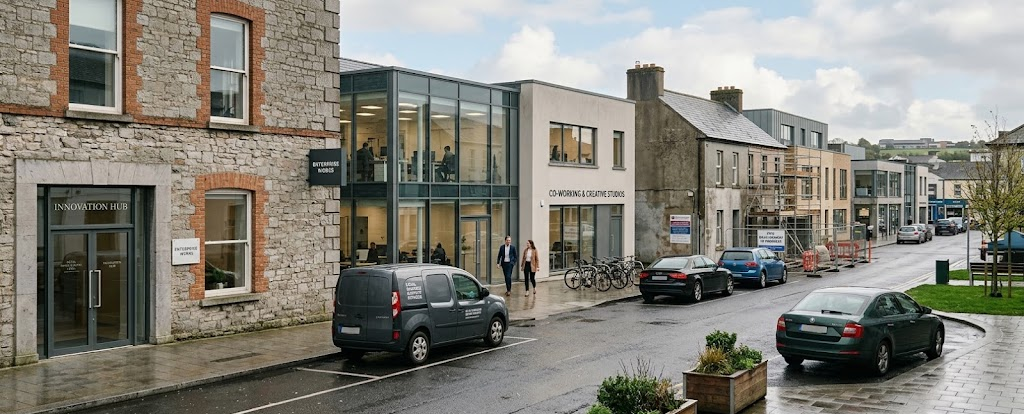
Ireland is experiencing an exceptional surge in company formation. Almost 15,000 new businesses were established in the first half of 2026, the highest number recorded for the period. But behind the headline lies a more interesting question for international entrepreneurs: is Ireland simply producing more founders, or has the country built a public support system that makes starting and scaling certain businesses materially easier?
Figures reported by The Irish Times and RTÉ in July provided the starting point for further independent Ireland Journal research into Ireland’s start-up environment and, in particular, the role played by grants, state investment and enterprise supports.
The conclusion is more nuanced than the popular idea that Ireland simply “gives grants to start-ups”. Grants are important, but they are selective, conditional and only one part of a much larger enterprise-support infrastructure.
A record 14,949 new companies in six months
According to Vision-net by CRIF data reported in the Irish media, 14,949 start-ups were registered during the first six months of 2026, 13% more than during the corresponding period in 2025. Vision-net said its records extend back 30 years and that it had never previously seen formation numbers at this level.
Technology stands out. IT start-ups increased by 62%, influenced strongly by artificial intelligence, while motor businesses increased by 31%, manufacturing by 26% and construction by 22%.
Those figures matter because they suggest that Ireland’s entrepreneurship story is broader than the country’s familiar position as the European base of major US multinationals.
But company registrations alone do not demonstrate that grants caused the boom. There is no evidence in the available data establishing such a direct causal relationship.
What the research does reveal is something potentially more useful: entrepreneurs establishing the right kind of business in Ireland can enter an unusually developed ecosystem of public funding, mentoring, innovation assistance and state-backed investment.
Ireland has built an extensive business-support system
The scale is easily underestimated.
Ireland’s government-backed National Enterprise Hub currently lists more than 300 business supports, covering areas ranging from starting and financing businesses to productivity, digitalisation, exports, employment, sustainability and innovation.
For very small companies, the country’s network of Local Enterprise Offices is particularly significant.
A Priming Grant, for example, is intended for qualifying micro-enterprises during their first 18 months. National LEO rules provide for support of up to 50% of eligible investment, normally subject to lower practical ceilings; awards approaching the stated €150,000 maximum are exceptional. Eligible expenditure can include equipment, salaries, consultancy, innovation and marketing.
Before a company even reaches that stage, a Feasibility Study Grant can contribute towards investigating whether a proposed product or service is commercially and technically viable. The national maximum is €15,000, with support generally covering 50% of eligible expenditure in the South and East and up to 60% in the Border, Midlands and West region.
After the initial start-up phase, qualifying businesses can potentially move towards Business Expansion assistance.
This creates something resembling a funding pathway rather than one universal “Irish start-up grant”.
Enterprise Ireland changes the equation for scalable businesses
For ambitious companies capable of selling internationally, the landscape changes again.
Enterprise Ireland currently offers an HPSU Feasibility Study Grant of up to €30,000 and a Pre-Seed Start Fund providing qualifying early-stage companies with €50,000 or €100,000 of investment. The latter requires considerably more than an idea: applicants are expected to demonstrate an MVP or beta product, early customer validation, a credible execution plan, innovation, internationalisation potential and employment capacity.
For high-potential technology businesses, support can become substantially larger. Enterprise Ireland lists co-funded equity investment of up to €800,000 through its Innovative HPSU Fund.
The ecosystem is not theoretical. Enterprise Ireland reported in May that it invested €32.9 million in Irish start-ups during 2025, supporting 198 companies, including 90 High Potential Start-Ups. Notably, 52% of the supported start-ups had AI at the centre of their product or service.
That provides useful context for the 62% increase in IT company formations recorded during 2026.
But there is an important catch: not every business qualifies
This is perhaps the most important point for an international entrepreneur.
Registering an Irish company does not automatically provide access to Irish grant funding.
LEO financial assistance prioritises manufacturing and internationally traded services businesses capable of developing exports and employment. Eligibility depends on factors including location, business size, commercial viability, market potential and the nature of the activity.
A conventional local consultancy, property company, retailer, restaurant or professional-services operation should therefore never construct its Irish business plan on the assumption that a large start-up grant will be available.
Even qualifying businesses frequently need their own capital. Dublin City’s Feasibility Grant, for example, operates as reimbursement against eligible expenditure: the entrepreneur must first have the resources to incur the expenditure and subsequently claim the approved proportion.
There is another practical lesson: timing matters. Some LEO schemes require an application before expenditure is incurred. Spending money first and investigating grant eligibility afterwards can therefore make otherwise relevant expenditure ineligible.
The regional dimension deserves attention
Ireland’s enterprise-support structure also challenges the assumption that serious start-up activity revolves entirely around Dublin.
LEO-supported businesses created 7,261 new jobs in 2025, and 82% of those new jobs were outside the Dublin region. Financially supported LEO clients collectively employed 40,285 people.
For an international founder choosing where to establish operations, this makes location part of the business-support analysis rather than simply a lifestyle or property decision.
Regional Ireland can offer different costs, labour markets, enterprise networks and, in some circumstances, different funding parameters. The higher percentage available under the LEO Feasibility Grant in the Border, Midlands and West is a simple example.
What this means for an international entrepreneur
The Ireland Journal’s analysis does not support the simple conclusion that grants are driving Ireland’s record company-formation figures.
It supports a more useful conclusion.
Ireland has constructed an unusually extensive institutional framework around entrepreneurship. The strongest opportunities are directed towards businesses that correspond with national economic objectives: innovation, exports, technology, manufacturing, productivity, skilled employment and international growth.
For an international entrepreneur, therefore, the question should not be “What Irish grants can I get after setting up my company?”
It should be asked much earlier:
“How should I structure and locate a commercially viable Irish operation so that its business model, investment programme and growth strategy fit the supports legitimately available?”
That distinction matters. Grants should never be the reason a business exists. But for the right company, researched before money is committed, Ireland’s combination of grants, state investment, mentoring, innovation programmes and export support can materially change the economics of establishing and scaling a business.
Conclusion
Ireland’s record 14,949 company formations in the first half of 2026 are evidence of unusually strong entrepreneurial activity, but they should not be interpreted as evidence of a grant-fuelled start-up boom.
The more important story is the infrastructure surrounding those businesses.
International founders considering Ireland should assess grants and enterprise supports before incorporation, investment and expenditure, identify which agency and programme fits the proposed business, and distinguish grants from loans and state equity investment.
For businesses with genuine innovation, employment and international-growth potential, Ireland offers considerably more than an attractive corporation-tax environment. It offers a structured route from feasibility and start-up through expansion, investment and internationalisation.
For businesses that do not meet those criteria, the lesson is equally valuable: build the business case without assuming public funding — and treat any support for which the project genuinely qualifies as an accelerator, not its foundation.