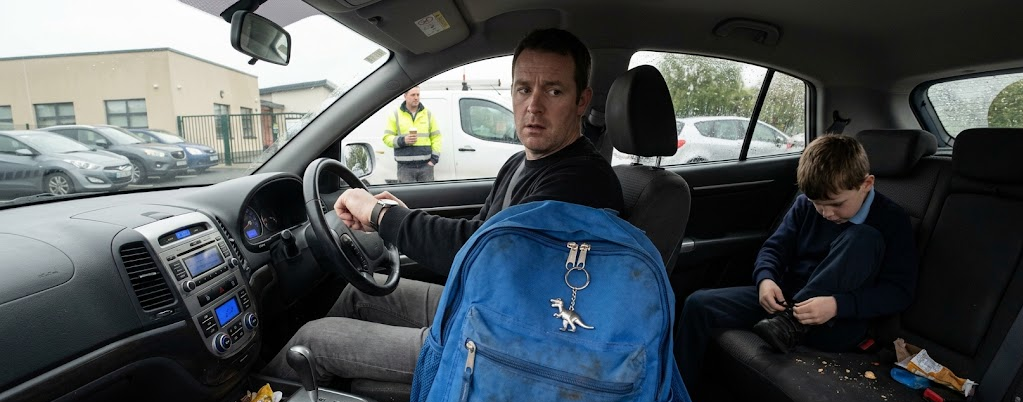
At 8.43 on Monday morning, the most important object in the Brennan household was not the car key, although Paul was already looking for it.
It was not Aoife’s laptop, which was open on the kitchen table with a half-written email to a client in Rotterdam.
It was a small blue schoolbag with a silver dinosaur hanging from the zip.
“Shoes, Conor.”
“I have shoes.”
“You have one shoe.”
“That’s still shoes.”
Paul appeared in the doorway holding the missing car key triumphantly.
“The school said nine o’clock,” he said.
Aoife looked at him.
“I know what the school said.”
“And it’s 8.43.”
“I also know what time it is.”
There are marriages in which seventeen minutes would barely register. In the Brennan marriage, on that particular Monday morning, seventeen minutes had become an infrastructure problem.
Until the previous week, Conor could be dropped at the school gate shortly after half past eight. Teachers at his primary school, like those at some other Irish schools, used part of their additional Croke Park hours to provide supervision before the official school day began.
From Monday, that arrangement was gone.
The Irish National Teachers’ Organisation had instructed members to stop cooperating with Croke Park hours as part of industrial action over the failure to agree a new public-service pay deal. Teachers remained responsible for pupils during their contracted school day, but schools using those additional hours for early supervision could no longer assume that teachers would be there before official opening time.
For the Brennan family, the national industrial dispute had arrived in the kitchen disguised as seventeen minutes.
And seventeen minutes, Aoife was discovering, could be surprisingly expensive.
She ran a small translation and regulatory consultancy from an office shared with two other businesses. Paul worked for an engineering company twenty-five minutes away, provided nobody had decided to dig up another section of road.
Normally, the choreography worked.
Paul dropped Conor. Aoife took their daughter Niamh to secondary school on her way to work. Paul reached his desk before nine.
Ireland, like most countries, runs partly on official systems and partly on arrangements that nobody notices until they disappear.
“You take him,” Aoife said.
“I’ve a nine o’clock.”
“So have I.”
“My nine o’clock has twelve people.”
“Mine has the person who pays us.”
Paul considered this.
“You win.”
From the hallway came Conor’s voice.
“I found my other shoe.”
There is something revealing about the dispute because the action does not initially remove the central service.
The school still teaches children.
The teacher is still there.
The classroom still opens.
What disappears is something at the edge — a little piece of flexibility that had quietly become part of other people’s working lives.
From 5 October, INTO members in primary and special schools are withdrawing cooperation with additional Croke Park hours and will not attend certain staff and parent-teacher meetings outside school hours. A one-day strike involving public-sector workers is planned for 14 October if the dispute remains unresolved.
The disagreement itself is much larger than a school gate. The previous public-service pay agreement expired on 30 June. Unions argue that cost-of-living pressures must be addressed and that there is not yet an adequate basis for negotiations. The Government says it is prepared to enter talks and objects to negotiations beginning with a predetermined outcome.
That argument belongs to ministers and union leaders.
At 8.51 on Monday morning, it belonged to Paul Brennan.
There were already six cars outside the school.
Nobody was allowed in yet.
A father in a fluorescent work jacket was standing beside a white van, drinking coffee from a paper cup. A woman Paul vaguely recognised from somewhere — which in an Irish town can mean school, football, pharmacy, somebody’s wedding or all four — lowered her window.
“What are you doing?”
“Waiting.”
“So are we.”
“I gathered that.”
She nodded towards the gate.
“Eight minutes.”
Paul looked at his watch.
“Seven now.”
“Great country altogether.”
Neither of them appeared especially angry. Mostly they looked at their phones.
That, perhaps, was the interesting part.
The Central Statistics Office gives some scale to the invisible machinery behind mornings like this. In Census 2022, primary-school children were the age group most likely to use childcare: almost 172,000 children aged five to twelve were recorded in some form of childcare, and just over half of those children used between one and ten hours a week. Among primary-age children using childcare, substantial numbers relied either on formal facilities or on unpaid relatives and family members.
Those small blocks of time matter because the working day and the school day do not naturally fit together.
That is not uniquely Irish.
What can feel particularly Irish is the network that grows around the mismatch.
Grandparents. Childminders. Afterschools. Neighbours. A parent working from home on Tuesdays. Another parent who can collect three children on Thursdays. Somebody’s older sister. Somebody’s mother who “doesn’t mind at all”, although everyone knows she minds occasionally.
The state has formal school-age childcare supports, including assistance through the National Childcare Scheme.
But alongside the formal system sits another one, made largely of people.
By Tuesday, the Brennans had created one.
Paul would do Monday and Wednesday mornings. Aoife would do Tuesday. Conor would go home with his friend Jack on Thursday. On Friday, Jack’s mother had an early shift, so Paul would take both boys.
No contract was drafted.
There was, however, a WhatsApp group.
In Ireland, this can amount to much the same thing.
For an international entrepreneur considering Ireland, this episode reveals something that corporation-tax comparisons and company-registration guides rarely capture.
A business does not operate only inside the business environment.
It operates inside the life around it.
An employee may have a perfectly manageable commute until a school changes its supervision arrangements. A founder may have an international client call at precisely the moment a child must be collected. A multinational can establish an Irish office, but its employees still need housing, transport, schools and childcare.
These are not peripheral quality-of-life questions. They affect punctuality, labour availability, working patterns and the practical attractiveness of a location.
Ireland can be unusually good at informal solutions.
It can also depend on them rather heavily.
On Wednesday morning, Aoife finally made her Rotterdam call from the office rather than the car.
At 9.07, Paul sent her a photograph.
It showed nothing remarkable: Conor’s blue schoolbag hanging from a hook beneath his coat.
Made it, the message said.
Aoife looked at the photograph for a moment before returning to her client.
The bag was safely inside the school.
Paul was presumably driving much too quickly towards work.
And somewhere between a national pay dispute, a government department, a teachers’ union, two employers, three families and a WhatsApp group, seventeen missing minutes had been found again.
For now.
Editorial note: The Brennan family and supporting characters are fictional composite characters created to illustrate the practical effects of the documented developments. The industrial-action details, dates and statistical context are based on current reporting and official sources.