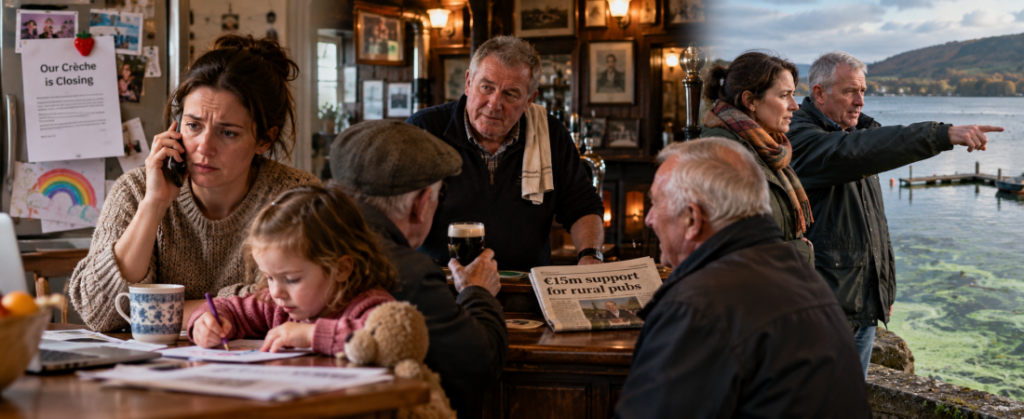
At twenty past eight on Tuesday morning, the most important piece of paper in Aoife Brennan’s kitchen was attached to the fridge with a magnet shaped like a strawberry.
It was not a tax bill. It was not a letter from the bank. It was a notice from her daughter’s crèche.
Aoife had read it four times since six o’clock.
Her husband, Conor, read it once, put the kettle on and read it again.
“So that’s it?” he asked.
“That’s it.”
“And everyone has to be out?”
“Everyone.”
“By when?”
Aoife pointed at the date.
Conor stared at it as though sufficient concentration might cause another month to appear.
Their four-year-old daughter, Lucy, was underneath the table trying to persuade the family dog to eat a piece of toast.
This, more than any speech in Leinster House, was how national policy usually arrived in an Irish home: on a piece of paper beside the electricity bill, the school calendar and a badly drawn rainbow.
The closure of another Dublin childcare facility had sent parents scrambling for places. Ireland had been debating childcare affordability for years, and Budget 2027 promised further intervention. But there was an awkward difference between making childcare cheaper and making a childcare place exist.
Aoife discovered this at 8.47am.
“No places until next September,” said the woman on the telephone.
“Next September?”
“I’m afraid so.”
“It is October.”
“I know.”
There was a pause during which both women seemed to acknowledge that no useful reply to this fact existed.
By nine o’clock, Aoife had joined three WhatsApp groups she had never previously known existed.
That, too, is part of modern Ireland.
A national problem becomes a local problem and then, remarkably quickly, becomes a group of twelve people who know somebody whose sister knows somebody who might have a solution.
The pub with a calculator beside the till
Ninety miles away, in a small town that tourists might describe as “traditional”, Declan Murphy was doing something less picturesque.
He was calculating his electricity costs.
Declan was fifty-eight and had run Murphy’s for long enough to remember when the principal financial question on a wet Tuesday was whether six people would come in or twelve.
Now he had insurance, energy, wages, supplier costs and fewer customers drinking during the week.
On the counter lay a newspaper carrying news of a €15 million Government support package for rural pubs.
A customer named Pat tapped the article with one finger.
“Fifteen million. You’ll be retiring.”
“I’ll buy an island,” said Declan.
“Somewhere warm?”
“Roscommon.”
Nobody laughed immediately, which made it funnier.
Behind the humour lies a serious change in rural Ireland.
The village pub is often presented abroad as a cultural symbol. Locally, it can be something more practical: an informal meeting room, somewhere older people encounter other human beings, a place for funerals, fundraisers, sports clubs and conversations that would never be scheduled in a community-development strategy.
Yet hundreds of Irish pubs have disappeared over the past two decades, with rural areas particularly affected.
The Government’s new support is therefore about economics, but also about something harder to measure.
What happens to a place when the places where people accidentally meet one another disappear?
Declan did not put it that way.
“We need customers,” he said, folding the newspaper. “You can’t subsidise an empty stool forever.”
Forty kilometres away, the water is green
Later that afternoon, near Lough Derg, another conversation was taking place beside water that features beautifully in tourism photographs.
Tomás Ryan had lived near the lake for most of his life.
Beside him stood Klara, a German woman who had moved to Ireland with her Irish partner three years earlier. She loved the lake partly because it was the Ireland she had imagined before coming here.
That made what she was looking at more difficult.
“Is that algae?”
Tomás nodded.
“Is it normal?”
“No.”
Then, after thinking about it:
“Not normal enough that we should start calling it normal.”
Algal blooms have become a serious environmental concern at Lough Derg, part of a wider problem affecting Irish waterways. Nutrient pollution, agricultural runoff, wastewater and warmer conditions can all contribute to the circumstances in which blooms develop.
From abroad, an Irish lake is scenery.
For people living beside one, it can be drinking water, tourism income, fishing, swimming, farming, property, childhood memory and local identity simultaneously.
That is the difference between looking at Ireland and living inside it.
Environmental policy stops being abstract remarkably quickly when the water at the bottom of your road changes colour.
It also explains why another argument taking place in Dublin matters here.
The argument about carbon
Budget 2027 brought an unexpected political reversal over carbon taxation and fuel costs, prompting environmental organisations to question the Government’s climate commitments.
Around Irish kitchen tables, however, climate policy has a habit of colliding with geography.
A carbon tax looks different to somebody living beside a frequent urban bus route than it does to somebody twenty kilometres outside a regional town who needs a diesel car to work, shop and bring children to school.
That does not make the environmental problem disappear.
Lough Derg is evidence enough of that.
It simply reveals one of the contradictions of contemporary Ireland: people can want serious climate action while also depending upon cars, heating systems and infrastructure that make changing behaviour difficult.
Ireland sometimes debates environmental policy as though citizens merely need to make better choices.
Outside the cities, many people would first like to have more choices to choose from.
Meanwhile, €8.5 billion was being discussed
Back in Dublin, politicians and commentators were examining an €8.5 billion Budget package designed, as one analysis memorably suggested, to avoid annoying almost anybody.
There were tax changes, welfare measures, business supports, childcare measures and attempts to cushion households against rising costs.
Who gained?
Who lost?
Who should have received more?
These are legitimate questions.
But by Tuesday evening, none of them was the question being discussed in Aoife Brennan’s kitchen.
She had made eleven telephone calls.
Conor had made seven.
They had found one possible childcare place.
It was forty minutes away in morning traffic.
“We could do it,” Conor said.
Aoife looked at him.
“You start work at eight.”
“I know.”
“I start at half eight.”
“I know.”
“And Lucy starts there at eight.”
“I know that as well.”
Lucy was colouring a horse purple.
She had no idea that two adults were redesigning their working lives around her.
The country between the announcements
This is the Ireland that guidebooks rarely explain.
It is not hidden because somebody is trying to conceal it.
It is hidden because ordinary life does not photograph as easily as cliffs.
Ireland can announce billions in public spending while a family cannot find childcare.
It can spend millions trying to preserve rural pubs while the economic model that sustained many of them continues to weaken.
It can market extraordinary lakes and landscapes while communities beside those waters worry about pollution.
It can commit to ambitious climate targets while large parts of the country remain practically dependent on private cars.
And none of those contradictions means that Ireland is failing.
Nor do they mean that everything is fine.
They mean that Ireland, like every real country, makes more sense from a kitchen table than from a brochure.
At half past nine that evening, Aoife’s telephone rang.
It was another mother from the crèche.
“I might have something,” she said.
“What?”
“My sister-in-law knows a woman who runs a small place near her house. One child is leaving.”
“Where?”
“About ten minutes from you.”
Aoife stood up.
“Are you serious?”
“I said might. Don’t frighten her.”
For the first time that day, Aoife laughed.
On the fridge behind her, the closure notice was still held beneath the strawberry magnet.
The Government could not see it from Leinster House.
No economic statistic would record the seventeen phone calls.
And no guidebook would tell you that sometimes, in Ireland, the distance between a national problem and a possible solution is somebody saying:
“My sister-in-law knows a woman.”