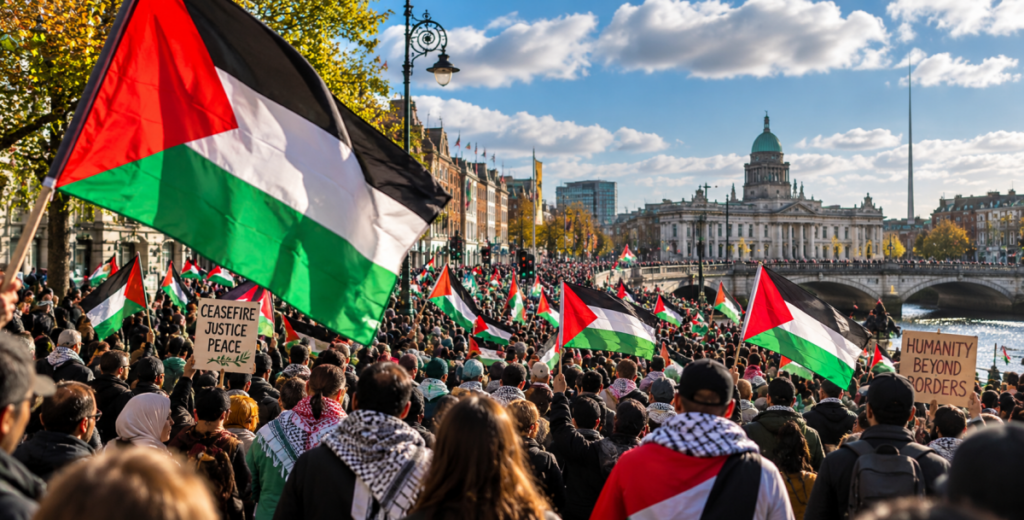
What a demonstration in Dublin reveals about Ireland’s remarkable tradition of solidarity, its historical memory and the human values that visitors rarely discover in a guidebook.
INSIDE IRELAND | Understanding Ireland Beyond the Guidebooks
A Saturday Afternoon in Dublin
On Saturday, 10 October 2026, the streets of Dublin became something more than a route through the Irish capital.
Palestinian flags moved above the crowd. People carrying banners made their way from the Garden of Remembrance towards Leinster House, the seat of Ireland’s parliament. Voices rose above the familiar noise of the city.
Somewhere among the thousands were people who had given up an ordinary Saturday afternoon to stand up for people they might never meet.
Around 10,000 demonstrators joined the march, according to reports by RTÉ and The Irish Times.
But the number alone tells us very little about Ireland.
The more interesting question is why so many people in a small European country, geographically distant from the Middle East, feel such a powerful connection to the suffering of another people.
To understand that, we need to look beyond Irish politics.
We need to understand something about the Irish heart.
What You Notice First: A Country That Refuses to Look Away
Ireland is often presented internationally through its landscapes, music, hospitality and famously welcoming atmosphere.
Visitors discover lively pubs, conversations with strangers and communities where personal relationships still matter.
But there is another side to Irish society that receives much less attention in travel writing.
Ireland has a long tradition of public solidarity.
It is visible in charity campaigns, community fundraising, humanitarian organisations, voluntary work and public demonstrations.
The Dublin march was a striking example.
According to RTÉ, more than 160 civil society organisations supported the demonstration. It was not an isolated gathering but the 21st national mobilisation organised since October 2023.
That persistence matters.
It suggests that, for many participants, solidarity is not simply a passing emotional reaction to disturbing images on television. It is a commitment they believe should continue even when international attention moves elsewhere.
And that tells us something important about the social character of Ireland.
A Historical Memory That Crosses Borders
Why does the Palestinian cause resonate so strongly with sections of Irish society?
Part of the answer lies in history.
Ireland’s experience of British rule, its struggle for independence, the Great Famine and generations of emigration have helped shape a national consciousness in which questions of power, displacement and national identity carry particular emotional weight.
This does not mean that Irish and Palestinian histories are identical. They are not.
Nor does it mean that every Irish person shares the same interpretation of the Middle East conflict.
But historical experience can influence how people respond to the suffering of others.
For some Irish people, stories of families losing their homes, communities being displaced or people struggling for political self-determination touch memories that are deeply embedded in the country’s cultural identity.
There is also an important historical irony.
Ireland was once a country from which enormous numbers of people departed because they could not build secure lives at home.
Today, it is a prosperous European nation.
Yet the memory of vulnerability has not entirely disappeared beneath that prosperity.
Perhaps this helps explain why distant humanitarian crises can become intensely personal issues in Irish public life.
The Often-Overlooked Point: Irish Kindness Is Not Always Quiet
International visitors frequently associate Irish friendliness with humour, conversation and hospitality.
Those qualities are real parts of Irish life.
But kindness is not always expressed through a smile or a welcoming word.
Sometimes it takes the form of disagreement.
At the Dublin rally, Ireland-Palestine Solidarity Campaign chairwoman Zoë Lawlor criticised Taoiseach Micheál Martin and the Irish Government, arguing that its response to Gaza had fallen short of its public statements.
The protesters demanded stronger political and economic action.
This is an important distinction.
The demonstration was not simply an expression of sympathy. It was also an attempt to turn sympathy into public accountability.
Ireland’s tradition of solidarity can therefore be both compassionate and confrontational.
People may feel deeply connected to their country while strongly disagreeing with those governing it.
For international readers, this is an aspect of Ireland worth understanding.
A welcoming society is not necessarily a quiet or politically unquestioning society.
Why This Matters If You Do Not Live in Ireland
Imagine moving to an Irish town.
You might initially judge the place by its housing, schools, transport connections, employment opportunities and proximity to the nearest airport.
All sensible considerations.
But over time, you may discover that the character of a community is also revealed by what its residents are prepared to do for other people.
Who organises a fundraiser when a family faces hardship?
Who volunteers when a local service is threatened?
Who speaks up when something seems unfair?
And who is willing to help someone without expecting anything in return?
These questions cannot be answered by property listings or tourism brochures.
Nor should a large demonstration in Dublin be taken as proof that every Irish community behaves in the same way.
Ireland contains many different political opinions, social attitudes and regional traditions.
Nevertheless, the country’s active voluntary and civic networks offer an important window into everyday life.
For someone considering a future in Ireland, understanding those networks can be just as valuable as understanding the local property market.
The Practical Reality: Solidarity Is Also Part of Everyday Life
The Dublin demonstration had immediate practical consequences.
Transport for Ireland warned that the march would delay Luas Green Line services, with tram tickets accepted on Dublin Bus during the disruption.
It was a small but revealing example of how civic participation intersects with ordinary urban life.
Ireland is not a picturesque landscape separated from politics, social concerns or the pressures of modern society.
It is a functioning democracy in which people organise, campaign, disagree and sometimes disrupt the daily routine to make their voices heard.
And the same country that produces these public demonstrations also faces difficult questions about housing, healthcare, infrastructure and social inequality.
Compassion does not mean that every problem has been solved.
It means that people may still believe those problems deserve attention.
One Thing to Check Before You Come
If you are considering living in Ireland, do something that property websites rarely encourage.
Look at the voluntary organisations, community groups and local campaigns active in the town you are considering.
Read the local newspaper. Visit a community event. Find out which causes bring people together.
Ask not only whether the town has good facilities, but whether its residents actively support one another.
You may learn more about the place in one conversation with a local volunteer than in an afternoon studying property advertisements.
A Small Country With Room in Its Heart for Others
The people who marched through Dublin on 10 October were expressing particular political demands. Not everyone in Ireland agrees with those demands, and no single demonstration can speak for an entire nation.
But the event reveals something that deserves attention beyond the immediate headlines.
For many people in Ireland, geographical distance does not automatically create emotional distance.
A crisis thousands of kilometres away can still become a matter of personal conscience.
Perhaps that is one of the more meaningful ways to understand Ireland beyond the guidebooks.
The warmth of a country is not measured only by how it welcomes visitors.
Sometimes it is also measured by how strongly its people care about those who may never have the opportunity to visit at all.
And on that October afternoon in Dublin, thousands of people made their feelings visible.
Because sometimes, understanding a country begins with discovering whose suffering its people refuse to ignore.
Final Resurrection Ltd. | Ireland Journal | Inside Ireland