An Irish Story by Final Resurrection Ltd.
The Silver Shoes
“Those shoes are a public safety concern.”
Máire O’Sullivan, sixty-eight, looked down at the silver heels sitting on her kitchen table.
“They were perfectly safe in 1981.”
“You were thirty years younger in 1981.”
“Forty-five, actually. But thank you for the compliment.”
Her daughter Niamh, forty-one, stood at the sink with a tea towel over one shoulder. Outside, rain was making its usual quiet argument with the kitchen window.
Máire had bought the shoes in a little shop off Patrick Street when Cork still had the sort of shops where a woman could spend an entire afternoon choosing something she couldn’t afford.
They had survived two house moves, one marriage, one funeral and several attempts by Niamh to send them to a charity shop.
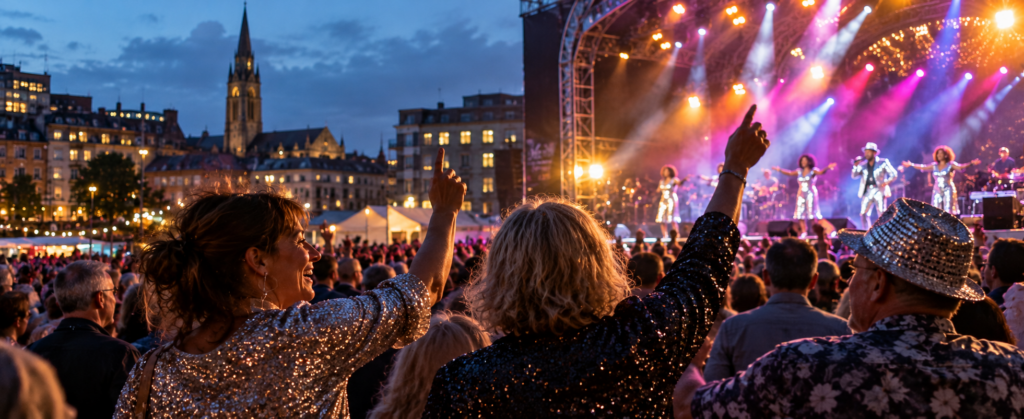
Now Boney M were coming to Cork.
And Máire intended to wear them.
A Festival That Never Quite Behaved
The Cork Jazz Festival had always confused people who hadn’t been to it.
A German visitor might reasonably expect jazz. Trumpets, perhaps. Serious musicians with closed eyes and complicated arrangements.
Cork had other ideas.
Over the years, the festival had grown into something much broader: jazz, soul, funk, blues, pop, late-night dancing and the sort of musical encounters that would make little sense on paper but perfect sense in a crowded Cork venue.
The announcement that Boney M would mark their fiftieth anniversary at the festival was entirely in keeping with that tradition.
There were people who would question what disco had to do with jazz.
There were also people in Cork who would question why anyone needed to ask.
Máire belonged firmly to the second group.
“Music is music,” she told Niamh.
“That’ll be news to the musicians.”
“Musicians are terrible for complicating things.”
The Woman from Hamburg
Across the city, Lena Fischer, thirty-four, was discovering another complication.
She had moved from Hamburg to Cork eight months earlier to work for an engineering company. Her colleagues had been welcoming. Her landlord had been less enthusiastic about replacing the washing machine.
She liked Ireland, although she still hadn’t entirely understood it.
People apologised when she bumped into them.
Strangers asked how she was and then appeared surprised when she answered properly.
And nobody seemed to consider a conversation finished merely because the original question had been answered.
On Thursday afternoon, her colleague Declan Murphy, fifty-six, stopped beside her desk.
“Are you going out for the jazz?”
“I don’t really listen to jazz.”
“Neither does half of Cork.”
Lena looked up.
“Then why is everyone going?”
Declan considered this.
“Because it’s the jazz.”
This was not helpful.
He noticed her expression.
“Look, there’ll be music everywhere. You might enjoy yourself.”
“I don’t know anybody going.”
“Well, that’s a temporary condition.”
The Cost of a Good Night
Back in Máire’s kitchen, Niamh was checking ticket prices, parking arrangements and the weather forecast.
Her mother was checking whether the silver shoes still fitted.
One of them did.
The other was negotiating.
“You could wear something comfortable,” Niamh suggested.
“I’ve been comfortable since your father died. It’s overrated.”
Niamh stopped scrolling.
Her father, Seán, had died four years earlier. He had never liked disco. He claimed all the songs sounded the same, though he could somehow recognise every one of them within three seconds.
He had been a quiet man who enjoyed watching Máire enjoy herself.
There had been fewer evenings out since he died.
Niamh put down the phone.
“I’ll come with you.”
Máire looked suspicious.
“You hate Boney M.”
“I don’t hate them.”
“You said they sounded like Christmas in a supermarket.”
“That was one song.”
“It’s a very good song.”
Niamh smiled.
The second shoe finally went on.
The City Changes Its Clothes
By Friday evening, Cork was preparing for its annual transformation.
The festival, now known as the Guinness Cork Jazz Festival, has developed far beyond its original jazz-focused identity. Its programme encompasses international performers and a wide range of musical styles, while concerts and related events spread through city venues.
For local businesses, the October bank-holiday weekend can bring welcome trade. For residents, it also brings crowded streets, noise, expensive nights out and the occasional difficulty of getting home.
A festival can be both a celebration and an inconvenience.
Cork understands this perfectly well.
Declan had invited Lena to meet a few colleagues before heading into town.
She arrived expecting a group of six.
There were fourteen.
Two were someone’s cousins. One was a neighbour. Another had worked with Declan twenty years earlier.
Nobody explained the relationships.
They simply made room.
“Lena, this is everyone,” Declan announced.
“Everyone” nodded.
A woman moved her handbag from a chair.
“Sit there, love.”
Lena sat.
For the first time since arriving in Ireland, she wasn’t being asked where she came from, how long she intended to stay or whether she liked the weather.
She was simply included.
The Music Starts
Máire and Niamh arrived at their venue earlier than necessary.
Niamh had insisted.
Máire had objected.
Both were pleased to discover they had time for a cup of tea.
Near the entrance, Máire noticed a younger woman studying her phone.
“Are you lost?”
“A little,” Lena admitted.
She had separated from Declan’s group while trying to find the correct entrance.
Máire looked at the screen.
“Ah, you’re nearly there. We’re heading that way ourselves.”
“Thank you.”
“Are you here for Boney M?”
“Yes. Though I don’t know much about them.”
Máire looked genuinely concerned.
Niamh intervened.
“Mam, she’s allowed.”
Within five minutes, Lena had learned that Máire had once danced to Boney M in a Cork nightclub, that Seán had disliked disco, and that Niamh had been an exceptionally difficult teenager.
“I was not,” Niamh said.
“You were very independent.”
“That sounds better.”
“It wasn’t meant to.”
Lena laughed.
Then the music began.
The Thing Nobody Had Planned
At first, Lena watched.
Máire danced with the determination of someone who had spent too many years sitting down.
Niamh joined reluctantly, then with increasing enthusiasm.
Around them were people of different ages, accents and backgrounds.
Some remembered the songs from their youth.
Others knew them through parents, parties or films.
Nobody needed to share the same memories to recognise the same rhythm.
Lena found herself dancing beside Máire.
“You’re very good,” she shouted.
“I’m very experienced.”
“Do you come every year?”
“When I can.”
“And your daughter?”
“Only when she thinks I need supervising.”
Niamh, dancing nearby, raised an eyebrow.
For a few minutes, nobody was a widow, a worried daughter or a newcomer trying to understand a different country.
They were simply people having a good evening.
What Cork Doesn’t Put in the Brochures
The interesting thing about Cork’s festival is not that a famous disco act can appear on a programme associated with jazz.
It is what happens around the music.
The city temporarily rearranges its ordinary social boundaries.
People who would otherwise remain within familiar circles encounter colleagues, neighbours, visitors and strangers.
Not every encounter becomes a friendship. Not every night is magical. Some people stay home because the tickets, taxis or drinks are too expensive.
But for those who participate, the festival creates something that cannot be measured simply by visitor numbers or hotel occupancy.
It provides an excuse to join in.
For someone arriving from another country, that can matter more than a list of attractions.
Irish friendliness is often discussed as though it were a permanent national characteristic.
In reality, friendships still require opportunities, repetition and a little courage.
Sometimes they also require someone like Declan, who considers fourteen people a perfectly reasonable number for a small gathering.
The Journey Home
Outside, the rain had returned.
Niamh was searching for her car keys.
Máire was carrying her silver shoes in one hand.
Lena stood beside them, checking whether she could find her way home.
“Give me your number,” Niamh said.
Lena hesitated.
“For what?”
“We’re having coffee next week. Mam knows a place.”
Máire nodded.
“Good cakes. Terrible chairs.”
Lena smiled and entered her number.
Niamh found the keys.
Máire looked at her shoes.
One heel had come loose.
“That’s the end of those,” Niamh said.
“Don’t be ridiculous. They’ll fix.”
“Who’ll fix them?”
Máire thought for a moment.
“I’ll ask around.”
And that, perhaps, was the most Irish answer Lena had heard since arriving.
Not because everybody in Ireland knows somebody who repairs silver shoes.
But because Máire already knew there was a reasonable chance that somebody knew somebody.
As they parted, Lena’s phone lit up.
A message from Niamh.
Coffee Thursday? Mam says bring comfortable shoes.
Lena looked back.
Máire was standing beside the car, barefoot on the wet pavement, arguing with her daughter about whether the broken heel could be glued.
The festival music was still audible somewhere behind them.
Lena put her phone in her pocket.
For the first time in eight months, Cork felt a little less like a city she had moved to.
And a little more like somewhere she might stay.
Editorial note: Máire, Niamh, Lena and Declan are fictional characters. Their conversations and experiences are imagined. The story is inspired by Cork’s established festival culture and the reported Boney M anniversary appearance; it is not an account of an actual encounter or concert.