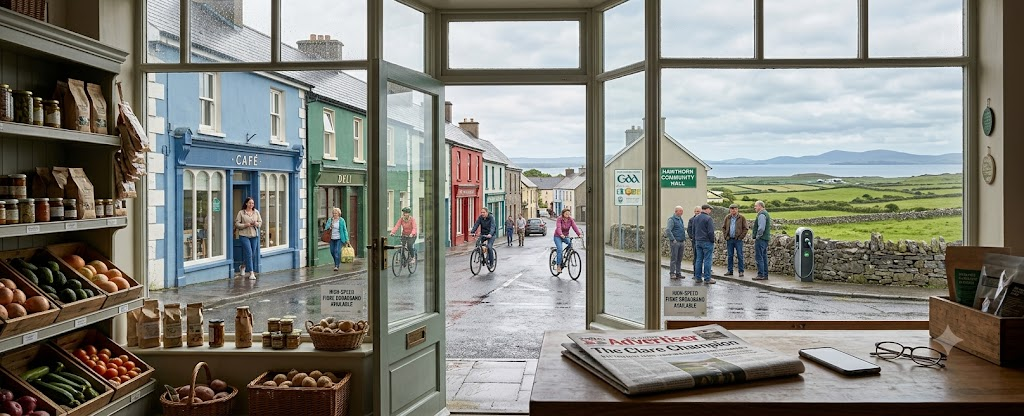
Ask someone outside Ireland what they know about the country and the answers are often remarkably similar. Rolling green hills. Friendly people. Traditional music. Guinness. The Wild Atlantic Way. While these images certainly form part of Ireland’s identity, they represent only a small part of the country’s everyday reality. Recent reporting across numerous regional Irish newspapers encouraged us to look beyond the familiar postcard image and explore what life is actually like inside Irish communities. The deeper we investigated, the clearer it became that the greatest strength of Ireland is not simply its spectacular scenery but the resilience of its local communities, the diversity between counties and the remarkable sense of place that still shapes everyday life throughout the country.
One of the greatest advantages of reading Ireland’s regional newspapers is that they reveal a country that rarely appears in international travel guides. While national media understandably focus on politics, the economy and major national events, local publications tell stories that reflect the rhythm of everyday life across Ireland.
Recent reporting from publications including the Clare Champion, Connacht Tribune, Southern Star, Western People, Donegal Democrat, Leitrim Observer and many other regional newspapers illustrates how individual communities continue to shape Ireland’s identity. These newspapers regularly report on local festivals, community initiatives, new businesses, sporting clubs, heritage projects, environmental improvements and voluntary organisations that rarely attract national attention but play an essential role in daily life.
This regional perspective prompted us to investigate what international visitors often overlook when considering Ireland.
Perhaps the most striking discovery is how different Ireland feels from one county to another. International visitors frequently view Ireland as a relatively small country with a single national culture. In reality, every county possesses its own character, traditions, economic strengths and social identity.
A coastal community in West Cork offers a very different experience from a market town in Roscommon, a growing regional centre in Galway or a farming community in Cavan. Local accents, business networks, community traditions and even everyday priorities can vary considerably despite relatively short travelling distances.
This diversity is one of Ireland’s greatest strengths.
For anyone planning to relocate, purchase property or establish a business, understanding these regional differences can become just as important as understanding national legislation.
Regional newspapers also reveal another important characteristic of Irish life: communities remain remarkably active.
Week after week they report on volunteers restoring historic buildings, local businesses sponsoring sporting events, residents organising festivals, environmental projects protecting biodiversity, schools expanding educational programmes and community groups raising funds for local initiatives.
These stories rarely become international headlines, yet together they demonstrate how community participation continues to influence everyday life throughout Ireland.
For international families considering relocation, this level of community engagement often becomes one of the country’s greatest attractions. Integration into local life frequently happens through schools, sporting organisations, cultural festivals, volunteer groups and neighbourhood events rather than through formal government programmes.
Another theme repeatedly appearing in regional reporting is Ireland’s ongoing transformation.
Many smaller towns are investing in public spaces, broadband infrastructure, tourism projects and town-centre regeneration. Independent cafés, artisan food producers, local retailers and remote-working hubs have become increasingly visible across regional Ireland.
This gradual transformation reflects a country that is evolving while maintaining many of its traditional values.
Recent reporting also demonstrates that Ireland’s future is increasingly being shaped outside Dublin.
Regional enterprise centres, innovation hubs, educational facilities and community organisations are helping create new opportunities throughout the country. Government initiatives supporting balanced regional development continue to encourage investment beyond the major cities, while local leadership often determines how successfully individual communities adapt to change.
For international entrepreneurs and remote workers, these developments deserve close attention.
Many overseas readers naturally begin their research by looking almost exclusively at Dublin. However, regional reporting frequently highlights opportunities that may offer a better quality of life, lower operating costs and stronger community integration than Ireland’s largest urban areas.
At the same time, regional journalism presents a realistic picture rather than an idealised one.
Local newspapers openly discuss challenges including healthcare access, housing availability, transport infrastructure, demographic change and economic pressures. This balanced reporting provides international readers with a much more accurate understanding of both opportunities and challenges than promotional tourism material alone.
Perhaps the greatest lesson emerging from our research is that Ireland cannot be understood through a single newspaper, one government report or a short holiday visit.
The Ireland experienced by residents is built from thousands of local stories taking place every week across cities, towns and villages throughout the country.
Understanding these stories provides international readers with something far more valuable than tourist recommendations.
It provides context.
It explains why neighbouring counties sometimes develop differently.
It illustrates how communities respond to economic change.
It demonstrates why quality of life often depends as much on local people as on beautiful scenery.
Most importantly, it allows future visitors and residents to appreciate Ireland as a living, evolving society rather than simply a travel destination.
INDEPENDENT RESEARCH INSIGHT
Recent reporting across Ireland’s regional newspapers encouraged us to explore how local journalism provides insights that are often absent from national headlines. Our own independent research suggests that combining official statistics with regional reporting creates a far more complete understanding of Ireland’s communities, opportunities and everyday realities before making decisions about travel, relocation or investment.
CONCLUSION
Ireland’s greatest attraction may not be found in its famous landmarks but in the everyday life taking place between them.
Regional newspapers consistently remind us that the country is built upon thousands of active communities, each contributing its own traditions, ambitions and identity to modern Ireland.
For international readers, taking the time to understand these local perspectives offers a richer, more balanced and ultimately more useful picture of Ireland than any guidebook alone can provide.
Those who look beyond the postcard often discover the Ireland they were really searching for.