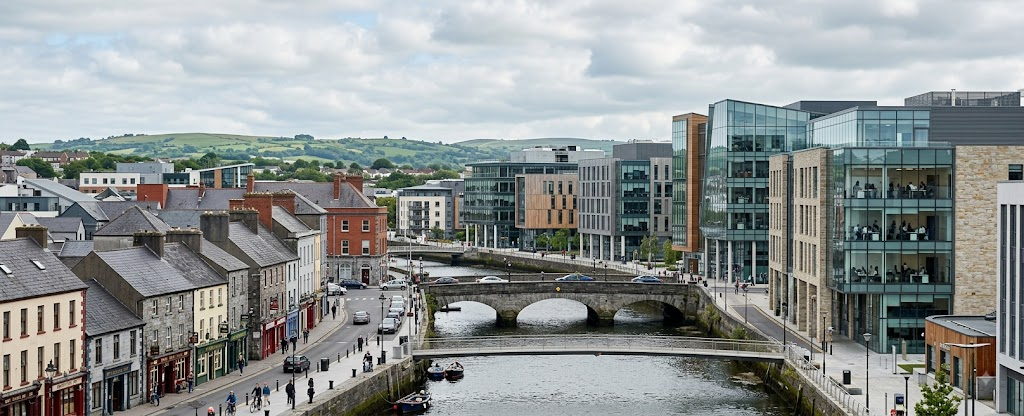
For an international entrepreneur considering Ireland, Dublin can appear to be the automatic choice. It is the capital, the centre of much of Ireland’s international business activity and home to the European operations of many global companies. But that is only part of the Irish business story. Cork, Galway, Limerick and Waterford have developed increasingly distinctive enterprise ecosystems of their own, combining universities, skilled workforces, international companies and regional innovation networks. In 2026, the more useful question may therefore no longer be simply whether to establish a business in Ireland, but where in Ireland that business has the best chance to succeed.
Ireland’s Business Map Is Becoming More Regional
A recent report published by The Irish Times prompted us to examine what Ireland’s changing regional business landscape could mean for international entrepreneurs considering establishing operations here. The report looked at Galway’s PorterShed innovation hub ten years after its creation and described an entrepreneurial environment that has developed its own identity rather than attempting to reproduce Dublin on a smaller scale.
That distinction matters.
Ireland remains one of Europe’s most internationally connected economies, but the advantages available to businesses are not distributed uniformly across the country. Different cities have developed different concentrations of talent, research, multinational investment and sector expertise. Selecting a location purely because it is Ireland’s largest city can therefore overlook opportunities elsewhere.
Official data supports the broader regional story. Figures released by the Department of Enterprise, Tourism and Employment in February 2026 showed that employment in companies supported by Enterprise Ireland, IDA Ireland and Údarás na Gaeltachta had reached a record level of more than 554,600 jobs. Significantly, every Irish region recorded employment growth over the ten years to 2025. Dublin recorded the strongest percentage increase, but the West followed with growth of 47 per cent over the period.
The Government is also putting substantial capital behind regional development. Its 2026–2030 enterprise capital programme provides €4.7 billion for enterprise, innovation and related development, including €500 million for IDA regional property solutions and €100 million for Next Generation Sites intended to attract major advanced manufacturing investments.
For an international entrepreneur, however, government programmes are only one part of the decision.
Dublin: Maximum Connectivity, Maximum Competition
Dublin remains Ireland’s dominant international business centre. For companies requiring immediate access to a large professional workforce, international advisers, investors, government institutions and the country’s largest airport, its advantages are difficult to replicate.
The continuing attraction of Dublin to major technology businesses was reinforced in July 2026 when OpenAI announced that its new EU headquarters would be located in Dublin, alongside plans for 250 additional positions over two years.
That concentration creates powerful network effects. A foreign entrepreneur arriving in Dublin can quickly access lawyers, accountants, recruiters, technology specialists, financial institutions and an extensive international business community.
But concentration also produces pressure.
Office requirements, recruitment competition, housing availability and employee living costs need to be considered carefully. A smaller international company competing for specialised employees may find itself recruiting in the same labour market as some of the world’s largest corporations.
Dublin can therefore be the right answer without automatically being the best answer.
Cork: Scale Without Being Dublin
Cork offers perhaps Ireland’s strongest alternative for companies wanting a substantial urban economy without locating in the capital.
The wider South-West has established strengths across pharmaceuticals, life sciences, technology, food, advanced manufacturing and internationally traded services. Cork also benefits from University College Cork, Munster Technological University, an international airport and a long-established multinational presence.
Government regional strategy specifically seeks to strengthen the South-West through innovation, entrepreneurship and digitalisation while expanding the role of digital enterprise and innovation hubs.
For internationally oriented companies, Cork’s attraction is its combination of scale and regional identity. It is large enough to sustain a serious professional and technical workforce while retaining a business environment distinct from Dublin.
The practical limitation is that an entrepreneur should not assume that every specialist service or employee available in Dublin will be equally easy to find in Cork. The relevant question is whether Cork’s particular talent base matches the company’s actual requirements.
Galway: A Specialised Innovation Ecosystem
Galway illustrates perhaps most clearly why Ireland should increasingly be viewed as a collection of business ecosystems rather than one national market centred on Dublin.
The city has particularly strong connections with medtech, healthcare, technology and research. Its universities, multinational employers and indigenous companies have created a pool of experienced people who can move between established companies and entrepreneurial ventures.
The Irish Times report on PorterShed provides a revealing example. The hub has grown from premises accommodating approximately 65 people to facilities capable of accommodating around 300 workers, with additional event capacity. Companies associated with the wider ecosystem include businesses developing AI, transport technology and international payroll solutions.
The West Regional Enterprise Plan reinforces this direction through support for entrepreneurship, innovation, digital transformation, AgTech and sector-specific start-up infrastructure.
For specialist technology businesses, Galway can consequently offer something more valuable than simple cost comparison: concentration of relevant expertise.
Its disadvantages must also be acknowledged. Galway is considerably smaller than Dublin, transport connections differ and housing pressures have not disappeared simply because a company moves west.
Limerick: Technology, Manufacturing and the Mid-West
Limerick occupies a strategically interesting position.
The Mid-West combines Limerick city with the wider economic influence of Shannon and County Clare. This creates an unusual mixture of technology, engineering, aviation, manufacturing, logistics and internationally traded business.
The regional enterprise strategy specifically targets stronger SME and start-up development, industry clusters, skills programmes and enterprise growth in regional towns.
For companies involved in advanced manufacturing, engineering, aviation-related services or certain technology activities, this existing industrial base can be more relevant than the prestige of a Dublin address.
Shannon Airport also gives the wider Mid-West an international connectivity dimension that should not be underestimated when evaluating regional operations.
Waterford: A Smaller City Worth Watching
Waterford represents a different proposition.
It does not have Dublin’s scale, Cork’s corporate concentration or Galway’s internationally recognised medtech cluster. But this can itself create opportunities for certain smaller businesses.
South East Technological University and initiatives linking research, innovation and industry are strengthening the South-East’s enterprise infrastructure. Recent regional development around innovation facilities illustrates an effort to connect education more directly with entrepreneurs and established companies.
IDA Ireland has also highlighted Waterford through international businesses that have successfully built operations from the city.
For a smaller internationally oriented company that does not require hundreds of specialised employees immediately, Waterford deserves consideration precisely because it operates at a different scale.
The trade-off is equally clear: a smaller labour market means that highly specialised recruitment needs must be tested before committing to the location.
There Is No Single “Best” Irish City
The most important conclusion for an international entrepreneur is therefore not that Cork, Galway, Limerick or Waterford is better than Dublin.
It is that location should follow the business model.
A technology company requiring a large international recruitment pool may conclude that Dublin’s costs are justified. A medtech or healthcare venture may discover that Galway’s specialist ecosystem provides more relevant connections. A pharmaceutical, technology or internationally traded business may find Cork compelling. An engineering, manufacturing or aviation-related operation could see advantages in the Limerick-Shannon corridor. A smaller company seeking a developing regional ecosystem might investigate Waterford.
There are also factors that cannot be established from national statistics alone.
Commercial property availability can vary dramatically within the same county. Broadband may be excellent in one regional location and less suitable in another. Housing availability can determine whether employees are actually willing to relocate. Public transport matters differently depending on workforce composition. Access to airports, universities, schools and healthcare can become important when international executives and their families are relocating alongside the company.
This is where regional investigation becomes essential.
Ireland is geographically small, but business conditions can change surprisingly quickly from one location to another. An address that appears attractive on a spreadsheet may prove less practical after recruitment, housing and transport are examined locally.
For international decision-makers, this is where independently prepared Irish research can add value by combining national data with regional reporting and practical local checks.
The emerging business geography of Ireland in 2026 therefore presents international entrepreneurs with something valuable: choice.
Dublin remains extraordinarily important, but establishing an Irish company no longer means automatically building the entire operation around the capital. Cork, Galway, Limerick and Waterford offer different combinations of talent, research, infrastructure, sector expertise and operating environment.
The best location in Ireland is increasingly not the most obvious one.
It is the one that fits the business.