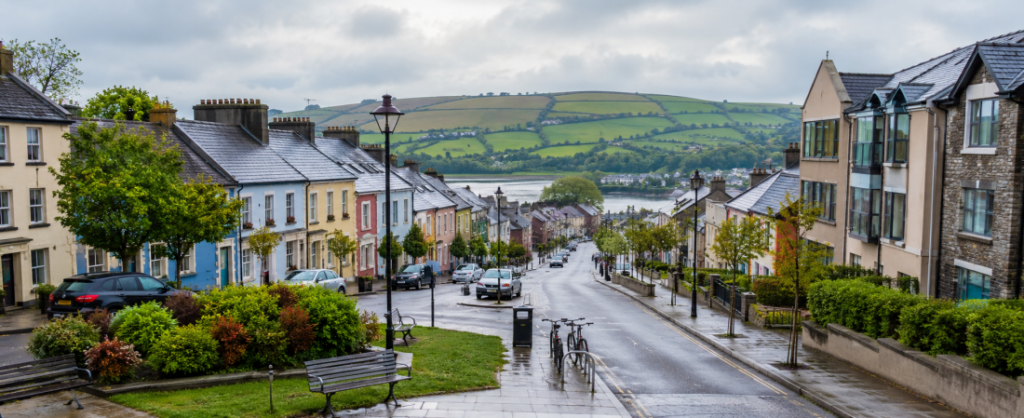
Ireland frequently performs well in international comparisons of prosperity, employment and quality of life. From outside the country, the picture can appear compelling: a strong labour market, rising incomes, attractive landscapes, an English-speaking society within the European Union and an economy deeply connected to international business. Yet anyone considering moving, investing or building a future here needs to ask a more difficult question. What does living well in Ireland actually mean once national averages meet the realities of housing, income, health, location and everyday life?
Looking Beyond Ireland’s International Reputation
A recent report published by The Irish Times prompted us to examine what Ireland’s latest well-being evidence could mean for international readers considering the country. Reporting on new research into life in Ireland, the newspaper described a nation with a strong economy and resilient society, but also one in which prosperity is experienced very differently depending on housing status, age and income.
That distinction is particularly important for people looking at Ireland from abroad.
International rankings inevitably compress complicated societies into scores and positions. They can be useful for comparison, but they cannot tell a prospective resident whether an attractive salary will comfortably cover housing, whether everyday services will be accessible in a particular county or whether the quality of life available in regional Ireland might outweigh the greater professional opportunities of Dublin.
Ireland’s Central Statistics Office provides a much more detailed way of looking at the country.
Its updated Well-being Information Hub, published in June 2026, tracks 35 indicators across 11 areas of life. These extend far beyond economic output and include health, income and wealth, housing, employment, environment, safety, use of time, social connections and trust.
The overall conclusion is encouraging. Most indicators have either improved or remained broadly consistent over the medium term.
But beneath that national picture are some striking differences.
Housing Can Change the Experience of Ireland
Housing may be the clearest example of why headline measures of Irish prosperity require context.
Ireland is building more homes. The CSO recorded 7,856 new dwelling completions during the first quarter of 2026, an increase of 33 per cent compared with the same quarter of 2025.
That is genuine progress.
Yet increased construction does not mean that housing has ceased to be one of the country’s most important practical challenges.
The well-being data exposes the consequences particularly clearly. In 2025, the at-risk-of-poverty rate after rent and mortgage interest was taken into account stood at 45.2 per cent for rented households, compared with only 6.3 per cent for owner-occupied households that still had a mortgage.
Separate CSO well-being research reinforces the divide. People living in owner-occupied homes recorded an average overall life-satisfaction score of 7.8 in 2025, compared with 7.2 among those renting. Satisfaction with household finances showed an even wider difference: 7.2 among owner-occupiers against 5.9 for people living in rented or rent-free accommodation.
For an international reader, that is an important warning against asking simply, “What salary could I earn in Ireland?”
The better question is: What would my disposable income and housing position actually look like after I arrive?
Ireland’s Strong Labour Market Is a Genuine Advantage
Employment remains one of Ireland’s significant strengths.
In the first quarter of 2026, employment rates stood at 73.3 per cent for men and 69.3 per cent for women. The CSO’s medium-term assessment also identifies employment and mean weekly earnings among the indicators showing positive change.
For international professionals and families, this matters. Ireland combines access to a substantial multinational economy with indigenous businesses, technology, financial services, pharmaceuticals, medical technology and other internationally connected sectors.
But national employment figures still require local interpretation.
The professional opportunities available in Dublin are different from those in Galway, Cork, Limerick or a rural county. Someone able to work remotely may have far greater freedom to optimise quality of life around housing and location than someone whose career requires daily access to a specialised urban labour market.
This is one reason why comparing Irish regions only by property prices can be misleading. Lower housing costs are valuable only when they are considered alongside employment, broadband, transport and access to essential services.
Quality of Life Is Not Distributed Equally by Age
The CSO evidence also challenges assumptions about who is benefiting most from modern Ireland.
In 2025, 26.5 per cent of respondents described their overall life satisfaction as high. But the differences between age groups were substantial.
More than a third — 36.5 per cent — of people aged 65 and over reported high overall life satisfaction. Among people aged between 25 and 49, the figure was only 22.1 per cent.
This does not mean that Ireland is necessarily better for retirees than for younger adults. It does demonstrate why national averages require careful interpretation.
Younger adults are more exposed to housing costs, childcare requirements, career pressures and the difficulties associated with establishing financial security. Older residents may face entirely different concerns, particularly healthcare access, transport and proximity to essential services.
The correct assessment therefore depends heavily on who is asking the question.
Health, Community and the Less Visible Ireland
Quality of life is also shaped by factors that rarely appear in property advertisements or investment presentations.
The CSO found a strong relationship between health and reported life satisfaction. In 2025, 37.5 per cent of people describing their general health as very good also reported high overall life satisfaction. Among those reporting bad or very bad health, the equivalent figure was only 7.8 per cent.
Social connections matter too. The data records differences in loneliness and in the number of people individuals believe they could rely upon during a serious problem.
These statistics help quantify something that can otherwise seem intangible.
Ireland’s towns, villages and rural communities can provide a very different social environment from its larger cities. Community organisations, local sports clubs, neighbours, voluntary organisations and informal personal networks continue to play an important role in many parts of the country.
For someone arriving from abroad, however, these networks are not automatically available on the day they collect the keys to a house. Becoming part of a community takes time.
Dublin and Regional Ireland Offer Different Versions of Quality of Life
Perhaps the biggest mistake an international reader can make is to discuss the “Irish quality of life” as though it were geographically uniform.
It is not.
A professional living in Dublin may have access to Ireland’s deepest labour market, extensive cultural amenities, universities, specialist healthcare and the country’s principal international airport. The price can be greater housing pressure, congestion and higher everyday costs.
Regional cities such as Cork, Galway, Limerick and Waterford offer different compromises between employment, housing, services and lifestyle.
Rural Ireland creates another equation entirely.
Space, landscape, community and potentially lower property acquisition costs can make rural locations exceptionally attractive. But distance to hospitals, schools, public transport, shopping and employment can become much more important.
Even two properties located within the same county can produce very different daily realities.
That is why averages are useful for understanding Ireland but insufficient for making a decision about Ireland.
What International Readers Should Take From the Evidence
The evidence does not support either of the simplistic narratives often applied to the country.
Ireland is neither the effortless quality-of-life paradise sometimes presented in international lifestyle material nor a country defined entirely by its housing problems.
The reality is more interesting.
Ireland combines a strong labour market, improving earnings, high levels of democratic satisfaction and many indicators of social resilience with serious housing pressures and substantial differences between renters and homeowners, age groups, income levels and locations.
For someone considering relocation, property acquisition or long-term investment, the critical question is therefore not simply whether Ireland offers a high quality of life.
It is what kind of life Ireland could offer that particular person, in that particular place, under their particular financial and professional circumstances.
National statistics provide the foundation for answering that question. Regional reporting adds context. Local investigation then establishes whether the theoretical advantages survive contact with everyday reality.
For international decision-makers, this is where independently prepared Irish research can add value by combining national data with regional reporting and practical local checks.
Ireland’s quality of life cannot be reduced to a ranking.
It has to be investigated.
And for anyone contemplating an important decision about Ireland, that may be the most useful finding of all.