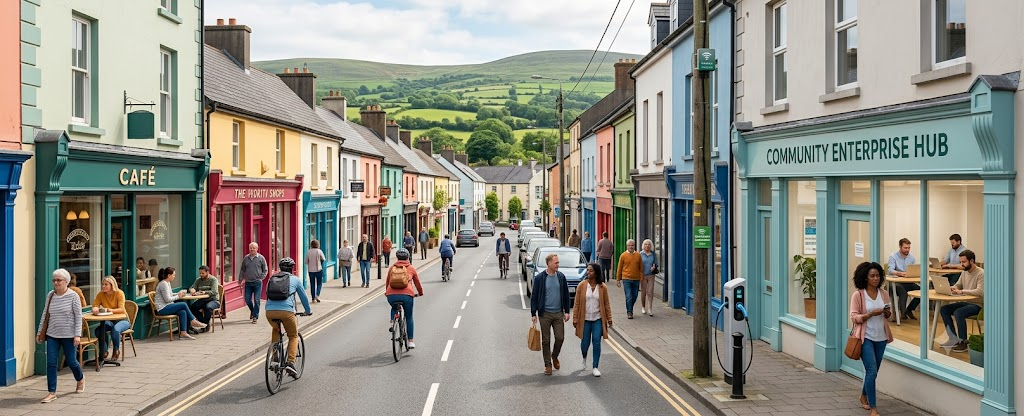
Remote work once appeared capable of redrawing the map of Ireland. Professionals would leave congested cities, revive smaller towns and build internationally connected careers from homes surrounded by open countryside. In 2026, that possibility still exists, but the evidence shows that it does not happen automatically. For an international family or professional considering Ireland, the most promising location may not be the most isolated or picturesque one, but the community where employment flexibility, housing, transport, services and social connection actually work together.
A recent Irish Times report prompted us to investigate the gap between the remote-working vision and the reality experienced across regional Ireland. Research discussed in the article suggested that the anticipated large-scale movement from Dublin and other cities into rural areas had not fully materialised. Instead, many workers had moved towards suburbs or accessible locations that allowed them to retain connections to offices, transport and essential services.
This finding does not mean that regional Ireland has failed. It means that choosing a future there requires more careful thinking than simply finding a house with good broadband.
The uncertainty surrounding remote work is one reason. Irish employees possess a legal right to request remote working, but this does not amount to an automatic entitlement to work remotely. RTÉ reported in February 2026 that only one of the completed complaints submitted under the framework had been upheld at that stage. Employers generally retain considerable discretion over how and where work is performed.
For someone planning to relocate on the basis of a remote position, the employment arrangement should therefore be documented and tested against possible future changes. A role described informally as remote may still require attendance in Dublin several times each month. A manageable journey twice a year can become exhausting twice a week. Before choosing a location, international workers should examine the employment contract, office policy, probation requirements and whether the employer can alter attendance expectations.
At the same time, the personal benefits remain significant. Research reported by The Irish Times found that 74 per cent of surveyed workers considered working from home less stressful than working entirely on site. Fórsa research presented in June also identified lower commuting time, increased productivity and reduced employment-related expenditure among the perceived benefits.
Regional centres may offer a practical middle ground. Towns with rail or motorway connections, healthcare, schools, supermarkets, cafés, cultural facilities and enterprise hubs can provide a different pace of life without complete dependence on a car or a single local service. The Irish Times has also reported growing momentum in regional centres, supported by hybrid working and investment in technology, pharmaceutical and medical-technology employment.
Social integration deserves the same attention as physical infrastructure. Remote work can remove the natural contact that comes from a shared workplace. Grow Remote reported that 69 community events attracted 452 participants across Ireland during the first 90 days of 2026. Of the people surveyed, 80 per cent said they felt more connected to their community after participating. This is a small but meaningful illustration of how local initiatives can help newcomers move from merely residing in a place to belonging there.
An international family should therefore investigate a prospective location on several levels. Is the broadband connection available at the exact property rather than somewhere in the general area? How far away are medical services, childcare and schools? Is there public transport, and does its timetable suit real working and family needs? What happens when a car is unavailable? Can the remote employee reach the company’s office if attendance requirements change? Are there clubs, volunteer groups, sports organisations or community events through which newcomers can build relationships?
The answers differ from county to county and often from one townland to the next. This is why general relocation rankings have limited value. A county praised for beauty or family life may still contain areas with long journeys to essential services. Conversely, a town overlooked by travel guides may offer exactly the combination of affordability, connectivity and community that a newcomer requires.