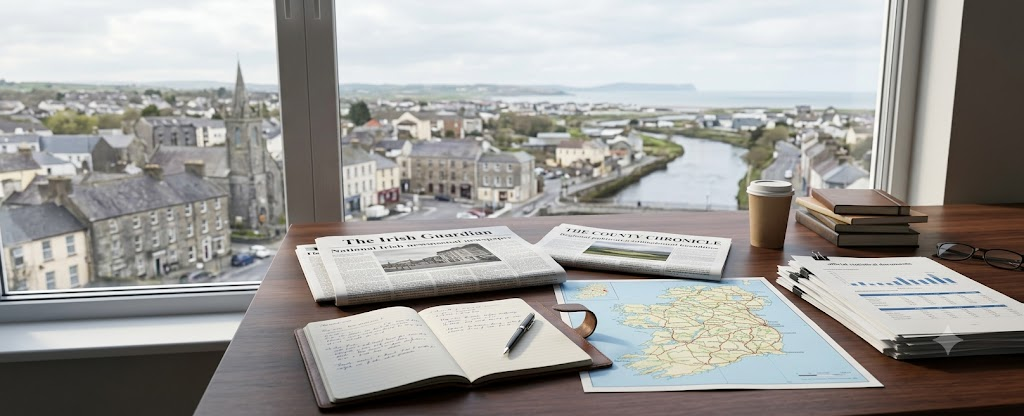
International readers can access more information about Ireland than ever before, yet reaching a reliable conclusion has not necessarily become easier. National newspapers explain policy, regional titles reveal local disputes, public bodies release statistics and social platforms offer confident opinions without always showing where the information came from. For anyone considering an investment, property purchase or relocation, the central challenge is therefore not finding information. It is learning how to assemble the right information.
A report published by The Journal on the Reuters Institute Digital News Report 2026 prompted us to look more closely at how international readers should research Ireland. The findings showed that RTÉ News Online and The Journal were Ireland’s two most widely used online news sources. At the same time, news avoidance had reached a record level, with 47 per cent of respondents saying that they sometimes actively avoided news. RTÉ’s coverage of the same study reported continuing trust in major brands but a wider decline in confidence in news generally.
For someone living outside Ireland, the lesson is not that Irish information is unreliable. The lesson is that different sources perform different jobs.
National broadcasters and newspapers are essential for understanding government decisions, economic policy, legislation and major national developments. RTÉ, The Irish Times, Irish Examiner, Business Post, Independent.ie and The Journal provide broad context and often have access to specialist correspondents. However, they cannot report every planning dispute, infrastructure delay, council decision, local business closure, healthcare difficulty or community development in each county.
Regional newspapers fill part of that gap. A local title may report on a delayed wastewater scheme, a proposed road, the shortage of general practitioners, the opening of an enterprise centre or objections to a housing development long before the issue attracts national attention. These stories can be extremely important to somebody considering a particular town, even though they appear minor from a national perspective.
Specialist publications add another layer. Agriland and the Irish Farmers Journal are valuable for agriculture, land use and the rural economy. Grow Remote offers insight into remote-working communities. Irish Rural Link focuses on the social and economic realities of rural areas. The Western Development Commission publishes research and investment information relating to the west and northwest, and reports a €100 million investment portfolio alongside work on regional policy and connected communities.
Official sources are indispensable, but they also require interpretation. The Central Statistics Office can show population, employment, housing and income trends. The Residential Property Price Register records completed property transactions. Revenue explains tax rules. The Companies Registration Office provides corporate filings. Local authorities publish planning applications and development plans. These are primary sources, but a figure or database entry does not automatically explain what is happening on the ground.
A county may show population growth while individual villages lose services. A town may have relatively affordable homes but inadequate rental supply. A development plan may identify land for housing even though water or road infrastructure has not yet been delivered. An investment announcement may sound significant nationally but create little direct opportunity for a particular local business.
International readers are especially vulnerable to three research mistakes. The first is relying on a single national headline to describe the whole country. Conditions in Dublin, Galway, rural Mayo and west Cork may be fundamentally different. The second is treating promotional information as independent evidence. Tourism bodies, property agents, development agencies and commercial advisers can provide useful material, but each communicates from a particular institutional or commercial perspective. The third is relying on social media testimony without checking whether the experience is current, representative or relevant to the same location and personal circumstances.
A stronger research method begins with a precise question. Instead of asking whether Ireland is a good place to live, ask whether a named area can provide suitable housing, healthcare access, schools, transport, broadband and employment for a particular household. Instead of asking whether Ireland is good for business, examine the potential customers, talent pool, costs, regulation and supports relevant to one specific company.
The next step is triangulation. A significant claim should normally be checked against an official source, a reputable national publication and at least one regional or specialist source. Direct enquiries may then be needed to confirm availability, waiting times, eligibility or the current condition of a service.
For international decision-makers, independently prepared Irish research can add value precisely because it does not stop with the published headline. It compares national data with local evidence, identifies contradictions and distinguishes between what is officially planned and what is currently operating.
Reliable information about Ireland does exist. It is distributed across different institutions, publications and regions. The most accurate understanding emerges not from finding one perfect source, but from knowing how to combine several imperfect yet credible ones.