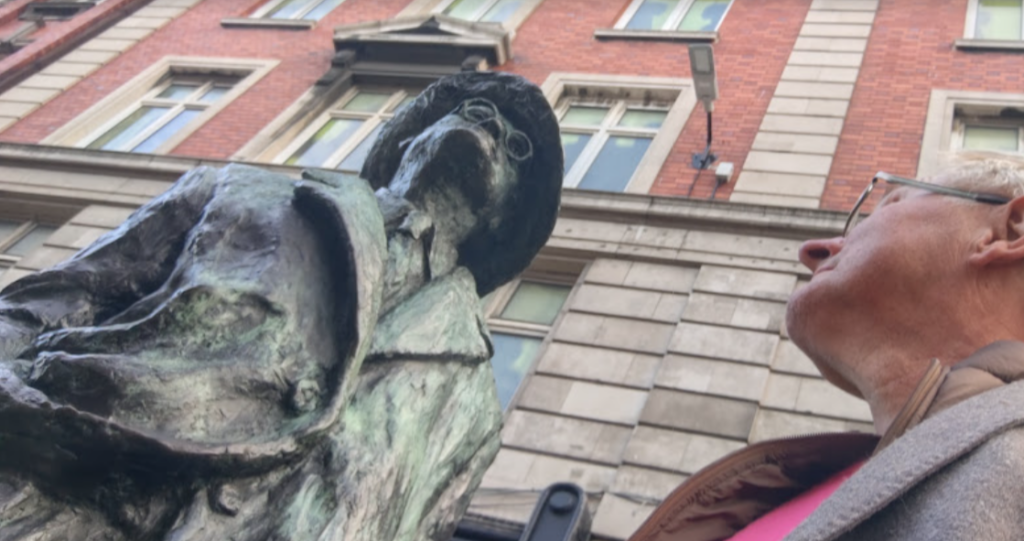
Every visitor arrives in Dublin with a plan. Some head for Trinity College. Others make a beeline for Temple Bar. But occasionally, the city interrupts even the best itinerary with a moment so unexpected that it becomes the highlight of the entire trip. Sometimes all it takes is a bronze writer, a walking stick, and a very curious tourist. There are statues that people walk past without a second glance. Then there is James Joyce. Also during cold January.
Standing quietly on North Earl Street, hat tilted slightly upward, walking stick in hand and wearing the expression of someone who has already read every book you ever intended to finish, Joyce has become one of Dublin’s most photographed residents. Thousands of visitors stop every week to take the obligatory picture before continuing towards O’Connell Street or crossing the River Liffey.
On a crisp January morning in 2026, however, one visitor decided that simply taking a photograph would be far too ordinary.
Instead, a small contest began.
The challenge was simple: who could appear more thoughtful?
The bronze novelist had one obvious advantage. After standing motionless for decades, James Joyce had perfected the timeless literary stare. His gaze seemed fixed somewhere beyond the rooftops of Dublin, perhaps searching for the next chapter of Ulysses, perhaps simply ignoring the January weather.
The visitor, meanwhile, attempted to match the pose with complete determination.
Head tilted.
Eyes narrowed.
Expression suitably philosophical.
For several long seconds, passers-by slowed their pace. Some smiled. Others stopped to watch. A few discreetly reached for their phones, perhaps wondering whether an official “Joyce staring competition” had somehow become one of Dublin’s newest tourist attractions.
Unfortunately, the result was never really in doubt.
James Joyce never blinked.
He never smiled.
He never shifted his weight.
The challenger eventually surrendered with a laugh, quietly admitting defeat to a man who had not moved since the late twentieth century.
That brief encounter says something rather charming about Dublin itself.
Few cities invite this kind of spontaneous interaction with their history. Literature is not hidden behind museum glass here. It stands on street corners, waits patiently among shoppers and commuters, and becomes part of everyday life. Great writers are remembered not only through plaques and libraries but also through moments of humour shared between strangers.
James Joyce himself might even have appreciated the scene. His writing celebrated the ordinary conversations, observations and unexpected encounters that give cities their personality. He understood that the most memorable stories often emerge not from grand monuments or official ceremonies but from everyday moments that nobody planned.
Perhaps that is one reason why visitors continue to seek him out. They come expecting to see a famous statue, yet often leave with something far more valuable—a story that belongs entirely to them.
Long after the photographs are forgotten, many will remember standing beneath Joyce’s calm bronze gaze, smiling at the ridiculous idea of trying to outthink one of Ireland’s greatest literary minds.
Spoiler alert: nobody ever wins.
Fortunately, in Dublin, losing can be just as enjoyable as winning, even during cold days in Juanuary 2026.