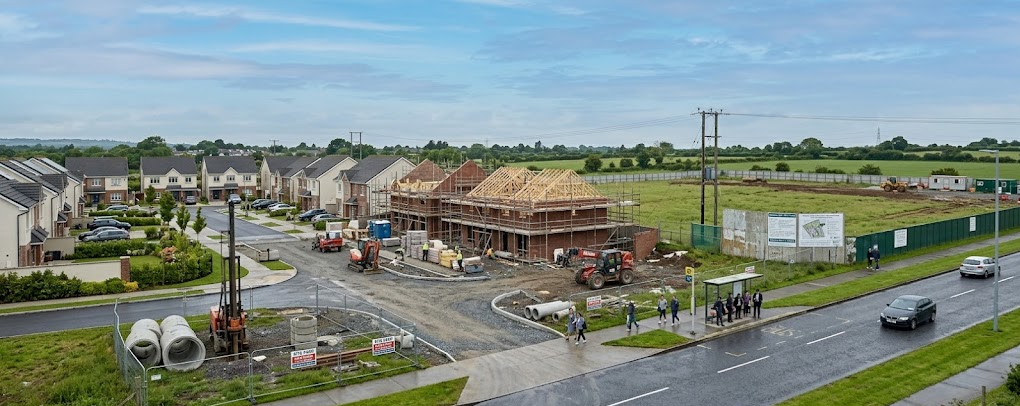
Ireland has no shortage of plans. Dublin has more than 80,000 homes with planning permission, a €14–€17 billion metro is moving towards construction, and billions are being committed to national infrastructure. Yet for anyone outside Ireland researching where to invest, establish a business or live, there is a crucial distinction hidden behind those numbers: approval is not delivery. Ireland’s challenge increasingly lies in the distance between a project being permitted, funded or announced — and becoming something that can actually be used.
That distinction matters because an international decision can easily be made on information that is entirely correct, but operationally premature.
What the Headline Tells Us
Two developments in September 2026 illustrate the problem unusually well.
On 16 September, the Irish Government approved MetroLink to proceed to detailed tender. The current estimated cost is €14.44–€17.49 billion, with a central estimate of €15.75 billion. Significant enabling works are intended to start in 2027. However, firm costs will only become clearer after market bids are received.
The following day, Banking & Payments Federation Ireland published another striking number.
At the end of Q2 2026, 80,285 residential units had planning permission across Dublin’s four local authorities. Only 33,623 — 41.9% — had been activated. More than 41,000 permitted apartments had not commenced construction.
Neither statistic means the underlying projects will not happen.
But neither means they have been delivered.
What the Headline Doesn’t Tell Us
This is where the Ireland Journal investigation becomes more interesting.
Ireland’s housing system contains several fundamentally different stages that are easily compressed into a single word such as “supply”: planning application, permission, commencement, construction and completion.
They are not interchangeable.
The Central Bank of Ireland has now linked project-level planning, building-control and construction records to examine what actually happens as housing moves through this pipeline.
Its conclusion is revealing.
For housing currently moving through the system, the average journey from initial planning application to completion is approximately four years — twice as long as a decade ago.
Even more importantly, permission does not guarantee eventual construction.
For housing approved between 2017 and 2020 — cohorts old enough for their original five-year permissions to have expired — the Central Bank found that 25–32% of approved units lapsed without construction ever starting.
That changes how an international reader should interpret an impressive pipeline number.
The Evidence
Ireland is building more housing. BPFI reports 16,679 completions during the first half of 2026, 11% above the equivalent 2025 period, and expects total 2026 completions to exceed 40,000.
But the pipeline remains uneven.
Dublin housing completions actually fell 16% year-on-year in Q2. National commencements have recovered from exceptionally weak 2025 levels but remain substantially below the previous peak. Planning permissions have averaged only around 35,000–37,000 annually in recent years.
The Central Bank expects housing output to rise towards 45,000 units in 2028, but explicitly makes that outlook dependent on improvements in infrastructure delivery and construction productivity.
MetroLink tells a parallel story on a much larger scale.
In 2022, its central indicative capital cost was €9.5 billion and construction was then envisaged to begin in 2025, with operations in the early 2030s.
Planning approval eventually arrived in 2025. In September 2026, Government approved progression to detailed tender, but the estimated range has become €14.44–€17.49 billion. Current expectations put operations around 2036–2038.
This is not evidence that MetroLink will fail. On the contrary, it has now passed important milestones towards delivery.
It demonstrates something different: the status of an Irish project matters enormously.
The Often-Overlooked Point
Here is the distinction international research too easily misses:
An Irish project can be completely real, officially approved and publicly funded — and still be years away from changing the practical conditions at a particular location.
That applies to housing, transport, utilities and other infrastructure.
The headline says Ireland has an 80,000-home permitted Dublin pipeline.
The more important reality is that fewer than half of those units had been activated at the measurement date.
The headline says Dublin is getting MetroLink.
The practical reality is that a company making a location decision in 2026 cannot operate as though MetroLink already exists.
Why This Matters Outside Ireland
Imagine an international company evaluating an office location in north Dublin.
An online assessment might identify future MetroLink access, substantial planned residential development nearby and strong projected population growth.
All three statements might be accurate.
But employees recruited in 2027 need transport and housing in 2027, not in 2037.
Similarly, an overseas property investor examining an area with thousands of approved homes cannot automatically treat those homes as imminent supply — or assume that the infrastructure required to support them will arrive simultaneously.
The correct question therefore changes from:
“What is planned here?”
to:
“What exists here now, what is actually under construction, and what still depends on another decision or delivery stage?”
From National Data to Local Reality
This becomes even more important outside Dublin.
National completion figures cannot establish housing availability in a particular town. A national infrastructure programme cannot establish when one site will receive sufficient electricity, water or transport capacity. A broadband availability database cannot necessarily establish whether one building can actually be connected immediately.
For an individual decision, geography eventually becomes more important than the national headline.
Questions Worth Verifying
Before relying on an Irish development or infrastructure announcement, an international investor, company or future resident should establish:
- Is the project proposed, approved, funded, tendered, under construction or actually operational?
- If housing has planning permission, has construction commenced and what proportion is genuinely progressing?
- Does the infrastructure required by the specific site already exist, or does the project depend upon future upgrades?
- Which dates are contractual or committed, and which remain forecasts or policy targets?
- What happens to the business, investment or relocation decision if delivery takes three or five years longer than expected?
When the Online Answer Is Not Enough
AI, government databases and online research are very good at answering whether something has been announced or approved.
They become less reliable when the real question is whether something works at a specific place, for a specific purpose, at a specific time.
A database may establish that infrastructure is planned. A planning register may establish that housing is permitted. Neither necessarily establishes what an international buyer, employer or investor will find when arriving at the site.
That is where documentary research sometimes has to become local verification.
Conclusion
After five minutes, the useful lesson is not that Ireland cannot deliver major projects. Housing is being completed, MetroLink has moved materially closer to construction, and substantial infrastructure investment is underway.
The lesson is more precise.
When researching Ireland, never allow “planned”, “approved”, “funded”, “commenced”, “available” and “delivered” to become synonyms.
The Central Bank’s housing research demonstrates why. Some approved homes never begin construction, and those that do now take substantially longer to move through the system. MetroLink demonstrates the same importance of project stage on a vastly larger scale.
For an international decision-maker, therefore, the most valuable Irish research may sometimes begin only after the online answer has been found:
Is it actually there yet?
Final Resurrection Ltd. can independently verify specific Irish questions remotely or locally for international clients where general information is not sufficient for a decision.