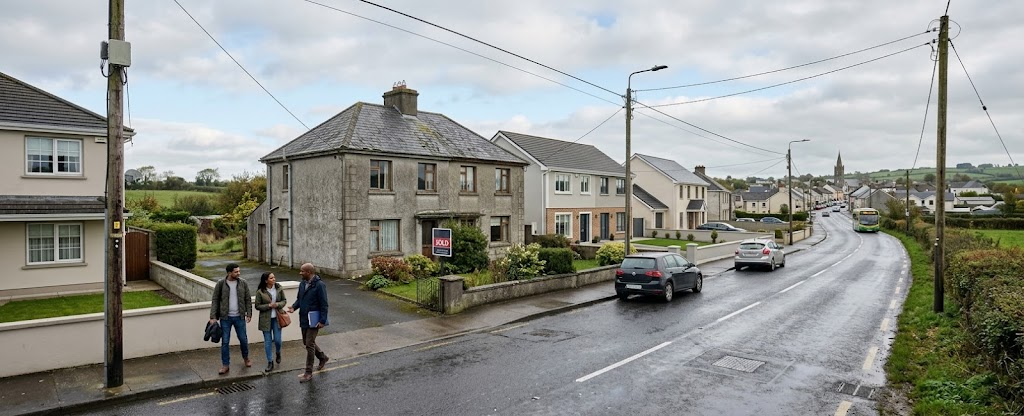
An international buyer searching Ireland from abroad can quickly reach an apparently logical conclusion: if Dublin is too expensive, look west, north or into the Midlands, where €200,000 can still buy something that would cost multiples of that figure in the capital.
But Ireland’s latest housing data suggests that this calculation is becoming more complicated.
The important question is no longer simply “Where can I buy cheaply?” It is: “What will this property cost before it becomes the home, base or retirement location I actually need?”
That distinction matters because some of Ireland’s cheaper markets are now experiencing the fastest price growth — while the practical gap between buying a house and successfully relocating to it can remain substantial.
What Is Happening in the Market?
Ireland is building more homes.
According to Banking & Payments Federation Ireland’s Housing Market Monitor for Q2 2026, 16,679 homes were completed during the first half of 2026, an increase of 11% year-on-year. Housing output was running at approximately 37,800 units on a rolling annual basis, and BPFI expects completions to exceed 40,000 during 2026.
Yet increased construction has not translated into falling prices.
The Central Statistics Office reported this week that Irish residential property prices were 5.5% higher in July 2026 than a year earlier. Dublin prices increased by 4.4%, but prices outside Dublin rose faster, by 6.4%.
There is another complication: more construction does not mean that every completed home enters the market for private buyers. BPFI says the proportion of newly completed homes available for sale nationally has fallen from 61% in 2019 to 41% in 2026.
More homes, therefore, does not automatically mean proportionately more choice for someone searching property portals from London, Frankfurt, Paris or New York.
What the National Numbers Hide
Ireland is increasingly a collection of very different property markets.
The national median transaction price in the 12 months to July was €399,999. Dublin’s median was €500,000, while Dún Laoghaire-Rathdown reached €684,411. At the other end, Longford’s median was €200,000. At Eircode level the difference was even greater: A94 around Blackrock in Dublin recorded a median of €850,500, compared with just €158,500 in F45 around Castlerea, County Roscommon.
But lower-priced Ireland is not necessarily static Ireland.
House prices in the Border region — Cavan, Donegal, Leitrim, Monaghan and Sligo — increased 11.0% year-on-year, while Midlands house prices rose 9.3%.
That matters for international buyers waiting for additional supply to make regional Ireland cheaper. The evidence currently points in another direction: affordability gaps remain enormous, but some of the lower-priced regions are appreciating faster than Dublin.
The Often-Overlooked Point
Here is the more important distinction:
A cheap Irish house and a cheap Irish relocation are not the same thing.
A €180,000 regional property requiring substantial insulation, heating, electrical or plumbing work may ultimately compete with a €250,000 property that can be occupied immediately.
Ireland’s Building Energy Rating, or BER, provides one useful starting point. SEAI says the BER allows buyers to compare energy performance and provides an indication of the running costs associated with heating a home comfortably. A BER and Advisory Report are generally required when a residential property is offered for sale.
But BER is only one layer.
For a rural property, the real due-diligence question may instead concern the private water supply, wastewater system, broadband connection, access or flooding history. Ireland has nearly half a million domestic wastewater treatment systems, mostly septic tanks, and the EPA specifically provides a buyer checklist covering registration, location, maintenance and whether the system is fit for purpose.
A low asking price can therefore be the beginning of the calculation rather than its conclusion.
The Property Versus the Life Around It
International buyers also tend to compare buildings before comparing lives.
Google Maps may show that a house is 15 kilometres from a town. That does not tell a future resident whether everyday life there requires two cars, how practical medical appointments will be, whether shops and services are declining or expanding, or whether reliable broadband is already connected to that specific property.
Broadband is a good example. National Broadband Ireland provides an address/Eircode-level rollout checker. That distinction matters: regional broadband availability and an actual usable connection at a particular house are not necessarily the same question.
Flood information can similarly be investigated through the OPW’s Flood Maps Viewer and records of past flood events, although the OPW cautions that its community-based maps do not designate the flood risk of an individual property.
National statistics tell you about Ireland. Relocation decisions eventually come down to an Eircode.
The Real Cost of the Decision
The relevant calculation is therefore closer to:
Purchase price + transaction costs + necessary works + energy performance + infrastructure + transport dependence + time before occupation + ongoing running costs + eventual resale liquidity.
Not every regional property performs badly under that calculation. Quite the opposite: regional Ireland can still offer extraordinary price differences compared with Dublin.
But the discount has to be real.
The Residential Property Price Register is useful for checking actual historical transactions rather than relying only on asking prices. It contains sale date, price and address information for Irish residential transactions since 2010. However, the regulator itself warns that it is not a property price index, may contain filing errors and provides no details such as floor area or number of rooms.
A €190,000 transaction nearby therefore does not prove that another €190,000 house represents value.
One Buyer Scenario
Consider a retired European couple choosing between a €185,000 detached rural house and a €260,000 home closer to a strong regional town.
The first property appears to save €75,000.
But suppose it needs heating modernisation, electrical work, insulation and improvements to its wastewater system. Reliable broadband still needs confirmation. Daily services require considerably more driving, and several months may pass before the property is comfortably usable.
The €260,000 alternative has a better energy rating, established utilities, fibre broadband, easier access to healthcare and shops and a broader local resale market.
This does not automatically make the expensive house the better purchase.
It means the buyer should compare €185,000 plus the cost of making the first property work against €260,000 — not €185,000 against €260,000.
That is a very different investment and relocation calculation.
Questions to Ask Before Booking a Flight
Before travelling to view an apparently attractive Irish property, an international buyer can investigate five things remotely:
- What have genuinely comparable properties nearby actually sold for — not merely been advertised for?
- What does the BER Advisory Report suggest may need improving, and what major systems require separate inspection?
- Are water, wastewater and broadband actually functioning at this property, rather than theoretically available in the area?
- What essential services will I realistically need each week, and how will I reach them?
- If I had to sell this property again in five years, who is the likely next buyer?
The fifth question is particularly easy to overlook.
Cheap entry does not necessarily mean easy exit.
When a Property Listing Is Not Enough
Irish property portals are excellent discovery tools. They are not relocation due-diligence systems.
Photographs cannot establish the condition of electrical installations. A map cannot confirm water pressure. A broadband coverage claim does not prove that fibre is installed inside the property. A beautiful rural setting says nothing about wastewater compliance or winter heating costs.
And an estate agent represents the seller, not the purchaser — a distinction explicitly reflected in the Government’s home-buying guidance.
A professional pre-purchase survey remains essential. Government guidance notes that unforeseen issues discovered by a surveyor or engineer can lead buyers to renegotiate, request repairs or abandon a purchase before contracts are signed.
Conclusion: Find the Real Discount
Ireland’s housing supply is improving, but international buyers should not assume that increased construction will quickly make desirable property cheaper.
Regional Ireland still offers substantial opportunities. The latest CSO data demonstrates just how dramatic the price differences remain.
But the strongest opportunities may not be the houses with the lowest asking prices.
They may be properties where the gap between purchase price and practical usability is smallest.
Before travelling to Ireland to inspect a property, Final Resurrection Ltd. can independently research the property, its location and practical local conditions and identify questions worth resolving before the buyer commits further time and money.
That research does not replace a surveyor, solicitor, engineer, financial adviser or tax adviser. Its purpose is earlier in the process: determining whether an attractive online property deserves the next stage of professional due diligence at all.