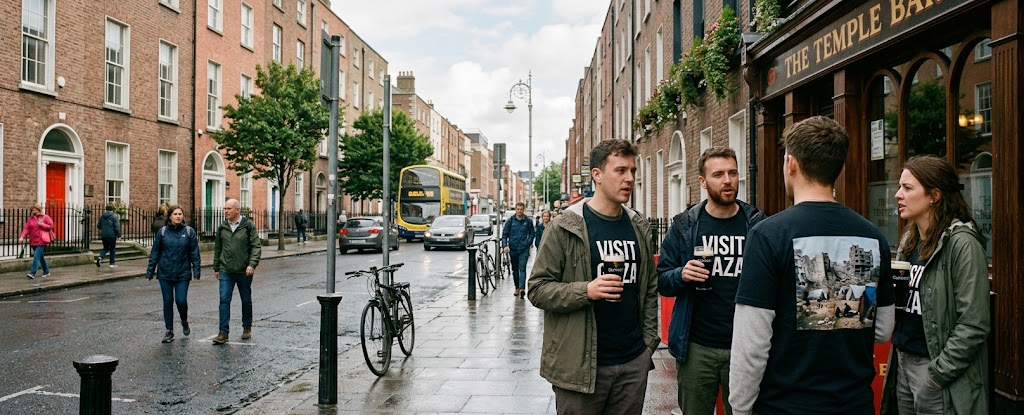
Ireland is often introduced to international visitors through landscapes, literature, music and hospitality. Yet understanding the country beyond the guidebooks also means understanding something less visible: Ireland has developed a distinctive willingness to take political positions on international questions even when larger European states are more cautious. The latest controversy surrounding Israeli government bonds provides a revealing example.
On 1 September 2026, Luxembourg ceased providing the regulatory approval under which Israeli bonds had been offered in several European Union markets. Israel will now need another EU jurisdiction if it wants to continue using the same mechanism for future public bond offerings within the European market.
For Ireland, the story has particular significance. Before Luxembourg assumed the role in September 2025, Ireland had been the regulatory home for Israel’s EU bond prospectus following Brexit.
What happened during that period tells international readers something important about modern Ireland.
From Ireland to Luxembourg
Government bonds are a means by which states borrow from investors. For securities offered publicly in the European Union, an approved prospectus provides investors with legally required information about the issuer and the securities.
After the United Kingdom left the EU, Israel selected Ireland as its Home Member State for this regulatory purpose. The Central Bank of Ireland therefore became responsible for examining the relevant prospectus documentation.
This generated increasingly intense controversy in Ireland following the escalation of the Gaza conflict after October 2023.
It is important to distinguish regulatory responsibility from political endorsement. The Central Bank repeatedly explained that approving a prospectus did not mean approving Israel, its government or its policies. Under the EU Prospectus Regulation, the Bank’s task was essentially to determine whether the required documentation met standards of completeness, comprehensibility and consistency.
Irish officials similarly stressed that the Central Bank could not simply reject a compliant prospectus because of political objections to the issuing state.
That legal distinction matters.
But so does what happened around it.
Irish Society Was Not Indifferent
The Israeli bond issue became the subject of parliamentary debate, political pressure and civil-society campaigning in Ireland.
Opposition politicians challenged Ireland’s involvement. The Oireachtas finance committee examined the issue. Campaigners argued that Ireland should not play any role, however technical, in a financial mechanism that enabled the Israeli state to raise capital while the war in Gaza continued.

Irish women standing up for Gaza, demonstrating, giving the -silenced ones- a voice.
Eventually, Israel moved the regulatory home of the programme.
The Irish-approved 2024 prospectus expired on 1 September 2025. Luxembourg’s CSSF approved the succeeding prospectus, while Ireland was not included among the countries in which bonds under that new prospectus could be offered publicly.
One year later, Luxembourg has allowed its own authorisation to expire.
The immediate financial question is what Israel does next. The more interesting Irish question is what the episode reveals about Ireland.
Ireland’s Position Goes Beyond the Bond Controversy
Ireland formally recognised the State of Palestine on 28 May 2024, alongside Spain and Norway.
The Irish Government presented recognition not as rejection of Israel’s right to exist, but as support for a political future in which Israel and Palestine exist as two states in peace and security.
Ireland has subsequently continued to criticise Israeli actions that it regards as contrary to international law. In May 2026, the Government approved the text of the Israeli Settlements (Prohibition of Importation of Goods) Bill, intended to prohibit imports into Ireland of goods originating in Israeli settlements in occupied Palestinian territory once enacted and commenced.
These are not isolated gestures. They reflect a political culture in which Palestine has occupied an unusually prominent position for many years.
For international readers, that is part of the Ireland that conventional travel literature rarely explains.
Why Ireland Responds Differently
Ireland’s relationship with questions of occupation, national self-determination and political sovereignty is inevitably influenced by its own history.
Historical parallels should never be pushed too far: Ireland’s past and the Israeli-Palestinian conflict are profoundly different in origin, circumstances and scale.
Nevertheless, Irish public culture retains a strong historical awareness of colonial rule, partition, political independence, emigration and national sovereignty. That background helps explain why arguments involving occupation, displacement and self-determination often resonate particularly strongly here.
There is another characteristic worth understanding.
Ireland is a relatively small European state, but it does not always behave internationally as though smallness requires silence.
Its recognition of Palestine demonstrated that clearly. Ireland acted together with other countries, but it was willing to move before many of Europe’s largest governments.
That independence can be encountered far beyond foreign-policy institutions. Irish political debate is remarkably accessible. International questions are discussed not only in government departments or academic circles but across radio programmes, newspapers, workplaces, universities, community organisations and ordinary conversation.
Foreign policy can become domestic conversation remarkably quickly.
An Ireland Beyond the Postcard
This is where the bond story becomes relevant to the broader purpose of Inside Ireland.
Anyone considering living, working or doing business here should understand that Ireland is not simply an attractive Atlantic economy with green landscapes and friendly towns.
It is a country with a pronounced civic and political personality.
Irish people frequently hold strong views about events far beyond the island. Public opinion can influence parliamentary debate, parliamentary pressure can challenge institutions, and questions that appear highly technical — such as which financial regulator approves a sovereign bond prospectus — can become matters of national ethical discussion.
The Central Bank itself remained bound by its interpretation of European securities law. That institutional independence is equally important to understanding Ireland: political pressure did not simply permit the regulator to disregard its legal obligations.
So two Irish characteristics were visible simultaneously.
One was respect for institutional and European legal frameworks.
The other was a society increasingly uncomfortable with Ireland having even an administrative connection to Israeli sovereign fundraising during the Gaza conflict.
That tension is more revealing than a simplistic claim that Ireland simply “banned Israeli bonds”.
It did not.
Instead, political Ireland questioned the arrangement intensely, the regulatory responsibility subsequently moved elsewhere, and Ireland was excluded from the public-offer jurisdictions under the succeeding Luxembourg-approved prospectus.
Now Luxembourg itself has stepped away.
Conclusion: A Small Country Willing to Have a Voice
For international readers trying to understand Ireland beyond the guidebooks, the significance of this story extends well beyond Israel bonds.
Ireland’s stance on Palestine illustrates a country prepared to attach considerable importance to international law, national self-determination and human rights, while simultaneously operating within the legal structures of the European Union.
One may agree or disagree with particular Irish policies. Understanding the country requires recognising the strength of the conviction behind them.
Ireland is small, highly internationalised and deeply integrated into the European economy. Yet it has repeatedly demonstrated that economic openness does not necessarily translate into political silence.
The transition of Israel’s bond prospectus from Ireland to Luxembourg in 2025, followed by Luxembourg’s decision not to continue its approval beyond August 2026, therefore tells a larger story.
It shows an Ireland that is not merely observing international events from Europe’s western edge.
Increasingly, it is prepared to have a voice in them.