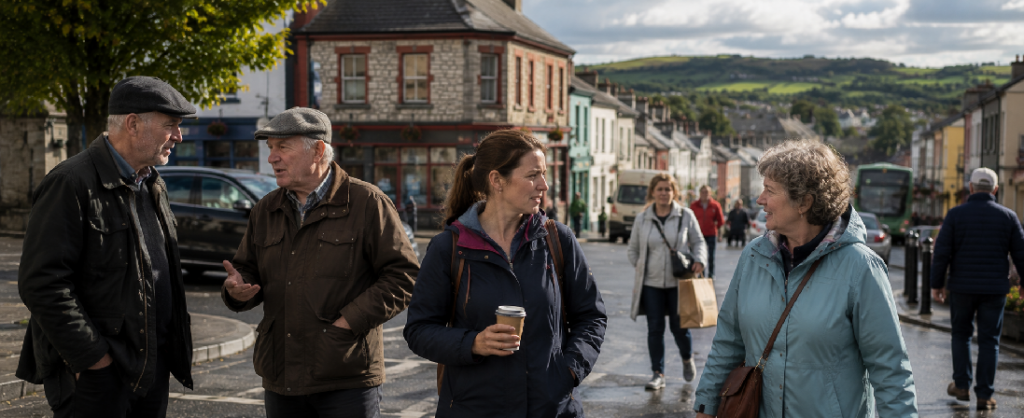
Drive beyond Ireland’s best-known cities and visitor routes and the country changes surprisingly quickly. Traffic thins, housing spreads out, fields begin almost where the town ends, and everyday life becomes organised around regional centres, smaller towns and networks of villages. The attraction is easy to understand: space, landscape, community and a different pace of life. But regional Ireland also operates according to practical realities that visitors may barely notice – particularly transport, healthcare, access to services and dependence on the car.
A recent RTÉ report from Tubbercurry in County Sligo provides a useful window into that less visible Ireland. Residents of the town – the second largest in the county – are campaigning for a new Local Link service because they believe their community and surrounding hinterland are underserved by public transport. Their proposal would connect communities including Charlestown, Tubbercurry, Achonry, Ballinacarrow and Collooney with Sligo.
It sounds like a local transport story. For the Ireland Journal, however, it prompted a broader question: what does everyday life outside Ireland’s major urban centres actually look like when viewed not as a visitor, but as someone who has to live there?
The answer is more complicated – and more interesting – than the familiar contrast between busy Dublin and peaceful rural Ireland.
Regional Ireland is not disappearing
One misconception is that Ireland outside its cities is simply declining while everybody moves towards Dublin.
The Central Statistics Office presents a more nuanced picture. Between 2016 and 2022, the population increased across all six urban and rural categories used by the CSO. Satellite towns grew by 12.2%, while independent urban towns increased by 11.5%, both ahead of the national population increase of 8.4%. Even highly rural and remote areas recorded population growth of 6.4%.
That matters because much of everyday Ireland exists in precisely these places: towns substantial enough to contain supermarkets, schools, cafés, pharmacies and local businesses, yet small enough that countryside remains only minutes away.
They are neither conventionally urban nor completely rural.
For an international visitor, this can be one of Ireland’s most distinctive characteristics. A town can have busy morning traffic, modern housing and multinational employers within commuting distance while still being surrounded by cattle fields, hedgerows and narrow regional roads.
The car changes everything
The most important practical difference may be mobility.
According to the CSO, 59% of commuters nationally travelled to work by car in 2022. In rural areas with strong urban influence, that reached 73%. By comparison, 44.8% of city commuters drove. Cycling accounted for 6.5% of city commuting but only around 0.5–0.6% across Ireland’s three rural categories.
Those numbers help explain why a campaign for a bus service in Tubbercurry is about considerably more than transport policy.
Outside the major cities, possessing a car can influence where you work, where children attend activities, how easily you shop and how practical it is to reach healthcare or neighbouring communities.
This does not mean regional Ireland is inaccessible. Bus Éireann, rail services and the expanding TFI Local Link network connect many communities, and individual towns can have surprisingly useful connections.
But frequency and convenience vary considerably.
In August, business organisations representing Galway, Shannon and Limerick called for faster investment in roads, rail, public transport and aviation, arguing that better western connectivity is necessary for future economic development.
Transport is therefore part of the economic geography of Ireland, not merely a matter of convenience.
Cheaper housing comes with a different equation
Regional Ireland also changes the financial calculation.
CSO research found a 2024 median residential property price of €435,000 in cities compared with €210,000 in highly rural or remote areas.
That difference can make regional life particularly attractive to people who do not need to live in Dublin.
But lower housing costs cannot be considered in isolation. A household needing two cars, travelling considerable distances for work or regularly accessing services in another town faces costs that an urban property comparison will not capture.
Income differs too. The median annual equivalised disposable income in 2024 was €36,981 in satellite urban towns but €24,636 in highly rural and remote areas, against a national median of €29,996.
The interesting middle ground may therefore be Ireland’s regional and satellite towns: places where housing, employment, countryside and access to larger centres overlap.
Digital Ireland has changed regional life – but geography has not disappeared
Broadband has altered what is possible outside the cities.
In 2025, 95% of Irish households had internet access and 87% had fixed broadband. However, regional differences remained: fixed broadband was recorded in 91% of Dublin households compared with 80% in the Border region and 83% in the West.
For remote workers and entrepreneurs, that makes checking connectivity at a specific property more useful than assuming that an entire county is either well or poorly connected.
This is representative of regional Ireland more generally.
National statistics tell you what is typical. Local investigation tells you whether it works at your address.
Healthcare provides another reality check
The same principle applies to healthcare.
An Irish Times analysis published in July found GP shortages particularly acute in rural and commuter-belt areas. Monaghan was reported as having approximately 50–52 GPs per 100,000 residents, Roscommon 59–61, Kilkenny 64–66 and Meath 67–69. The Irish College of General Practitioners acknowledged that the expanding GP workforce was still insufficient to meet current demand.
For a tourist spending two weeks in Ireland, this is almost invisible.
For someone considering spending ten years here, it matters.
And that distinction captures much of what separates the Ireland of a travel itinerary from the Ireland experienced by residents.
Ireland’s towns can be thriving and struggling at the same time
Regional Ireland should not be romanticised in the opposite direction either.
An Irish Times series on vacancy and dereliction recently highlighted the uneven condition of Irish town centres. Bray, for example, combines a thriving seafront with long-vacant properties on its main street. The newspaper noted that similar problems occur across Munster, Connacht and Ulster and are not confined to one type of town.
This apparent contradiction is familiar in Ireland.
A town may contain busy cafés, excellent independent businesses, renovated public spaces and attractive residential neighbourhoods – and, only a few doors away, vacant buildings or neglected upper floors.
That is not necessarily evidence that the community itself is failing. It reflects the complicated evolution of Irish towns as shopping patterns, housing, car ownership, employment and population have changed.
What does regional Ireland actually feel like?
Here the distinction between data and observation becomes important.
Statistics can measure population, income, property prices and commuting. They cannot fully describe the experience of walking through a regional Irish town on an ordinary Tuesday.
The observable reality is often quieter and less polished than tourism imagery, but also more socially textured.
School traffic appears and disappears. Delivery vans stop outside small shops. Older residents meet people they know. A supermarket car park can function almost as a community crossroads. Weather changes several times during the day. Houses transition rapidly into farmland. Local sports grounds can occupy a social importance that would be difficult to understand from a map.
And distances are deceptive. Something that appears “nearby” geographically may involve a substantial drive because of road conditions and routes.
None of these observations is universally true. Galway is not Sligo; West Cork is not Roscommon; a commuter town in Kildare operates differently from a community in Donegal.
That variation is itself one of the most important things to understand about Ireland.
Conclusion: The real Ireland begins where the itinerary ends
Regional Ireland offers something that international visitors often sense but do not have enough time to understand: the landscape and the community are closely connected to everyday life.
There can be more space, lower property prices and immediate access to countryside. There can also be greater dependence on cars, uneven public transport, different healthcare access and significant variations in broadband and local services.
Neither version should be exaggerated.
For visitors, understanding this makes Ireland more interesting. For prospective residents, it is essential. For entrepreneurs, it helps explain why regional markets and infrastructure differ. And for international readers, it replaces the idea of one uniform “Irish lifestyle” with something considerably more accurate.
Ireland beyond the guidebooks is not simply quieter Ireland.
It is a network of cities, regional centres, independent towns, villages and rural communities – each offering a different balance between connection and distance, convenience and space, opportunity and limitation.
That is where much of Ireland is actually lived.