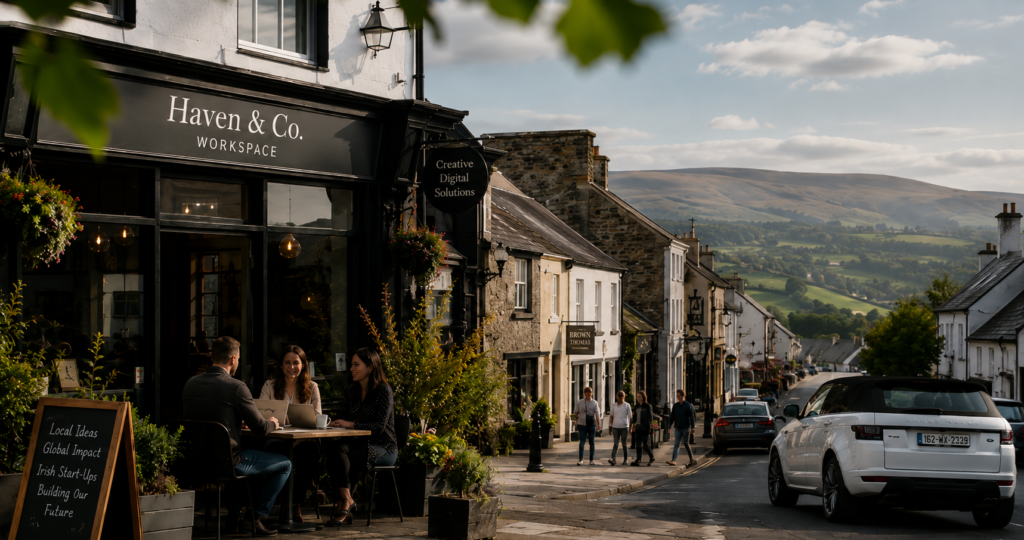
Ireland entered the second half of 2026 with an unmistakable signal of entrepreneurial confidence: almost 15,000 new companies were registered during the first six months of the year. The 13 per cent year-on-year increase represents more than a statistical milestone. It suggests that entrepreneurs are continuing to establish businesses despite geopolitical uncertainty, high operating costs and growing competition for skilled workers. Even more significantly, the increase is being recorded across much of the country rather than remaining confined to Dublin.
Irish entrepreneurship is often discussed through the language of multinational investment. Technology campuses, pharmaceutical plants and international financial firms naturally dominate the headlines. Yet beneath that highly visible layer of the economy, another Ireland is taking shape: one built by thousands of smaller companies, independent professionals, construction businesses, technology specialists and locally based service providers.
The first half of 2026 produced the highest number of new company registrations ever recorded for that period. Nearly 15,000 companies were created, an increase of approximately 13 per cent compared with the same period a year earlier. The figures follow an already strong 2025, when around 26,500 companies were formed—the highest annual total in 15 years.
What makes the 2026 increase particularly interesting is its geographic distribution. New-company activity rose across 18 counties. This means Ireland’s entrepreneurial momentum can no longer be understood solely through Dublin’s technology and professional-services sectors.
Construction is one important part of the story. Ireland’s need for housing, infrastructure, retrofitting and energy improvements continues to generate demand for contractors, engineering services and specialist suppliers. Information technology is another major contributor, but the modern technology business is no longer always a large employer occupying a city-centre office. It may be a small consultancy in Galway, a cybersecurity specialist working from Mayo or a software company founded from a rural home connected by fibre broadband.
This regional spread matters. A small company established outside the principal cities can generate work for accountants, tradespeople, designers, legal advisers, local cafés and property owners. Its economic footprint may be modest in national statistics but substantial within a town.
Ireland also remains highly successful in attracting international investment. IDA Ireland reported 190 investments during the first half of 2026, including 54 first-time investors, 39 expansions and 57 research, development and innovation projects. This combination of indigenous company formation and foreign investment gives Ireland a valuable dual structure: international capital on one side and locally rooted entrepreneurship on the other.
However, registrations alone do not guarantee durable businesses. New firms must still contend with insurance, energy, commercial rents, financing, recruitment and regulatory compliance. Ireland’s next challenge is therefore not simply to celebrate the number of companies being created, but to improve the environment in which they attempt to survive.
The deeper message of the 2026 figures is one of resilience. Entrepreneurs are not waiting for perfect economic conditions. They are responding to visible demand, developing specialist services and creating businesses in parts of Ireland that were previously considered peripheral.
Ireland’s start-up surge is therefore not merely a record. It is evidence that the geography of Irish enterprise may finally be beginning to broaden.