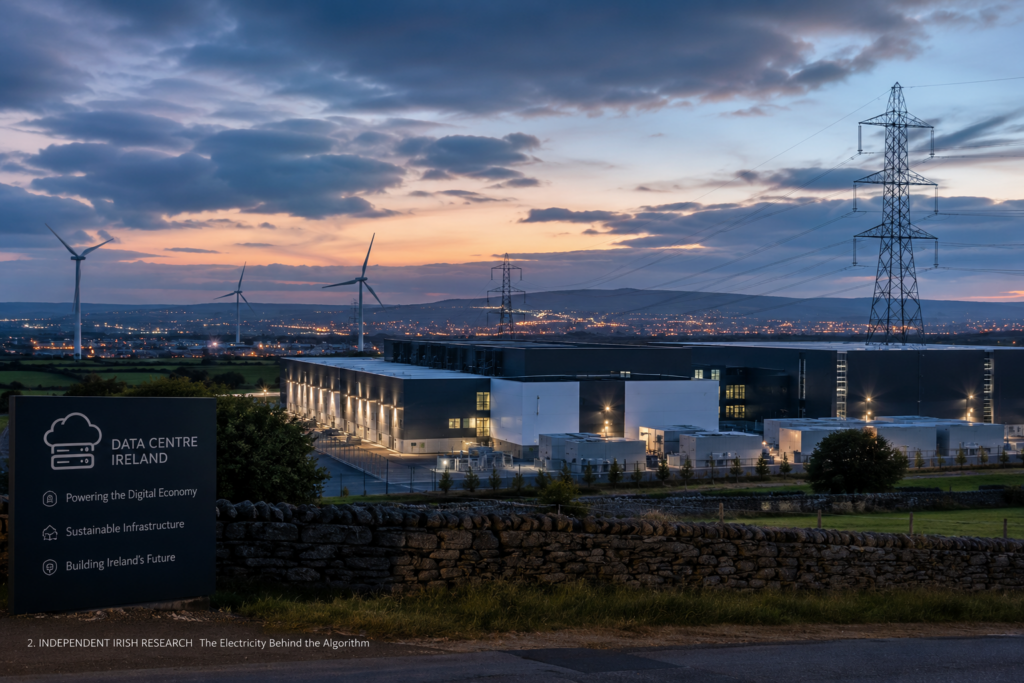
Data centres consumed approximately 23 per cent of Ireland’s metered electricity during 2025, bringing their total demand close to that of all Irish households combined. The figures expose a difficult national trade-off. Ireland’s digital economy attracts investment, employment and international influence, but its physical infrastructure requires extraordinary quantities of electricity. The central question is no longer whether data centres belong in Ireland, but what conditions should govern their next stage of development.
The modern digital economy often appears almost weightless. Data moves through invisible networks. Artificial intelligence is delivered through a browser. Cloud storage seems to exist somewhere beyond geography.
In reality, the cloud has a postcode.
Behind Ireland’s role as a European technology centre lies a rapidly expanding estate of industrial buildings containing servers, cooling equipment, security systems and backup power infrastructure. Their growing demand for electricity is now reshaping Ireland’s energy debate.
Figures for 2025 indicate that data centres used approximately 7,663 gigawatt-hours of electricity, representing around 23 per cent of total metered consumption. Residential homes accounted for roughly 28 per cent. Data-centre electricity use increased by about 10 per cent in a single year and has grown dramatically over the past decade.
This is not simply a dispute between technology and environmental policy. Data centres are connected to Ireland’s wider economic model. They support cloud computing, international digital services and the infrastructure used by some of the largest companies operating in the country. Rejecting the sector entirely would carry economic consequences.
Yet accepting unlimited development would create equally serious risks. Ireland has a relatively small electricity system. Additional large-scale demand can require new generation capacity, grid reinforcement and long-term investment that may ultimately affect businesses and households.
The important distinction is between attracting digital investment and subsidising unlimited energy demand. A facility that consumes vast quantities of electricity while creating relatively few permanent local jobs should be assessed differently from an innovation project producing research, specialist employment and measurable regional value.
Ireland’s updated approach to large energy users attempts to make future development more conditional. New facilities may be required to provide generation capacity and secure a high proportion of their electricity from renewable sources. The underlying policy direction is clear: technology companies seeking access to Ireland’s grid will increasingly be expected to contribute to the energy system rather than merely draw from it.
Location will also matter. Concentrating additional facilities around Dublin intensifies pressure in the area where demand is already greatest. Development closer to renewable generation might support a more balanced system, but only where transmission capacity, water requirements and local environmental effects have been examined honestly.
The debate also needs greater transparency. Communities should be able to understand how much electricity and water a proposed facility will consume, how many permanent jobs it will create, what infrastructure the developer will finance and how the project contributes to national climate objectives.
Ireland has benefited enormously from recognising the economic importance of digital technology earlier than many other European countries. It must now demonstrate a second form of foresight: understanding that the next phase of digital growth cannot be separated from energy, land, water and local consent.
The algorithm may be global, but the electricity that powers it remains profoundly local.