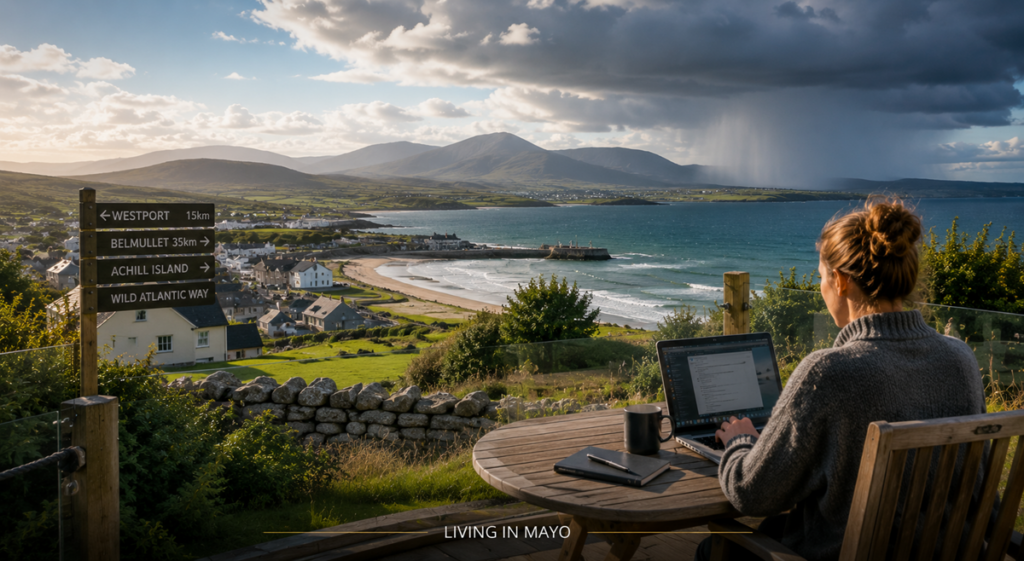
Summer Extremes on the Wild Atlantic Way: How Mayo Balances Record Heat with Digital Hubs. County Mayo isn’t trendy. Mayo isn’t Instagram. Mayo isn’t the destination of classic Ireland tourists. Exactly why the digital nomad movement is discovering Mayo. Summer 2026 paradoxically fueled this movement through extreme weather events that show how resilient life here can be. Irish weather service Met Éireann issued an official Status Yellow High-Temperature Warning in early June, meaning extremely unusual for Irish standards but not emergency-class. Thermometers climbed to 27 degrees Celsius, a Mayo record. Immediately after came spectacular summer storms.
The Atlantic turned dramatic, the sky showed its power, and for 48 hours people on the Wild Atlantic Way experienced what it’s about: nature’s force. Yet life went on. Cows stayed calm. People went to the beach. Internet held. Westport and Belmullet are the two centers of this remote-work renaissance. Westport has a population of 6,500 and offers Europe’s best fiber-optic network that is gigabit-capable. Co-working spaces feature Clew Bay views. International-caliber cafés and restaurants are available. Flight connections exist to Dublin, Cork, and Shannon at 55 minutes distance. Belmullet has a population of 800 and is even more authentic and wilder. High-speed fiber is available, yes really.
Untouched beaches like Enniscrone and Barleycove exist. Active Irish language culture remains. Anyone coming to Mayo to work remotely isn’t seeking Starbucks digital nomad experience. These people want no distraction except nature, high productivity without urban noise, real quiet not Instagram-quiet, and cost at €800 to €1,200 per month for a one-bedroom apartment. For any remote worker earning $80,000 or more annually, Mayo makes mathematical sense. In Northern California, $80k net after tax, housing, and food equals minus $5,000 per year. In Dublin, $80k net equals plus $8k per year but with burnout from costs. In Mayo, $80k net equals plus $25,000 per year with savings, freedom, and no burnout. This isn’t digital nomad backpacker mindset, it’s rational economics.
A day in the life of a Mayo remote worker starts at 6 AM making coffee, walking to Clew Bay with headphones for a quick 20-minute walk, having an 8 AM Zoom call with San Francisco since the timezone is perfect, and working while the sun rises over the bay. At noon, you have lunch in a local pub for €8 to €12, take a brief beach walk, and have afternoon calls with European teams. In the evening, you end work at 5 PM, walk with real people like neighbors and other expats, have dinner with sea views for €15 to €25 in restaurants, and go to bed at 9 PM with natural exhaustion, not stress-exhaustion. Compared to San Francisco, London, and Berlin, the mental difference isn’t small; it’s life-changing.
June heat and summer storms weren’t problem but were part of the place. Irish people in Mayo grow up with changeable weather where 26 degrees Celsius heat, then storms, then rain, then sun happen all the same day. Infrastructure works, not always 100 percent modern but functions. Human networks solve problems through community, not anonymity. This isn’t primitive conditions; this is lived resilience. Unlike Dublin and Galway, Mayo house prices are slightly falling at approximately minus 1 percent annually. Supply sources run deeper with very high vacancy in villages.
Digitalization lets traditional workers leave. Young people migrate to Dublin and Cork in classic brain drain. A three-bedroom cottage with heat pump and fiber costs €280,000 to €350,000, not €600k like Galway.
Summer 2026 in Mayo proved it: life here isn’t romantic fantasy but functioning reality with digital infrastructure. For remote workers, digital entrepreneurs, and people wanting quiet plus productivity plus savings, Mayo isn’t a secret tip anymore, it’s a rational choice. The next three to five years will make Mayo Ireland’s hidden remote-work hub. Anyone coming now rides an opportunity that still makes sense, not an already-crowded, expensive valley.