CAVAN CYBER-SECURITY. How Cavan and the Midlands Protect SMEs Against Modern Cyber Fraud.
While media focuses on geopolitical conflicts, tariffs, and inflation crises, something subtler and more dangerous is happening for Irish SMEs: the cyber-threat landscape is expanding exponentially and local businesses are completely unprepared. This isn’t academic or theoretical. In the last 18 months, cyber criminals have stolen over €450 million from Irish SMEs, mostly through phishing, Business Email Compromise (BEC), and ransomware. Now security infrastructure is mobilizing.
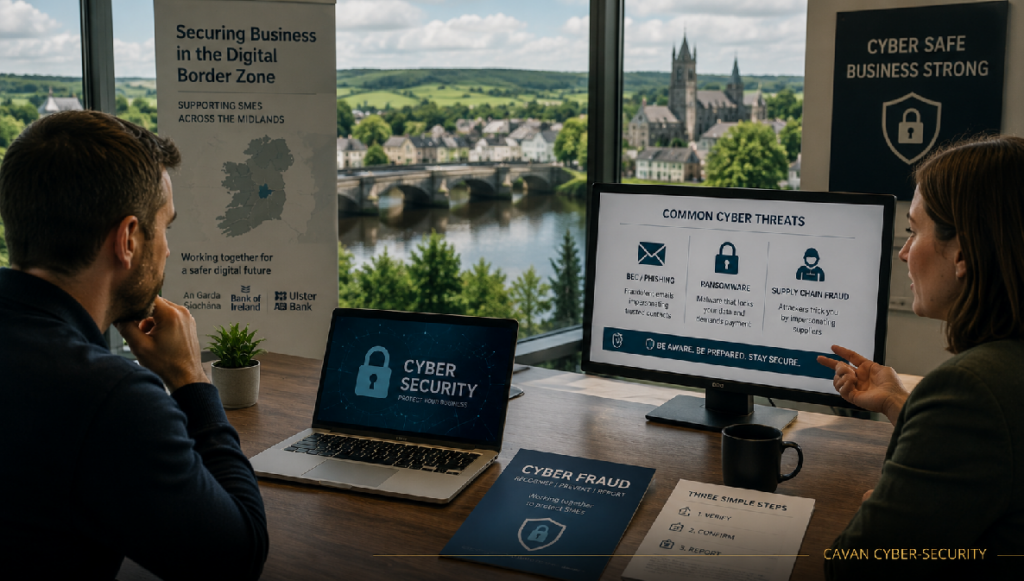
The most common attack pattern against Irish SMEs involves several scenarios. In the first scenario, the fake boss, an attacker hacks the CEO’s Gmail or impersonates them. They email accounting an urgent message: “Please transfer €50,000 immediately to this account for a secret acquisition project.” The accountant, under pressure, sends it. Money’s gone. In the second scenario, ransomware on the server, an employee clicks a malicious link in a job application email. Ransomware encrypts all business data. The attacker demands €80,000 for a decryption key. Business is paralyzed. In the third scenario, supply chain infiltration, fraudsters hack the supplier’s email or impersonate them. They email the customer: “Our banking details have changed, please send future payments to this new account.” Months later, the real supplier realizes no funds arrived.
The problem is these attacks aren’t technical; they’re social-engineering-based. No firewall protects against an accountant believing the boss needs money. Irish police An Garda Síochána partnered with major banks BOI, AIB, and Ulster, launching a massive education and training initiative. Regional fraud awareness events occur in business centers where Cavan, as a border region, gets special attention because of high cross-border traffic between north and south, logistics hubs including cross-border routes, and SMEs lacking large-corporate IT infrastructure. Specialized training for finance teams covers recognizing BEC fraud through grammar errors and unusual urgency, implementing two-factor authentication for critical transactions, establishing secure email protocols, and creating incident response plans.
Digital identity audits for SMEs are free, checking if your email or company data appear on dark-web marketplaces. If yes, free notification and protection tips follow. Cavan is a border region between Republic and Northern Ireland, which means mixed regulations with GDPR in the south and UK Data Protection in the north, cross-border business with SMEs operating on both sides, logistical complexity with goods flows, documentation, and payments, and criminals exploiting jurisdiction gaps where if an attack originates north, it’s unclear who investigates.
This makes Cavan a type of weak point, and fraudsters know it. Immediate actions this week include shifting all employees to two-factor authentication with WhatsApp, email, banking, and CRM all having 2FA at zero cost since most services are free and taking one hour per employee. Strengthen email filters by flagging external emails with an EXTERNAL tag, auto-blocking suspicious file types like .exe and .scr at a cost of €50 to €200 per year with Microsoft Defender or Proofpoint. Employee training happens one-time for 90 minutes with live phishing simulation, recognizing social engineering, and understanding what to do if something looks suspicious by reporting and not clicking. Medium-term actions over three to six months include obtaining a cyber-insurance policy that covers ransomware demands and data-loss liability at €2,000 to €5,000 per year for SMEs, reducing actual cyber damage by 60 to 80 percent. Regular security audits occur annually or twice yearly at costs of €1,500 to €3,000 per audit, finding blind spots before criminals do.
In 2026, Gardaí launched a specialized Cyber-Crime Unit focusing on financial cyber crime against SMEs, ransomware gang prosecution, and border cooperation with UK Police and Europol. This means cyber-incident response time dropped from six to twelve weeks to one to two weeks. Countries are no longer just observers but actively investigate. The coordinated offensive by Gardaí, banks, and financial institutions makes clear: Ireland takes cyber threats seriously. Regionally, especially in border zones like Cavan, security is now a competitive advantage.
SMEs investing now benefit from lower vulnerability with 2FA, training, and monitoring neutralizing 90 percent of standard attacks, insurance discounts where firms with proven security standards pay 20 to 30 percent less, and competitive advantage where clients want to work with secure firms, making that a marketing point. The next 24 months are critical. Anyone not waking up now will feel the costs over the next three to five years emotionally, financially, and reputationally.