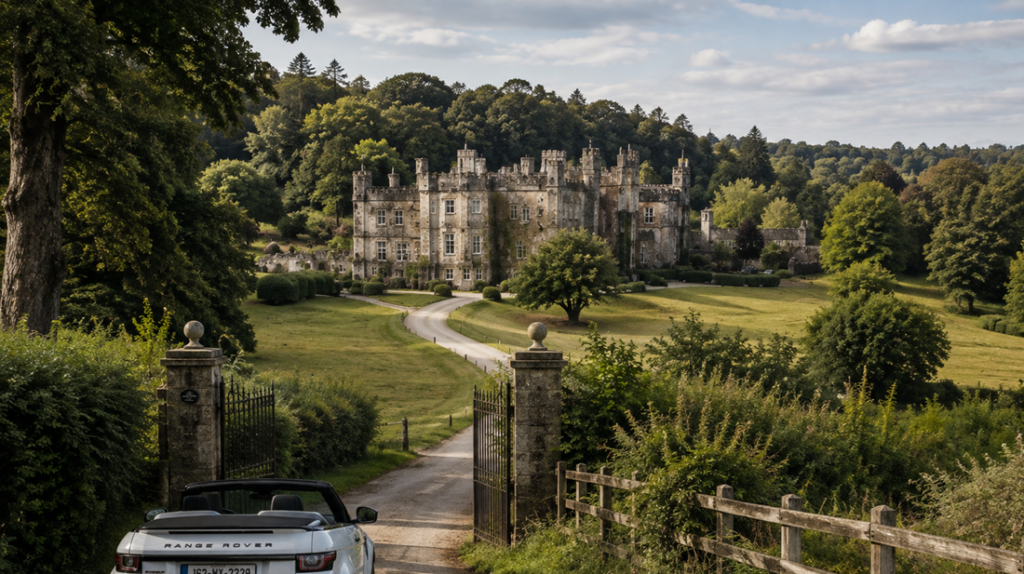
The purchase of a 440-acre historic estate in County Waterford by Mark Zuckerberg and Priscilla Chan is more than an eye-catching property story. It places another internationally prominent name in rural Ireland and raises a more interesting question: why are some of the world’s wealthiest individuals increasingly looking beyond Dublin towards the Irish countryside?
Independent Irish Intelligence for an International Audience
Mark Zuckerberg, the founder and chief executive of Meta, and his wife Priscilla Chan have purchased Strancally Castle in County Waterford, adding one of the technology world’s best-known families to a remarkable collection of international owners of major Irish country estates.
The acquisition was first reported by The Irish Times on 20 August. The transaction took place off-market and had not yet appeared on Ireland’s Property Price Register when the news became public. The property comprises Strancally Castle and approximately 440 acres of land on the banks of the River Blackwater.
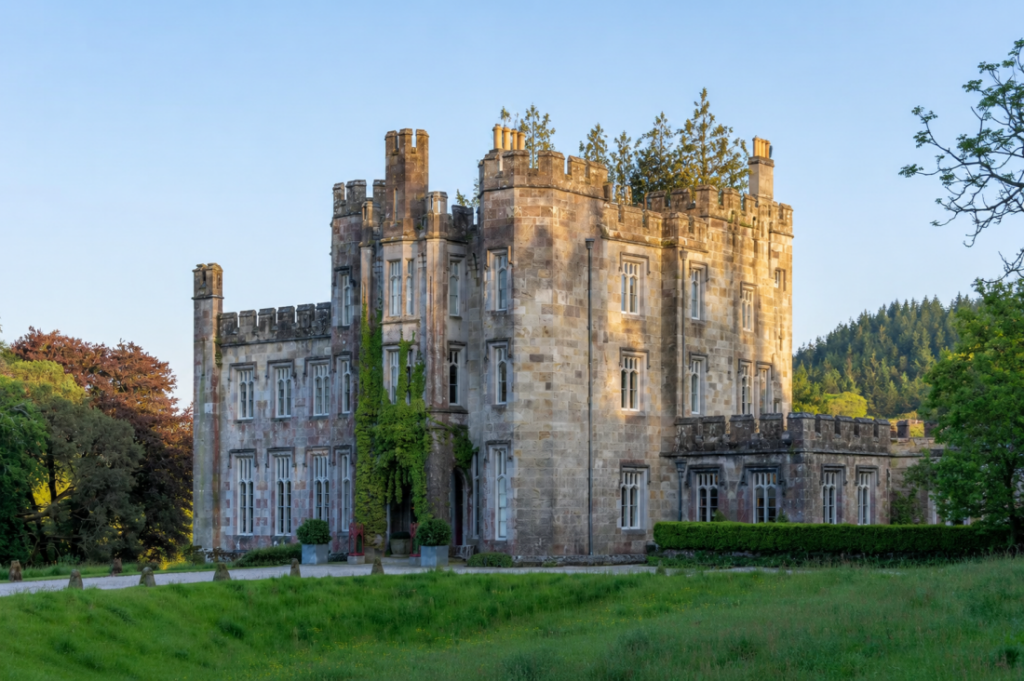
The Gothic Revival house dates from around 1830 and was built for John Keily, a former MP for Clonmel. The estate was most recently owned by Michael and Giancarla Alen-Buckley and underwent extensive restoration work in the early 2000s.
The final purchase price has not been officially disclosed. That distinction matters. Estimates surrounding major private estates can quickly become reported as fact, particularly when a globally recognised billionaire is involved. What is confirmed is the acquisition itself, the scale of the estate and Zuckerberg’s intention to spend time in Ireland.
A spokesperson for Zuckerberg said that Mark and his family were excited to continue caring for the historic property and looked forward to spending time in Ireland, where Meta has maintained a major presence for many years.
That connection is important.
Ireland is not a new country for Zuckerberg or Meta. Facebook established its international headquarters in Dublin in 2009, and Meta today maintains operations in Dublin, Cork and Clonee, County Meath. Ireland has therefore been part of Zuckerberg’s international business geography for well over a decade.
But buying a historic country estate is something different from operating a European corporate headquarters.
It creates a personal connection to the country.
And the location is perhaps even more interesting than the famous purchaser.
Strancally is not in Dublin, Dalkey or one of the capital’s traditional high-value residential enclaves. It lies in rural County Waterford, close to the River Blackwater and the border with County Cork.
That places the purchase within a much broader and increasingly visible pattern.
International wealth is discovering rural Ireland.
British entrepreneur James Dyson acquired the nearby Ballynatray estate in 2024 for a reported figure of around €29 million. American billionaire Kelcy Warren owns Castletown Cox in County Kilkenny and has more recently been associated with a major private investment proposal for Waterford Airport.
These transactions should not be interpreted as evidence that every rural Irish property market is suddenly experiencing a billionaire-driven boom. Ireland’s housing market, its country-estate market and the market for historically significant properties are very different things.
But they do tell us something about Ireland’s international positioning.
For an internationally mobile buyer with substantial capital, Ireland offers a combination that is becoming increasingly difficult to find elsewhere in Western Europe: political stability, an English-speaking environment, extensive countryside, historic properties, comparatively low population density and direct access to both European and transatlantic business networks.
For buyers at the very top end of the market, privacy itself becomes an asset.
A 440-acre estate on the River Blackwater offers something that cannot easily be replicated in London, Paris, New York or Silicon Valley regardless of budget: physical space, landscape and separation.
That may help explain why the international story of Irish property is increasingly extending beyond Dublin.
There is also a rural economic dimension that deserves attention.
The arrival of wealthy owners does not automatically transform a local economy, and communities are right to distinguish between private ownership behind closed gates and investment that actually circulates through the surrounding area.
But major historic estates require maintenance.
Buildings need restoration. Grounds need management. Heating, electrical, security and water systems need maintaining. Local contractors, builders, gardeners, tradespeople, suppliers, caterers and service businesses can all become part of that economic ecosystem.
Reaction around Strancally reflects precisely this mixture of curiosity and pragmatism. Local reporting following the announcement found residents wondering what Zuckerberg’s arrival might mean, while also pointing to employment and local spending associated with the restoration and maintenance of other major estates in the region.
There is another side to the story.
Ireland possesses a substantial stock of historic houses and estates whose long-term preservation is expensive. Romantic photographs of Irish castles can disguise the extraordinary cost of maintaining roofs, stonework, heating systems, drainage, grounds and buildings originally constructed for a completely different economic era.
Without owners capable of financing them, some properties risk gradual deterioration.
Private international capital can therefore play an unexpected role in preserving parts of Ireland’s architectural heritage, although that benefit must always be balanced against questions of access, community relationships and the changing ownership of historically significant Irish land.
Strancally itself illustrates the complexity perfectly.
It is simultaneously a private residence, a historic building, a major rural estate and now an internationally reported property associated with one of the world’s most recognisable technology executives.
But perhaps the most interesting aspect of the transaction has little to do with Zuckerberg personally.
It is what his decision says about Ireland.
From Silicon Valley to the Blackwater: Ireland’s Quiet Global Advantage
For decades, Ireland’s international economic story was largely told through corporations.
American technology and pharmaceutical companies came to Ireland. Multinationals established European headquarters. Foreign direct investment created employment, exports and tax revenues. Dublin became one of Europe’s major technology centres.
A different layer is now becoming more visible.
Some of the people behind global businesses are not simply locating companies in Ireland. They are discovering Ireland as a place in which they personally want to spend time.
That distinction could become increasingly important.
The post-pandemic world has made senior executives, entrepreneurs and internationally mobile families far less dependent on living permanently beside a corporate headquarters. Connectivity, private aviation, remote communications and increasingly sophisticated rural infrastructure have altered the geography of where wealthy individuals can base themselves.
Ireland has significant weaknesses in this competition. Housing shortages, planning complexity, infrastructure gaps and poor connectivity in some rural areas remain genuine constraints.
Yet those weaknesses coexist with advantages that are difficult to manufacture.
Ireland has space.
It has coastline.
It has historic estates.
It has internationally recognised landscapes.
It has an English-speaking population inside the European Union.
It has longstanding commercial links with the United States.
And, outside its largest cities, it still offers something increasingly scarce in highly developed economies: genuine rural privacy within a relatively small country.
For County Waterford, Zuckerberg’s arrival is therefore interesting for reasons extending well beyond the gates of Strancally Castle.
It brings international attention to a part of Ireland that rarely features in global conversations about wealth, technology and international mobility.
The Blackwater Valley is unlikely to become the next Silicon Valley, nor should it try.
Its attraction is almost precisely the opposite.
It offers landscape rather than density, history rather than new construction, and privacy rather than proximity to a technology campus.
That may be exactly the point.
Ireland has spent decades persuading international companies that it is a good country in which to conduct business.
The purchase of Strancally Castle suggests a subtly different possibility.
For some of the people who built those companies, Ireland may increasingly be becoming a country in which they also want to live.
And for rural Ireland, that could ultimately be the more interesting story.