How a quotation about absence leads to an Italian artist, Ireland’s national museum of modern art, and a different way of understanding the country’s cultural identity.
A Few Words That Lead Somewhere Unexpected
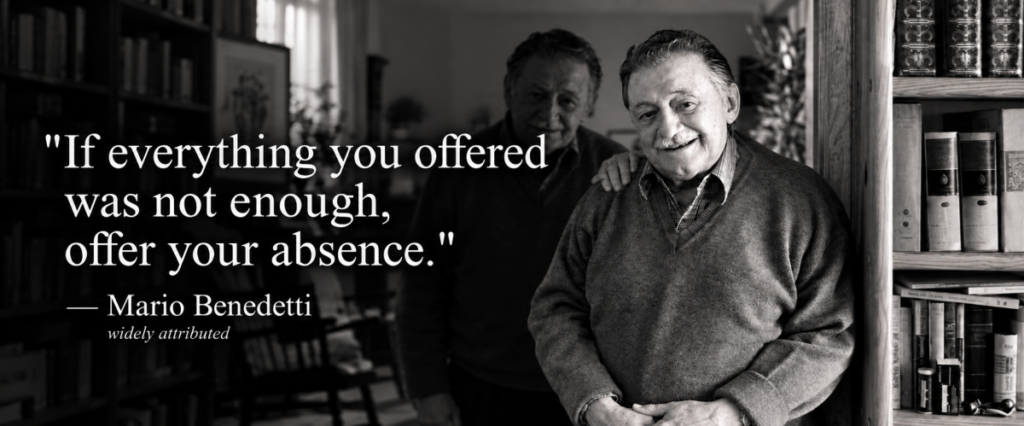
“If everything you offered was not enough, offer your absence.”
The sentence, widely attributed to the Uruguayan writer Mario Benedetti, carries the quiet force of something learned through experience. It speaks of knowing when to leave, when generosity has reached its limits, and when absence may communicate more than presence.
Its precise literary origin, however, is difficult to establish.
Now imagine following that name across the internet, expecting to discover more about the poet, and arriving instead at the Irish Museum of Modern Art in Dublin.
There, among the names of Irish and international artists, appears Mario Benedetti.
But this is not the man whose words inspired the search.
It is another Mario Benedetti entirely.
And this small coincidence opens a surprisingly interesting window onto Ireland — not the Ireland of postcards, traditional music or familiar historical landmarks, but a country whose cultural identity extends far beyond its own borders.
What You Notice First: A Different Dublin
The Irish Museum of Modern Art, commonly known as IMMA, occupies the historic Royal Hospital Kilmainham in Dublin 8.
The setting itself is remarkable.
A monumental seventeenth-century building, originally created for retired soldiers, now provides a home for modern and contemporary art.
Visitors encounter an unusual relationship between historical architecture and contemporary creativity. The building belongs unmistakably to Ireland’s past, while the art inside reaches into an international present.
It is easy to visit such a place simply to admire the architecture, gardens or exhibitions.
But look more closely at the museum’s artist directory and another story begins to emerge.
Among internationally recognised names is Mario Benedetti.
Not the celebrated Uruguayan poet born in 1920, but an Italian visual artist born in Terni in 1938.
Two men. The same name. Different countries, generations and artistic disciplines.
One became known for literature exploring love, displacement and human experience.
The other developed a career in painting, sculpture and printmaking, investigating materials, form and artistic expression.
Their shared name creates the connection. Their different lives make it interesting.
The Artist Behind the Name
The Italian Mario Benedetti studied in Milan and became closely associated with the city’s artistic environment.
Beginning in the 1960s, his career developed through exhibitions in Italy and abroad.
His work moved across several disciplines, including painting, engraving, sculpture and collaborations with architects.
He also taught engraving techniques at Milan’s prestigious Brera Academy of Fine Arts.
His artistic approach was strongly connected to materials and experimentation.
Rather than treating artistic creation as an entirely predetermined process, Benedetti described the importance of responding to unexpected developments while working.
The material itself could influence the outcome.
That philosophy offers an intriguing contrast with the literary world of his namesake.
The Uruguayan writer explored human relationships through language. The Italian artist explored expression through physical materials.
There is no documented personal or artistic relationship between them.
Yet both remind us that creativity can emerge from very different attempts to understand human experience.
And Ireland provides an unexpected setting in which their stories can meet — at least in the imagination of a curious reader.
What This Actually Tells Us About Ireland
There is a tendency among international visitors to approach Irish culture through a familiar collection of references.
James Joyce. W. B. Yeats. Samuel Beckett. Traditional music. Ancient monasteries. Celtic symbolism.
These are important parts of Ireland’s cultural heritage.
But they are not the whole story.
Ireland’s contemporary cultural institutions also participate in international artistic conversations that have little to do with conventional ideas of Irishness.
IMMA, established in 1991, is a particularly visible example.
Its work connects Irish audiences with artists, movements and ideas originating far beyond the island.
The presence of an Italian artist in its directory is not extraordinary in itself.
That is precisely the point.
International cultural exchange has become a normal part of how contemporary Ireland presents and understands art.
A country can remain deeply attached to its own history while making room for cultural experiences that originated somewhere else.
These two qualities are not contradictory.
They are part of what makes modern Ireland more complex than its familiar international image.
The Often-Overlooked Point: Ireland Is Not Only Looking Back
Ireland’s history is frequently told through departure.
Emigration, exile and the movement of Irish people abroad have shaped its national memory for generations.
But there is another direction to the story.
Ideas, artists and cultural influences also arrive in Ireland.
They become part of its museums, universities, libraries, festivals and everyday intellectual life.
The Italian Mario Benedetti’s appearance in IMMA’s records is a small example of that outward-looking cultural environment.
It does not establish a special historical relationship between the artist and Ireland.
Nor does it mean that his work is necessarily on public display today.
What it demonstrates is something subtler: Ireland’s cultural institutions cannot be understood simply by examining Irish-born artists.
Their international connections are part of the picture.
For someone considering Ireland as a place to live, work or develop a long-term relationship, that distinction matters.
It suggests a cultural landscape broader than the one presented by tourism marketing.
Why This Matters Before You Come to Ireland
An international visitor might reasonably assume that understanding Ireland means learning about Irish history, traditions and social customs.
Those things certainly matter.
But understanding contemporary Ireland also means noticing how the country interacts with the wider world.
A museum visit can reveal these connections more effectively than another afternoon spent visiting familiar tourist attractions.
It can also raise better questions.
What kinds of international ideas are welcomed here?
How do historical institutions adapt to contemporary society?
Where do Irish and international perspectives encounter one another?
The answers will differ between Dublin and smaller regional communities.
Cultural infrastructure is not distributed evenly across the country, and the presence of a major national museum in the capital should not be mistaken for equal access everywhere.
Nevertheless, institutions such as IMMA offer an important reminder that Ireland’s cultural life is not confined to its traditional image.
One Thing to Check Before You Visit
Before visiting an Irish museum, look beyond its current exhibition advertisements.
Search its online collection and artist directory.
Choose an unfamiliar international artist and investigate why that name appears in an Irish institution.
Then check whether the relevant artwork is currently on display, held in storage or associated with an earlier programme.
These distinctions matter. An artist’s inclusion in a museum database does not automatically mean that visitors can see a particular work during their visit.
For Mario Benedetti, the starting point is IMMA’s artist directory.
The exercise may reveal something more interesting than a conventional sightseeing itinerary: the international relationships that quietly shape Ireland’s cultural institutions.
Two Names, One Unexpected Lesson
The original quotation speaks about absence.
Perhaps that makes the discovery particularly appropriate.
The poet Mario Benedetti is absent from the Irish museum connection that initially appears to bear his name.
Instead, another artist emerges — with a different biography, different artistic language and a different place in cultural history.
A simple search has become a reminder that names do not always tell the whole story.
Neither do countries.
Ireland is often described through the familiar symbols of its past. Yet behind those symbols exists a contemporary cultural landscape shaped by international encounters, unexpected connections and stories that rarely appear in guidebooks.
Sometimes understanding a country begins not with finding what you expected, but with discovering why something unexpected is there.
And in Dublin, that discovery can begin with a name.
Mario Benedetti.