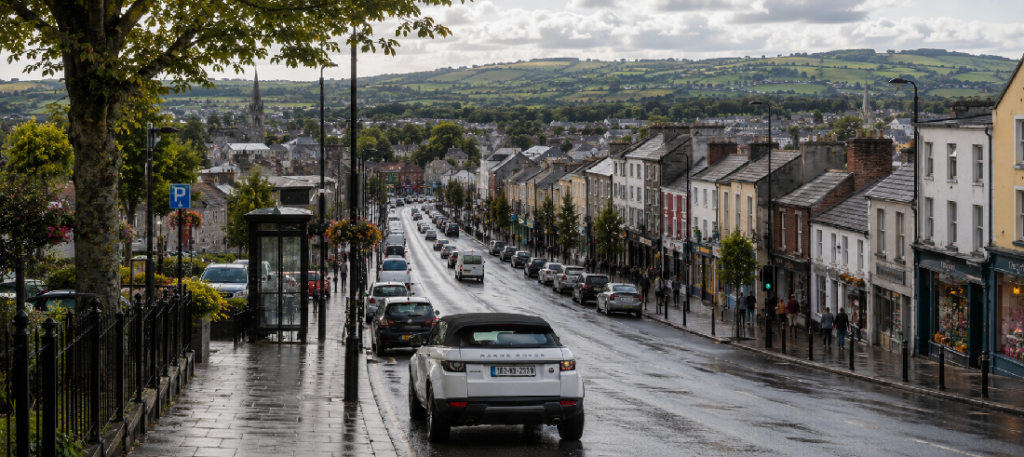
Ireland continues to attract people from around the world: 110,600 immigrants arrived in the State in the year to April 2026, marking the fifth consecutive year in which immigration exceeded 100,000. But another number deserves equal attention: 62,500 people left. Ireland remains a prosperous, English-speaking EU country with a large international workforce and substantial employment opportunities, yet choosing Ireland for a new life involves more than finding a job. Housing, location, transport, cost of living and the type of life available in different parts of the country increasingly determine whether moving to Ireland works in practice.
The latest Population and Migration Estimates from Ireland’s Central Statistics Office, published on 24 August 2026 and subsequently examined by RTÉ, The Irish Times and the Irish Examiner, prompted the Ireland Journal to look beyond the immigration headline. The official figures show that Ireland is still gaining residents through migration, but also reveal substantial movement in the opposite direction.
For someone considering Ireland as a future home, that makes the more useful question not simply “Why are people moving to Ireland?” but “What makes building a sustainable life here possible?”
Ireland is still attracting people – in large numbers
The scale of inward migration remains remarkable for a country of 5.526 million residents.
In the 12 months to April 2026, 110,600 people immigrated to Ireland. They included 30,200 returning Irish citizens, 20,700 citizens of other EU countries, 4,300 UK citizens and more than 55,000 citizens from elsewhere in the world. More than half of immigrants were aged between 25 and 44.
Immigration nevertheless fell by 12% from the previous year. Net migration – immigration minus emigration – declined from 59,700 to 48,100.
That suggests moderation after several years of exceptionally strong population growth, rather than a reversal of Ireland’s international attractiveness.
The employment picture helps explain part of that attraction.
Ireland had 2.839 million people in employment in Q2 2026, 21,200 more than a year earlier. The employment rate among people aged 15–64 was 74.3%, while unemployment stood at 5.1%.
For international professionals, Ireland continues to offer opportunities in sectors including technology, pharmaceuticals, healthcare, financial services, engineering and internationally traded services. The State also continues to operate an employment-permit system for eligible non-EEA workers, with official statistics showing permits issued across multiple sectors and counties.
But employment alone does not explain whether somebody ultimately stays.
The other side of the story: 62,500 people left
Ireland recorded 62,500 emigrants in the same 12-month period.
Their age profile is striking: 32,900 – 53% – were aged 25–44, while another 19,900 were aged 15–24.
Irish citizens themselves recorded net outward migration. About 30,200 Irish citizens returned during the year, while 35,400 departed, producing net outward migration of approximately 5,200 Irish citizens.
These statistics need careful interpretation.
They do not tell us why each person left. The official migration figures cannot demonstrate that housing costs, career decisions, family circumstances or lifestyle preferences caused an individual to emigrate.
But they do provide an important warning against presenting Ireland as a one-directional migration success story.
People continue to arrive in substantial numbers. People – including many Irish citizens – also continue to leave.
Housing may change the relocation calculation
For a prospective resident, one of the clearest practical constraints is housing.
A recent Daft rental-market report found an average market rent of approximately €2,204 per month for a two-bedroom apartment nationally, rising to €2,634 in Dublin. Fewer than 2,400 homes were advertised for rent nationwide at the beginning of August.
But the national number conceals a significant geographical divide.
Rental availability in Dublin was 18% lower than a year earlier, while availability across the rest of Ireland increased by 40%. Even after that improvement, national rental availability remained substantially below pre-pandemic norms.
Buying also produces enormous regional differences.
The latest CSO property data put the national median transaction price at €396,000. Dublin’s median was €500,000, compared with €198,000 in Longford. At Eircode level, the differences were wider still: Blackrock’s A94 area recorded a median of €851,750, compared with €157,000 around Castlerea in County Roscommon.
This is why “How expensive is Ireland?” is often the wrong question.
The better question is where in Ireland can your income, housing requirements and preferred lifestyle realistically coexist?
Dublin is not Ireland – and regional Ireland is not one place
Dublin now contains almost 1.6 million residents, or 28.9% of the State’s population.
For some international residents, Dublin’s concentration of employers, international connections, public transport and professional networks may justify its housing costs.
For others, Cork, Galway, Limerick, Waterford or a smaller regional centre may provide a better balance.
And for people with remote employment, entrepreneurship or retirement income, smaller towns and rural locations can broaden the possibilities considerably.
But lower property prices should never be confused automatically with better value.
A regional home should be assessed alongside access to healthcare, schools where relevant, broadband, public transport, employment, shops, social networks and the practical need for a car.
Remote work has widened the geographical possibilities, but even here the direction is worth watching. The CSO estimates that 990,600 employed people worked from home to some extent in Q2 2026, 22,500 fewer than a year earlier.
Location therefore remains a practical economic decision, not merely a lifestyle choice.
Ireland is increasingly international
For someone arriving from abroad, one important change is sometimes missed by traditional images of Irish life.
Ireland already has an estimated 931,000 non-Irish citizens, representing 16.8% of the resident population.
International communities are therefore not peripheral to modern Ireland. They form a substantial part of its workforce, universities, businesses and everyday society.
Again, however, experience varies geographically.
Living in central Dublin, suburban Cork, Galway, a Midlands town or rural Donegal can produce markedly different experiences of Ireland. Community size, housing, transport, employment and access to services can differ even between neighbouring counties.
That makes local research particularly important before relocation.
So why do people stay – and why do they leave?
There is no official dataset capable of providing a simple answer, and it would be misleading to invent one.
The evidence instead points towards a balance of advantages and constraints.
Ireland offers a sizeable labour market with 2.84 million people employed, an English-speaking environment within the EU, international employers, established immigrant communities and locations ranging from major urban centres to sparsely populated rural regions.
Against that must be weighed housing availability and cost, regional infrastructure, personal taxation and living expenses, transport requirements and access to services.
Recent consumer-price data illustrates the continuing pressure: housing, water, electricity, gas and other fuels were 7.3% more expensive in June 2026 than a year earlier, even though overall consumer-price inflation was 3.4%.
For many prospective residents, therefore, the success of an Irish relocation may depend less on whether Ireland is broadly attractive than on whether the right part of Ireland fits their individual circumstances.
Conclusion: Research the life, not just the country
The latest migration statistics send two messages simultaneously.
Ireland remains sufficiently attractive for more than 110,000 people to move here in a year, and net migration remains strongly positive. Yet 62,500 people also left, including large numbers of working-age residents and more Irish citizens than returned.
Neither figure should determine somebody else’s decision.
For international readers considering Ireland, the sensible next step is therefore not to ask whether Ireland is objectively a “good place to live”. There is no universal answer.
Instead, compare specific locations against five practical requirements: income and employment, housing, everyday infrastructure, access to essential services and the kind of community and lifestyle you actually want.
Only then compare Dublin with Cork, Galway, Limerick, Waterford or individual counties and smaller regional towns.
Ireland can offer an exceptionally attractive future for the right circumstances. But successful relocation depends increasingly on matching expectations to a particular place – and understanding the everyday Ireland that begins after the decision to move has been made.