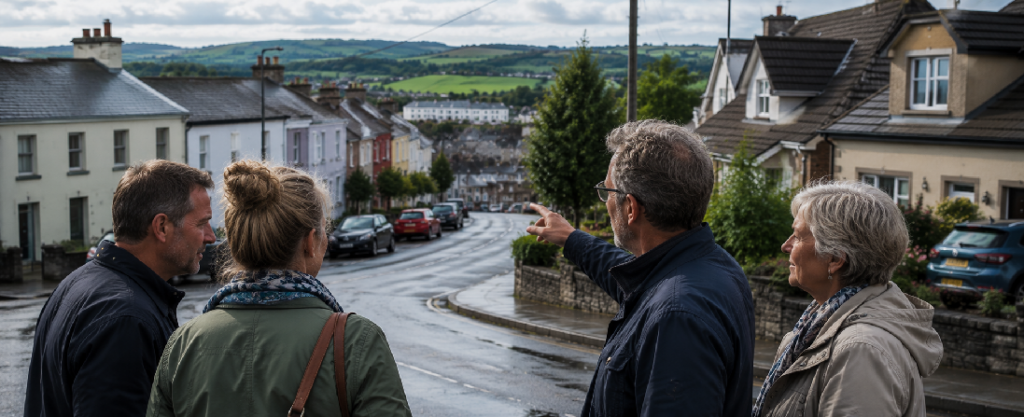
Ireland’s housing problem is not simply that property has become expensive. For many prospective buyers, the more immediate difficulty is finding a suitable property for sale at all. Only 14,388 second-hand homes were advertised nationally in July 2026, according to recent market research – around 0.7% of Ireland’s private housing stock. For international buyers, this scarcity changes the relocation strategy: an attractive house at an affordable price is only the beginning of the investigation. The property, its condition, its location and the infrastructure surrounding it must all work together if it is to become a viable long-term home.
A recent Irish Times report describing Ireland’s second-hand housing market as being under “acute pressure” prompted the Ireland Journal to examine the issue beyond the immediate property-market headline. The Irish Examiner reported the same underlying supply problem, while new Central Statistics Office data provides an independent picture of prices and completed transactions.
The combined evidence reveals something particularly relevant to foreign buyers: Ireland is not one property market. Availability, price, infrastructure and the practicality of everyday life can change dramatically between counties – and sometimes between neighbouring towns.
The shortage is about choice, not only price
In July 2026, just 14,388 second-hand homes were advertised for sale across Ireland. That was 2.2% fewer than a year earlier and 20.6% below July 2020 levels.
The shortage becomes more significant at lower price levels.
Only 5,676 properties below €350,000 were advertised, almost 10% fewer than a year earlier. Below €200,000, availability had fallen 20.6% to just 1,531 properties.
This is important for international buyers searching online from another country. A property portal can create the impression that Ireland offers an enormous range of houses because listings from 26 counties appear on one screen.
The relevant question, however, is how many suitable properties exist within the location, price range and practical requirements of the individual buyer.
Once commuting distance, broadband, healthcare access, property condition, number of bedrooms, energy efficiency and proximity to everyday services are added, the effective choice can become considerably smaller.
Lower prices outside Dublin do not necessarily mean easier buying
The latest official CSO figures illustrate Ireland’s extraordinary geographical price differences.
The median price paid for a residential property during the 12 months to June 2026 was €396,000 nationally and €500,000 in Dublin. Dún Laoghaire-Rathdown reached €682,334, while Longford recorded a median of €198,000.
At Eircode level, the difference was greater still: Blackrock’s A94 area had a median price of €851,750, compared with €157,000 around Castlerea in County Roscommon.
For an overseas buyer, a €200,000–€300,000 regional property can therefore appear remarkably attractive compared with Dublin, London or many other European cities.
But price is only one component of value.
A cheaper house may require greater dependence on a car. A rural property may have a private well or septic tank rather than mains services. An older house can require significant expenditure on heating, insulation, windows, roofing or energy upgrades. Broadband quality, access to GPs and hospitals, schools, shops and public transport also require location-specific investigation.
The Ireland Journal’s analytical conclusion is therefore simple: property affordability and relocation suitability are not the same thing.
Regional supply is becoming especially important
There is another misconception worth challenging: leaving Dublin does not automatically solve the availability problem.
Recent market research found second-hand prices outside Dublin rising faster than in the capital. Sherry FitzGerald recorded annual second-hand price growth of 7.2% outside Dublin compared with 3.5% in Dublin, reflecting particularly constrained regional supply.
By July, advertised second-hand stock in western Ireland had fallen another 9% year-on-year to 1,580 properties. Border counties recorded a 4.5% reduction to 1,283. The Midlands was the exception, with supply increasing by more than 9%.
Official price data points in the same direction. House prices in the Border region – Cavan, Donegal, Leitrim, Monaghan and Sligo – increased 10.5% in the year to June, while the Midlands rose 10%. By comparison, Cork and Kerry recorded 3.7% growth.
This is precisely why foreign buyers should avoid treating “rural Ireland” or “the west of Ireland” as single property markets.
New construction is improving – but it does not immediately solve the problem
There are positive supply indicators.
More than 16,600 new homes were completed during the first half of 2026 according to market analysis, around 10% more than during the corresponding period a year earlier.
More recent government figures showed construction commencing on 3,028 homes in July alone, bringing 2026 commencements through July to 18,974.
The CSO transaction data also shows the growing contribution from new properties. Of 4,058 household purchases filed in June, 1,085 involved new dwellings – 15.8% more than in June 2025. Existing-home purchases, by contrast, fell 3.8%.
These figures indicate improving new supply, but commencements are not completed homes and new developments are not distributed evenly across the country.
A foreign buyer considering relocation now must therefore work with the market that actually exists rather than future national housing targets.
The attractive house is only half of the purchase
This becomes particularly important with Ireland’s detached and rural housing stock.
Online photographs naturally concentrate on the property: the kitchen, garden, fireplaces, bedrooms and views. A successful relocation requires a second investigation focusing almost entirely on what the photographs do not show.
How far is the nearest supermarket? Is a car essential? Where is the nearest GP, pharmacy and hospital? Is reliable broadband available at that exact address? What heating system is installed? Is water supplied privately or publicly? Is wastewater connected to mains drainage or a septic system? What is the BER energy rating? What are the likely maintenance requirements?
For families, schools and daily travel matter. For entrepreneurs and remote workers, connectivity becomes critical. For retirees, healthcare and year-round access may outweigh an impressive view.
And for anyone considering an older Irish property, an independent building survey is particularly important.
These are not arguments against buying regionally. They are arguments for evaluating a regional Irish home as a working piece of everyday infrastructure, not simply as a property.
Renting first is not necessarily the easy alternative
International buyers sometimes assume that they can rent for six or twelve months while searching.
That can be a sensible relocation strategy, but Ireland’s rental shortage makes it something that needs to be planned rather than assumed.
At the beginning of August, fewer than 2,400 rental properties were available nationwide. The average market rent for a two-bedroom apartment was €2,204 per month nationally and €2,634 in Dublin.
There has been improvement outside Dublin: rental availability rose 40% year-on-year across the rest of the country while falling 18% in Dublin. Nevertheless, national availability remains well below the pre-pandemic level of more than 4,300 homes typically available at one time.
A “rent first, buy later” strategy can therefore still be sensible, but temporary accommodation should ideally be researched before the relocation itself.
Conclusion: Search for a place to live, not simply a property to buy
Ireland’s latest housing figures reveal an unusual combination.
Price growth is moderating nationally – annual residential property inflation slowed to 5.6% in June, its lowest rate since January 2024 – while the number of second-hand properties available remains exceptionally constrained.
For international buyers, that means patience and local research may be more valuable than simply expanding a property budget.
The strongest approach is to reverse the usual search process.
First determine the region in which everyday life would actually work. Examine employment or remote-working requirements, healthcare, transport, schools where relevant, broadband, shops and social infrastructure. Then establish the realistic purchase budget, including renovation and running costs. Only after that should individual properties become the focus.
A beautiful Irish house can be found online in minutes.
Finding a house in the right part of Ireland, with the right services, infrastructure and long-term practicality, is the more important task.