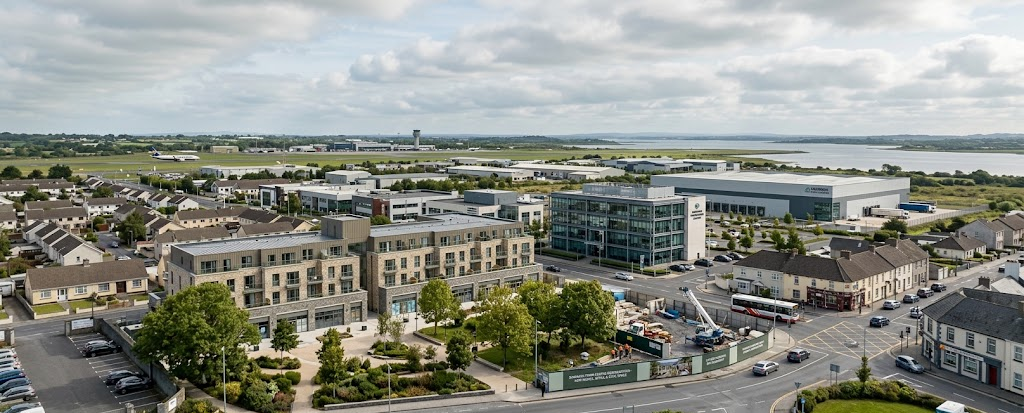
A newly acquired 20-acre site in the centre of Shannon could become much more than another property development. For international companies and investors considering Ireland beyond Dublin, the project highlights an increasingly important question: can a successful business location also become a place where people genuinely want to live?
Shannon has occupied an unusual position in Ireland’s economic history. Built around an international airport and one of the world’s pioneering free trade zones, it became a powerful location for manufacturing, aviation, technology and foreign direct investment long before it developed the characteristics normally associated with an Irish town.
A development announced at the beginning of September 2026 could begin to change that balance.
Shannon Gateway Projects has acquired a strategic 20-acre town-centre site and appointed Dublin-based Grafton Architects to lead a masterplanning process. No final development scheme has yet been announced. The stated objective is broader: to create a long-term vision capable of strengthening Shannon as a place to live, work and spend time.
Shannon Chamber described the investment as potentially transformational.
That announcement prompted Ireland Journal to examine the wider economic question behind the project: what does Shannon now offer an international business looking for an Irish location outside Dublin — and why could the quality of the town itself increasingly matter to that decision?
An Investment Location That Already Exists
The important distinction is that Shannon is not trying to create an economic cluster from nothing.
The wider Mid-West — Clare, Limerick and Tipperary — already contains 153 IDA Ireland client companies employing more than 27,500 people, according to IDA Ireland’s current 2025–2029 strategy.
The regional economy includes advanced manufacturing, engineering, life sciences, technology and research activities. Shannon itself hosts established industrial and technology operations, while the Future Mobility Campus Ireland provides an environment for research into connected and autonomous transport technologies.
Recent investment provides further evidence that the location continues to attract sophisticated businesses. In May 2026, Irish space-technology company Mbryonics announced a second manufacturing facility in Shannon: a 40,000 sq ft operation intended to produce thousands of optical communications terminals by 2027.
International connectivity is another significant advantage.
Shannon Airport recorded more than 2.3 million passengers in 2025, its strongest year in 16 years. Its 2026 network expanded to 40 routes, including connections across Europe, the United Kingdom and the United States.
The latest CSO aviation statistics reinforce that momentum: Shannon handled 728,654 passengers during the second quarter of 2026, 15% more than during the equivalent quarter of 2025.
For businesses serving US and European markets, that connectivity is commercially relevant rather than simply convenient.
The Missing Part of Shannon’s Success
The paradox is that Shannon’s economic infrastructure has historically been stronger than its urban centre.
Census 2022 recorded a population of 10,256 for Shannon. Yet the town developed primarily around employment, airport and housing requirements rather than around the traditional commercial and civic centre found in most comparable Irish towns.
That weakness is explicitly recognised in public planning policy.
Clare County Council’s Shannon Town Centre Masterplan proposes a combination of residential, commercial, retail, educational and civic development. Its ambitions include an improved town square and main street, new town-centre housing, a One Shannon Hub and an innovation campus potentially accommodating 1,000 employees and 1,500 students.
The newly acquired 20-acre site therefore matters partly because it sits within an existing public-policy direction rather than representing an isolated private development.
Shannon Gateway Projects says Grafton Architects’ work will take account of the existing council masterplan and involve consultation with local stakeholders.
At this stage, however, investors should distinguish ambition from delivery. There is not yet a final scheme, confirmed mix of uses, construction timetable or published investment value for the proposed development.
The significance lies in the strategic opportunity rather than in buildings that are guaranteed to appear.
Why Housing and Quality of Life Have Become Business Issues
For international companies, Shannon illustrates a wider change in how locations need to compete.
Corporate location decisions are no longer determined only by corporation tax, industrial property and transport links. Companies competing for specialised employees also need places where those employees can realistically build their lives.
Housing availability, schools, services, public space, restaurants, cultural activity, transport and the quality of the surrounding environment consequently become part of the business infrastructure.
That makes Shannon particularly interesting.
Its employment base and international connectivity are already unusually substantial for a town of approximately 10,000 residents. What it has historically lacked is an urban centre proportionate to that economic role.
If the new project successfully introduces a stronger combination of housing, community facilities, commercial activity and public space, Shannon’s proposition could evolve from a place where companies locate operations into a place where companies can more easily attract and retain people.
That distinction matters.
Ireland Beyond Dublin
Shannon also fits into a much larger Irish economic strategy.
IDA Ireland is explicitly pursuing regional investment alongside continued development of Ireland’s established FDI centres. The Mid-West already has the scale of multinational employment, universities, research infrastructure and transport connections needed to compete for further investment.
Meanwhile, the Shannon Estuary Economic Taskforce has identified additional long-term opportunities around renewable energy, offshore wind, logistics and industrial development. Its strategy envisages the possibility of up to 30GW of Atlantic offshore wind development through the estuary by 2050.
None of that guarantees that Shannon will outperform competing Irish or European locations.
But it creates an unusual combination: an established international industrial base, direct transatlantic connectivity, a growing regional technology and research ecosystem, comparatively small urban scale and significant scope for further physical development.
For an entrepreneur or international company assessing Ireland, that makes Shannon worthy of examination alongside Dublin, Cork, Galway and Limerick rather than merely as an industrial satellite.
What International Investors Should Examine
The lesson is not that every company should move to Shannon.
The more useful conclusion is that location analysis in Ireland should go deeper than headline tax rates or Dublin office availability.
An international investor considering Shannon should examine the relevant skills pool, access to University of Limerick and Technological University of the Shannon, airport connectivity, suitable commercial property, housing supply, recruitment requirements and the development trajectory of the town itself.
The new 20-acre project adds another factor to that assessment: the possibility that Shannon’s physical and civic environment may begin catching up with its economic importance.
Conclusion
Shannon was one of Ireland’s earliest experiments in internationally oriented economic development. Its airport, free-zone heritage and multinational business base helped demonstrate that major international investment did not have to be concentrated in Dublin.
The challenge now is different.
The next generation of successful regional economic development will require more than factories, offices and transport infrastructure. It will require places capable of supporting the lives of the people those businesses need.
The acquisition of 20 acres in Shannon town centre does not by itself achieve that transformation. Planning, financing, consultation and execution still lie ahead.
But the direction is economically important.
For international companies looking at Ireland beyond Dublin, Shannon increasingly presents an interesting proposition: business infrastructure, international connectivity and industrial experience already exist. The next investment cycle may be about building the town around them.