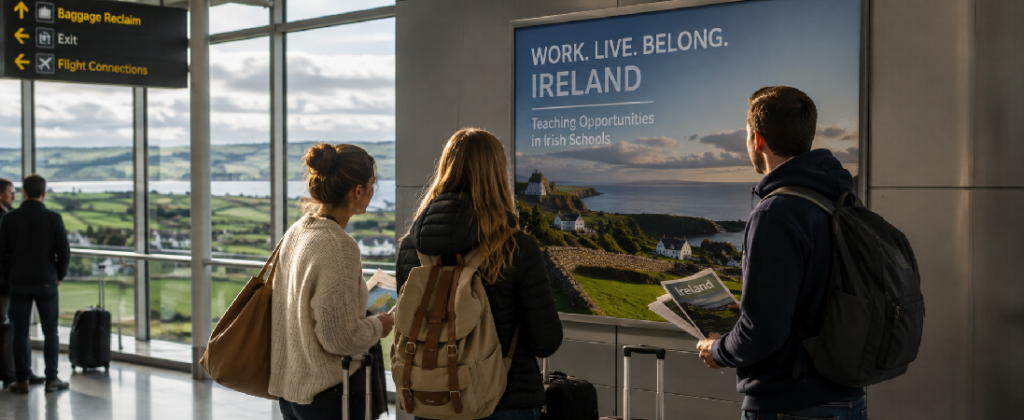
Rural Ireland does not simply face a shortage of teachers. Evidence from education, healthcare, construction and other essential sectors points towards a more complicated challenge: many regional communities need skilled people, but increasingly struggle to attract, accommodate and retain them. For international readers considering where to live, work, invest or establish a business in Ireland, this is an important reality that national economic statistics alone can easily conceal.
A report published by the Irish Farmers Journal on 2 September 2026 provides a striking illustration.
As schools begin the new academic year, the newspaper reports that rural secondary schools are struggling to recruit teachers and, in some cases, are reducing the range of subjects available to students.
The problem is supported by earlier research commissioned by the Association of Secondary Teachers Ireland (ASTI). A RedC survey of school leaders found that 77% of participating second-level schools had received no applications for at least one advertised position during the 2024/25 academic year. Some 67% reported unfilled vacancies because of recruitment difficulties, while 42% had removed one or more subjects from their curriculum.
But Ireland Journal’s examination of the issue suggests that teachers may be one highly visible symptom of something broader.
The question is increasingly not simply whether rural Ireland can create jobs.
It is whether regional Ireland can attract and retain the people required to make communities and local economies function.
Ireland Does Not Have a Simple Jobs Problem
At national level, Ireland’s labour market still appears remarkably strong.
The Central Statistics Office estimated that 2.84 million people were employed in the second quarter of 2026. The labour force was approaching three million, while employment outside Dublin increased by approximately 12,000 over the preceding year.
Those numbers matter. They contradict any simplistic picture of rural and regional Ireland as economically declining while Dublin expands.
But national employment figures cannot show whether the right people are available in the right places.
A teacher vacancy in rural Mayo cannot necessarily be filled by an available worker in Dublin. A GP shortage in Wexford is not resolved by employment growth in Cork. A construction company in Galway cannot build additional housing simply because Ireland’s national employment rate is high.
Labour markets have geography.
And geography becomes particularly important when workers must physically live close to the communities they serve.
Teachers Are the Warning Signal
Education demonstrates the consequences particularly clearly.
Schools cannot relocate mathematics, Irish, science or language classes to Dublin when teachers cannot be recruited locally. Nor can most secondary education be delivered remotely.
The ASTI research found schools responding to shortages by employing casual or non-qualified teachers, reassigning Special Education Needs teachers and removing subjects.
For rural communities, this creates a potentially damaging cycle.
If smaller schools offer fewer subjects, the educational proposition for families becomes weaker. If families become less willing to settle in those communities, maintaining schools and other local services becomes harder.
A shortage of workers can therefore gradually become a problem of regional viability.
Healthcare Shows the Same Geographic Problem
General practice provides another example.
The Irish health system has acknowledged difficulties sustaining GP services in rural areas. The Government introduced a locum-support initiative covering up to 239 GPs in rural and remote locations, while additional medical-training capacity includes a proposed Rural and Remote Graduate Entry Medicine stream at the University of Galway.
Parliamentary discussions in 2026 have also highlighted communities where residents report travelling considerable distances while still struggling to find GP practices accepting new patients.
This distinction is important for outsiders researching Ireland.
A national statistic showing the total number of doctors tells someone considering relocation relatively little about whether a GP is readily accessible in the particular town where they intend to live.
Ireland Needs Workers to Build the Places Workers Need
Construction exposes an uncomfortable circular problem.
Ireland needs considerably more housing and infrastructure. But delivering it requires skilled construction workers.
At a national construction and infrastructure skills roundtable in May 2026, more than 94% of participating construction companies, industry bodies and state agencies said shortages in specific skills were affecting performance. Reported shortages included engineers, surveyors, planners and tradespeople.
The Government has consequently expanded employment-permit eligibility across construction and other shortage sectors.
This produces a fundamental regional-development challenge:
Ireland needs skilled workers to build housing, while housing availability can itself influence whether skilled workers are willing or able to move to an area.
Recruitment cannot therefore be separated entirely from housing policy.
Could Remote Work Solve the Problem?
Remote work has changed rural Ireland — but only partially.
CSO data show that approximately 990,600 people worked from home at least some of the time during the second quarter of 2026. Ireland also now has a national network of more than 400 Connected Hubs supporting remote and hybrid working.
That creates genuine opportunities for regional communities to attract professionals whose employment is no longer tied permanently to a city office.
But there are two important qualifications.
First, working from home has declined from its pandemic peak. The number of people working from home at least occasionally fell by 22,500 year-on-year in Q2 2026.
Second, remote work cannot solve shortages in occupations that require physical presence.
Teachers must enter classrooms. Nurses must work with patients. Builders must reach construction sites. Electricians, plumbers and mechanics cannot perform most of their work through broadband.
Remote work can strengthen regional populations and spending power. It cannot substitute for a functioning local labour market.
The Issue Is Attraction — and Retention
This is where international perceptions of rural Ireland can become misleading.
Tourism marketing understandably emphasises landscape, community, space and quality of life. Those are genuine assets.
But someone deciding whether to relocate to regional Ireland needs a different information set.
Can they find suitable housing? Can their partner find employment? Are schools able to provide the subjects their children need? Is healthcare accessible? Is broadband reliable? How far must they travel for services? Is there a viable local business ecosystem? Can an employer recruit specialised staff?
These questions determine whether an attractive place to visit is also a sustainable place to live and work.
Ireland’s challenge therefore may not be simply persuading more people to move outside Dublin.
It is creating regional communities in which skilled people can realistically build long-term lives.
A National Labour Market With Local Bottlenecks
There is also a danger of describing this as exclusively a “rural crisis”.
Ireland’s housing and recruitment pressures affect cities too. Teacher shortages are not confined to rural schools, healthcare recruitment is a national problem, and employers across Ireland report skills constraints.
The distinctive rural problem is scale and substitutability.
A large urban labour market may have several employers, schools, medical practices and alternative workers within commuting distance. In a small town, the departure of one GP, mathematics teacher, engineer or tradesperson can have a disproportionately large impact.
That makes local intelligence essential.
Conclusion
The teacher shortages highlighted at the beginning of Ireland’s 2026 school year deserve attention in their own right. But viewed alongside shortages in healthcare and construction, they reveal a larger question about Ireland’s regional development model.
Ireland has succeeded remarkably well at creating employment.
The next challenge is ensuring that communities can attract the particular people they need — and give those people sufficient reasons and practical possibilities to remain.
For international readers considering Ireland, the lesson is straightforward: national statistics provide the economic picture, but they do not provide the complete local picture.
Before choosing a region in which to live, establish a business or invest, research should extend beyond property prices and employment figures to schools, healthcare, workforce availability, transport, broadband, housing supply and local services.
Because the future of rural Ireland may ultimately depend less on whether opportunities exist there than on whether enough people can realistically build their lives around them.