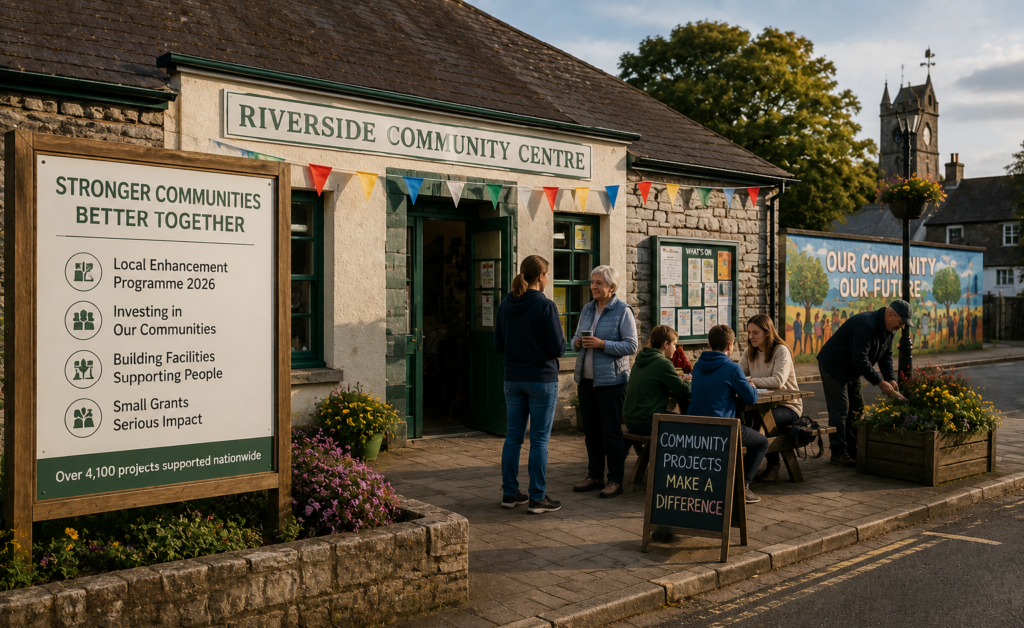
More than 4,100 community projects are receiving support through Ireland’s 2026 Local Enhancement Programme, while additional investment is being directed towards community centres and local facilities. These relatively modest interventions rarely dominate national headlines, but they can determine whether a town or village retains meeting spaces, youth activities, social services and the local networks that allow communities to respond to change.
National policy is often discussed through very large numbers. Billions for infrastructure. Thousands of houses. National targets extending to 2030.
Local life is frequently shaped by much smaller sums.
A repaired roof over a community hall, accessible toilets in a sports club, new kitchen equipment in a parish centre or improved heating in a men’s shed may not appear economically significant. Yet these facilities are often the physical infrastructure of community life.
Ireland’s Local Enhancement Programme for 2026 is supporting more than 4,100 projects around the country. Separate community-centre funding is providing opportunities for organisations to refurbish and modernise existing buildings.
The importance of these investments is easiest to understand at local level. In a small town, the community centre may host exercise classes for older residents in the morning, childcare activities in the afternoon and a public meeting in the evening. It may become an emergency coordination point during storms or power interruptions. It can provide a venue for new residents to meet established communities.
These buildings are also part of local economic development. A well-managed centre can host training, remote-working sessions, markets, exhibitions and small business events. In places without extensive commercial facilities, it may be the only flexible indoor space available.
Digital connectivity is expanding what such locations can provide. The National Broadband Plan is expected to reach hundreds of thousands of rural premises, and remote communities such as Inishturk Island are now gaining access to high-speed fibre. Broadband Connection Points have already demonstrated how shared digital infrastructure can support work, education, emergency communication and community services.
But connectivity alone does not create community. Fibre arriving at the edge of a village is valuable only when people possess the skills, spaces and confidence to use it.
This is why local facilities matter. They provide the human interface between national programmes and everyday life. A digital training course delivered in a familiar hall may reach residents who would never enrol through an anonymous online platform.
There is also a wider lesson for international investors, researchers and relocation clients. The quality of a location cannot be measured solely by property prices or distance from an airport. The strength of local organisations, voluntary activity and shared facilities often reveals more about whether a community is capable of adapting.
Ireland’s local resilience is built through networks that remain largely invisible until they are needed. Community centres, development groups, sports clubs and local volunteers form part of the country’s social infrastructure.
The grants supporting them may be small in comparison with national capital programmes. Their impact, however, can be measured in something much larger: whether a place continues to function as a community rather than merely existing as a collection of houses.