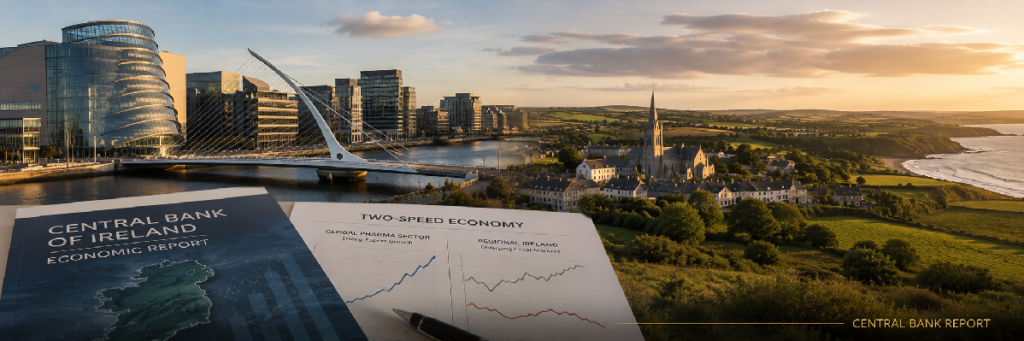
Two-Speed Market and Pharma Shield: The New Central Bank Report on Ireland’s Economic Immunity. While global economies struggle under regulatory uncertainty, the latest Irish Central Bank report paints a fascinating picture: Ireland is economically two worlds, increasingly diverging.
One world is the global, pharma-dominated export machine. The other is local, regional Ireland with its housing markets, local service providers, and consumers. This divergence creates new investment opportunities. A central phenomenon of our time is carbon leakage, when companies relocate production and investments from countries with strict climate regulations to regions with lower standards.
This hits Europe hard, especially Germany. But Ireland? Practically immune. Why? Because the Irish state hosts the world’s highest density of pharmaceutical megacorps including Pfizer, Janssen, AbbVie, Eli Lilly, Novartis, and many more. These companies aren’t in Ireland for tax reasons, those aren’t attractive anymore, but because of decades of built-up supply chains, high-skill talent pools, and regulatory network effects with the EMA (European Medicines Agency). This means even if the West tightens climate regulations, pharma giants won’t leave Ireland because they’re too embedded. This protects Ireland’s economy from one of the next decade’s biggest risks. Simultaneously, Central Bank data reveals a paradoxical housing market pattern.
In major cities like Dublin and Cork, prices are falling by two to five percent quarterly with new supply waves pressuring prices, overheating narratives cooling down, and real supply-demand equilibrium emerging. In rural and regional areas like Wexford, Galway, Mayo, and Offaly, prices are rising continuously at three to seven percent annually with second-hand inventory extremely tight, new infrastructure projects like HIIF driving demand, and a population reversal with remote workers fleeing cities back to countryside.
The Central Bank report suggests the classic urban-premium play no longer works. The new playbook looks different. For regional property ballast strategy, you buy in emerging regions like Wexford, Galway, and Limerick with solid infrastructure, hold for five or more years, benefit from sustained demand and scarcity, and with HIIF investments can expect ten to twenty percent price appreciation in 36 months. For pharma exposure strategy, you pursue Ireland pharma ETFs or direct positions in Irish pharma supply-chain companies that are inflation-resistant and benefit from geopolitical uncertainty.
With aging European populations, pharma is a megatrend. The Central Bank report shows Ireland comprises two separate economies: the global pharma machine that is immune to Western stress, and the regional real estate play with enormous growth potential. Invest only in Dublin and you lose. Combine regional real estate opportunities with pharma exposure and you’ve placed an asymmetric bet that wins.