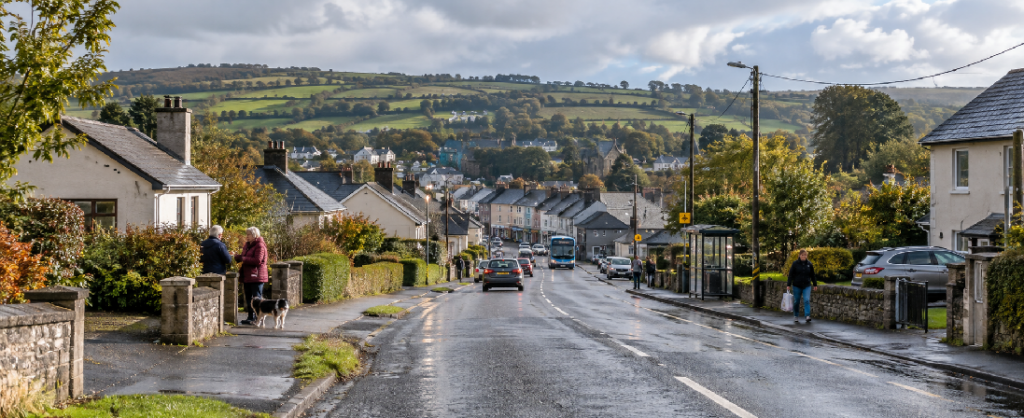
Drive out of an Irish regional town and the transition can happen remarkably quickly.
The shopfronts thin out. Streetlights disappear. Houses no longer form continuous streets but sit individually behind hedges and stone walls. Five minutes later there may be fields on both sides of the road — and yet another detached house appears around the next bend, followed by another.
To an international visitor, this can look like isolation.
To many Irish people, it looks like home.
That difference helps explain an unusually strong finding published this week: 67% of rural adults strongly support moves to loosen restrictions on one-off rural housing. The issue is about far more than planning permission. It reveals something fundamental about how rural Ireland actually works — and why understanding an Irish location requires more than measuring its distance from the nearest town.
What You Notice First
Visitors accustomed to continental European settlement patterns can be surprised by how dispersed Irish rural housing is.
Instead of moving neatly from town to village to open countryside, parts of Ireland contain homes scattered along minor roads, around farms and across generations of family land.
Current government policy still reflects the tension this creates. Existing rural housing guidance supports people who are intrinsically part of rural communities through economic or social need, while generally directing demand around cities and towns towards urban centres. In areas suffering population decline, the approach is more permissive.
The Government now intends to make that system more consistent and less restrictive. Ministers argue that existing rules have been applied differently between local authorities — what they have described as an “Eircode lottery”. The planned reforms are expected to go formally before Cabinet in early 2027 after environmental assessment.
The public response in rural Ireland is striking.
Support in the Irish Examiner/Ipsos B&A Rural Ireland Thinks survey was particularly strong among both younger and older respondents: 82% approval among 16–24-year-olds and 90% among those aged 65 and over.
What It Actually Tells Us
This is not simply an Irish debate about where houses should be built.
It is also about how people understand belonging.
Housing policy often treats settlement as a planning problem: concentrate homes, infrastructure and services where they can be provided efficiently.
Rural families may see the same landscape differently. A house beside family land can mean remaining near ageing parents, supporting a local school, participating in community organisations or allowing the next generation to remain in the area.
That explains why one-off housing can remain politically and emotionally important even when planners raise legitimate concerns about infrastructure, car dependence, public services, climate policy and rural sprawl. Critics of the proposed changes argue that dispersed housing creates costs extending well beyond the individual household.
Both sides are therefore discussing more than houses.
They are discussing what keeps a rural community alive.
The Often-Overlooked Point
For someone outside Ireland, however, there is another lesson:
In rural Ireland, distance is not the same thing as access.
Suppose two houses are both advertised as being “10 minutes from town”.
One sits close to a reliable regional road, has fibre broadband available, a Local Link bus nearby, neighbours within walking distance and straightforward access to shops and healthcare.
The other is reached by narrow local roads, has no useful public transport connection and requires driving for almost every practical need.
On a property map, they can appear almost identical.
As places to live, they are not.
This is why the standard international method of evaluating rural property — house, price, acreage, kilometres to town — can miss much of what actually determines everyday life.
Why This Matters If You Do Not Live Here
Ireland’s broadband transformation demonstrates the point.
The National Broadband Plan is approaching completion of its main infrastructure build. By late August, more than 510,000 premises had been passed by the NBI network and almost 188,000 were connected. By mid-September, 59,137 farms in the rollout area had access to high-speed fibre, with 26,247 already connected.
That has changed what “remote” can mean.
A farmhouse several kilometres outside a small town may now support video conferencing, an online business or remote professional work remarkably well.
But fibre availability does not eliminate geographical reality.
You cannot download a GP appointment. A child cannot travel to school through broadband. Fibre does not take an elderly resident to hospital, collect groceries or get somebody to a railway station.
Digital connectivity has made rural Ireland more viable. It has not made location irrelevant.
The Practical Reality
Public transport is changing too.
TFI Local Link operates throughout rural Ireland, connecting towns and villages and feeding into Bus Éireann, commercial bus and rail services. New and enhanced routes continue to be introduced under the Connecting Ireland Rural Mobility Plan.
But this is precisely where outsiders need to look beyond the words “public transport available.”
A route may exist without matching the times at which you need to work, shop, attend appointments or reach a railway station. Some rural households can function comfortably with one car; others effectively require two.
The same principle applies to services.
A small town that retains a supermarket, pharmacy, GP, café, hardware shop, school and active community organisations can provide a surprisingly self-contained life.
Another place of similar population and appearance may require frequent journeys elsewhere.
Ireland’s national planning strategy explicitly recognises the importance of strengthening towns and villages through regeneration, services and transport rather than viewing rural development solely as isolated housing.
This creates one of the less obvious realities of rural Ireland:
A small town with strong connections can feel less remote than a beautiful house much closer to a larger town but poorly connected to it.
One Thing to Check Before You Come
If you are considering visiting, buying or eventually living in rural Ireland, do one unusually simple exercise before booking anything.
Choose the exact Eircode or location you are interested in and imagine it is Tuesday in February, not Saturday in July.
Then ask:
Without assuming that I can simply jump into a car every time, how would I get from this house to the five places I would actually need in an ordinary week?
Check the supermarket.
Check the GP or medical centre.
Check your workplace or broadband connection.
Check the nearest useful public transport connection.
Check the place where you would actually meet other people.
That exercise will tell you considerably more about rural Ireland than calculating kilometres to Dublin.
Conclusion: The Space Between the Houses
Ireland’s debate about one-off rural housing is ultimately revealing something larger than a dispute over planning regulations.
Rural Ireland has never simply been empty countryside between towns.
People live in that space. Families remain connected to it. Fibre networks now run through parts of it. Buses increasingly connect it. Communities depend upon people continuing to inhabit it.
But that does not make every rural location equally practical.
The Ireland beyond Dublin can offer space, landscape, community and a quality of everyday life that is difficult to understand from abroad.
It can also create car dependence, longer journeys and surprisingly important differences between locations only a few kilometres apart.
That is the detail a guidebook rarely captures.
In rural Ireland, the important question is often not how far away something is. It is how easily you can actually reach it.