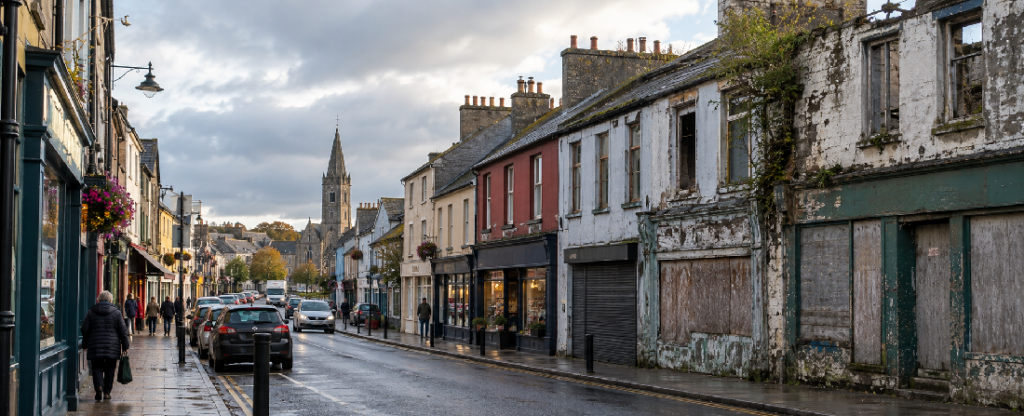
Ireland is experiencing a severe housing shortage, a growing population and one of Europe’s most internationally connected economies. Yet walk through the centre of many Irish towns and another Ireland appears: shuttered shops, empty upper floors, boarded houses and buildings that have been deteriorating for years. This is not simply a story of decline. It is one of the most revealing contradictions in modern Ireland – and something international visitors, future residents and investors rarely understand until they actually spend time on the ground.
A recent Irish Times series investigating dereliction in towns including Bray, Mallow, Ballaghaderreen and Ballybofey provided the starting point for further independent Ireland Journal research. The national and regional data reveal that what is visible on these streets is not anecdotal: vacancy remains deeply embedded in parts of Ireland, but its distribution – and the reasons behind it – are far more complicated than appearances suggest.
Ireland’s housing shortage exists alongside thousands of empty properties
The contradiction begins with the numbers.
GeoDirectory recorded 81,373 vacant residential units in Ireland in the second quarter of 2026, together with 19,137 properties classified as derelict.
At the same time, Ireland is struggling to produce enough homes for a population that has now exceeded 5.5 million.
This does not mean that Ireland has 81,373 homes ready to solve its housing shortage.
Some vacant properties are undergoing renovation or changing ownership. Others may be tied up in inheritance, legal or planning issues. Many derelict buildings require substantial investment before they could be safely occupied. And crucially, an empty property in a location with weak housing demand does not automatically solve a shortage in Dublin, Cork or Galway.
Nevertheless, the coexistence of housing scarcity and large-scale vacancy is one of the realities international observers need to understand.
The regional differences are enormous
Vacancy is not evenly distributed across Ireland.
In June 2026, Dublin had a residential vacancy rate of only 1.4%. Kildare stood at 1.6%, Waterford at 2.2%, while Meath and Wicklow were both at 2.4%.
Travel west and north-west and the picture changes dramatically.
Leitrim recorded 11.5%, Mayo 10.3%, Roscommon 9.9%, Donegal 8.9% and Sligo 8.3%.
This helps explain why the physical appearance of Ireland can change considerably between regions.
A visitor who knows Dublin, prosperous commuter towns or rapidly growing parts of Cork may encounter a completely different environment in a western or north-western town where population, investment, property demand and commercial activity have followed different trajectories.
Neither represents the whole country.
It is happening on Main Street too
Commercial vacancy adds another dimension.
GeoDirectory’s latest Commercial Buildings Report identified 30,611 vacant commercial units across Ireland in June 2026, representing 14.5% of the national commercial building stock.
There is some encouraging news: this was the first year-on-year reduction in the national commercial vacancy rate since GeoDirectory began reporting the data in 2013.
But again, the national average hides extraordinary differences.
Donegal had a commercial vacancy rate of 20.7%, Sligo 20.2% and Galway 18.6%. Meath, by contrast, recorded 9.9%.
Among individual towns examined by GeoDirectory, Shannon in County Clare reached 34.9%, while Carrigaline in County Cork was just 5.1%.
These numbers help explain something easily observed when travelling through Ireland: two towns of comparable size can feel remarkably different.
Bray shows that prosperity alone does not prevent vacancy
Bray is particularly revealing because it cannot easily be explained as a remote town suffering from economic isolation.
County Wicklow’s largest town has around 34,000 residents, a coastal location, rail connections to Dublin and proximity to one of Ireland’s strongest employment regions.
Yet an August investigation by The Irish Times documented significant vacancy and neglect around its traditional centre.
The contrast within Bray itself is striking. Its seafront can feel busy and prosperous while parts of Main Street contain long-vacant premises.
The reported commercial vacancy rate in Bray was 15.2%, compared with only 5.3% in nearby Greystones.
That comparison illustrates an important feature of everyday Ireland: regional analysis sometimes needs to operate at town level rather than county level.
Two places separated by a relatively short drive can have different housing markets, commercial centres and levels of visible investment.
Mallow demonstrates another side of the problem
Mallow in County Cork presents a different case.
It is a substantial regional town with rail connections and reasonable access to Cork city. Yet visible dereliction has affected parts of its centre for years.
The former Central Hotel became an especially prominent example. Once an important social building in the town, it closed in 2007, deteriorated and was ultimately demolished after becoming unsafe.
The issue is not that Mallow has ceased functioning. Shops operate, people work, trains arrive, houses are occupied and ordinary community life continues.
That is precisely what makes dereliction so noticeable.
A functioning Irish town can contain a busy business beside a shuttered building, an attractive residential street around the corner from a deteriorating property and a modern supermarket only minutes from an old commercial street struggling for footfall.
This mixed reality rarely appears in tourism photography.
Why did Irish town centres change?
There is no single explanation.
Traditional Irish towns developed around compact commercial streets containing shops, banks, pubs, professional services and homes above businesses.
Modern patterns of life gradually altered that structure.
Large supermarkets and retail parks developed on town edges. Banking moved online. Car ownership changed where people shopped. Family businesses closed when owners retired. New housing estates expanded outward. Some upper floors became difficult or uneconomic to adapt to modern residential standards.
Ownership can also be complicated, particularly where buildings pass through generations or multiple parties.
The result can be a growing town whose historic centre simultaneously becomes weaker.
Ireland is now trying to reverse the process
There are increasingly significant attempts to bring empty buildings back into use.
The government’s Vacant Property Refurbishment Grant currently provides up to €50,000 towards qualifying vacant properties, with a further €20,000 derelict-property top-up potentially bringing support to €70,000.
In April 2026, the scheme was expanded further to encourage the conversion of vacant commercial buildings and unused spaces above shops into housing. Government figures stated that the programme had already helped return approximately 5,200 vacant or derelict homes to use since its launch in 2022.
That is important because the solution to Ireland’s housing problem does not necessarily lie only on greenfield construction sites.
Some potential homes are already standing in Irish towns.
The difficult part is making them usable again.
What you notice when you actually walk through Ireland
There is a final distinction between data and observation.
Walking through an Irish regional town after rain, you may pass an immaculate independent café, two occupied houses, a shuttered shop, an empty upper floor, a pharmacy, an abandoned building and a construction project – all within a few hundred metres.
The street may look quiet at 10am and busy at 4pm.
A town that initially appears tired may contain strong schools, active sports clubs, good broadband and a deeply established community. Another that looks attractive during a brief visit may have poor transport connections or limited essential services.
These are local observations rather than statistical conclusions.
But they explain why understanding Ireland requires looking beyond national rankings – and beyond appearances.
Conclusion
Empty and derelict buildings reveal an Ireland that international visitors rarely see, but they do not tell a simple story of national decline.
Ireland is simultaneously experiencing population growth, housing shortages, new construction, international investment and substantial economic activity while trying to deal with buildings and town centres shaped by decades of changing demographics, ownership and shopping patterns.
Some places are regenerating faster than others. Some have strong economies but weak Main Streets. Others contain inexpensive vacant buildings but lack the demand or infrastructure needed to restore them easily.
For visitors, entrepreneurs and people considering a future in Ireland, this local reality matters.
Do not judge an Irish town solely by its prettiest street – but do not judge it solely by its emptiest building either.
Walk through the centre. Look above the shopfronts. Visit the surrounding residential streets. See where people shop, work and meet. Look at what is being renovated as carefully as what has been abandoned.
That is where the Ireland beyond the guidebooks begins.