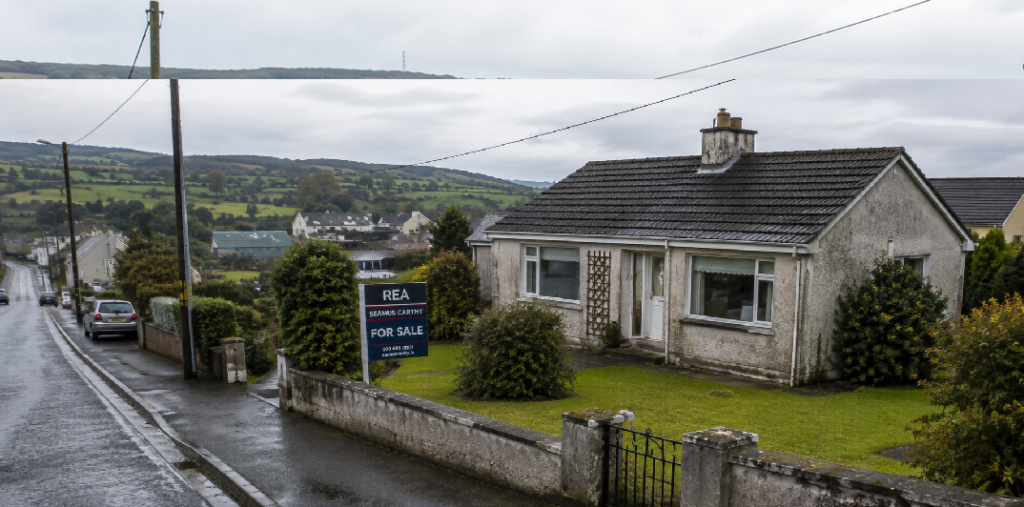
For international buyers looking at Ireland, the photographs can be irresistible: a detached house, a generous garden, green countryside and an asking price that appears remarkably low compared with Dublin, London, Paris or many other European markets. In 2026, genuinely inexpensive homes can still be found in parts of rural Ireland. But the purchase price is only the beginning. A €150,000 house can be a very different proposition once renovation, energy performance, water and wastewater systems, legal checks, transport, broadband and access to everyday services are considered.
The question therefore is no longer simply: Can you still buy a cheap house in Ireland?
It is: Can you buy a cheap house that remains affordable after purchase — and that works as a place to live?
Why We Investigated the “Cheap Irish Home”
A recent Irish Examiner feature with architect and Cheap Irish Homes presenter Tadhg Casey provided the starting point for this research. Casey’s work is particularly relevant because it draws attention not simply to houses, but to the relationship between buildings, communities and their surrounding landscape.
For international buyers, however, that idea deserves to be taken one step further.
Ireland still has an extraordinary geographical price divide.
The latest Central Statistics Office Residential Property Price Index, published on 19 August 2026, puts the national median transaction price for the 12 months to June at €396,000. Dublin’s median was €500,000.
Yet the cheapest Eircode area in the country was F45 Castlerea, County Roscommon, at just €157,000. Clones in County Monaghan stood at €176,000 and Lifford in County Donegal at €177,500.
Those differences are real.
But so is the pressure on rural prices. Residential property prices outside Dublin increased by 6.4% year-on-year, while house prices in the Border region — Cavan, Donegal, Leitrim, Monaghan and Sligo — rose by 10.5%.
Cheap Ireland still exists. It is simply becoming harder to find.
Purchase Price Is Not the Cost of the House
For a foreign buyer, one of the most dangerous calculations is also the simplest:
Asking price + legal fees = cost of property.
For an older rural house, a more realistic calculation is:
Purchase price + acquisition costs + immediate repairs + structural contingency + energy upgrades + water/wastewater works + adaptation to modern living = effective acquisition cost.
Stamp duty on a normal residential purchase is currently 1% up to €1 million. Buyers also need a solicitor, and an older property should normally be independently surveyed rather than relying on appearance or the sales particulars.
Planning history matters too. Extensions, garages, conversions and other alterations should be checked to establish whether required permissions were obtained and whether the property being purchased corresponds with its legal and planning position.
The attractive kitchen in an online listing tells you very little about the condition of the roof, wiring, plumbing, heating system or drainage.
BER: The Letter That Can Change the Economics
Ireland’s Building Energy Rating, or BER, should be treated as more than another line in a property advertisement.
A valid BER is generally required when a property is sold or rented, and it gives buyers an indication of its energy performance. Older rural houses can require substantial investment in insulation, windows, heating systems and other improvements to reach modern standards of comfort and efficiency.
SEAI operates grants for individual improvements as well as complete home energy upgrades. A full One Stop Shop upgrade aims to bring qualifying homes to at least a B energy rating.
That can transform an older house — but the buyer should investigate the likely works and grant eligibility before assuming that a low-rated property is automatically a bargain.
Water and Septic Tanks: The Rural Due-Diligence Problem
Outside towns and villages, buyers may encounter private wells and private wastewater systems rather than public services.
This is not a minor technical detail.
The Environmental Protection Agency says Ireland has nearly half a million domestic wastewater treatment systems, mostly septic tanks. Its latest inspection results are striking: 59% of the 1,466 systems inspected in targeted high-risk areas during 2025 failed inspection.
That does not mean 59% of all Irish septic tanks are defective — inspections target higher-risk locations — but it demonstrates why buyers should establish exactly what system serves a property, where it is located, how it has been maintained and whether there are known problems.
The same principle applies to water.
A tap producing water during a viewing does not establish adequate pressure, reliable supply or water quality.
The €50,000–€70,000 Opportunity — With Conditions
Ireland’s Vacant Property Refurbishment Grant makes some older properties considerably more interesting.
A qualifying vacant property can receive support of up to €50,000, rising to €70,000 where the property qualifies as derelict.
The scheme applies in rural areas as well as towns and cities. However, eligibility conditions matter: among other requirements, the property must generally have been vacant for at least two years and built before 2008.
For international buyers, the important lesson is simple: never include a grant in your financial calculation until eligibility has been verified.
A €100,000 renovation does not become a €30,000 renovation merely because a €70,000 maximum grant exists.
Broadband Has Changed Rural Ireland — But Check the Eircode
One major argument against rural relocation has weakened considerably.
Ireland’s National Broadband Plan is approaching the completion of its principal fibre build. By 24 August, National Broadband Ireland reported that more than 510,000 rural homes, farms and businesses had been passed by its fibre infrastructure and more than 186,000 were connected.
The network’s main build is intended ultimately to make high-speed broadband available to around 566,000 premises.
For remote workers and internationally active business owners, this can fundamentally change where living in Ireland is practical.
But availability must still be checked at the specific property, not assumed because fibre exists somewhere in the county.
The Bigger Question: Can You Actually Live There?
This may be the most important part of rural property research.
A beautiful detached house costing €170,000 can be poor value if every essential journey requires a car and the nearest supermarket, GP, pharmacy, school or railway station is inconveniently distant.
Conversely, a €220,000 house in or immediately outside a functioning regional town may offer much better long-term value.
Ireland’s TFI Local Link network has substantially improved rural mobility, with regular routes connecting towns and villages and some door-to-door services. But frequency varies considerably by location.
That means international buyers should research the life radius around a property:
How long does it actually take to reach groceries, healthcare, schools, banking, restaurants, an airport, a railway station and a larger town?
And what happens when driving is temporarily impossible?
Supply Is Still a Structural Problem
Cheap rural homes also exist within a national housing market that remains undersupplied.
The CSO recorded 8,823 new dwelling completions in Q2 2026, 3.6% fewer than a year earlier. More revealingly, almost 95% of new scheme houses were built in cities, satellite towns or independent urban towns.
Rural Ireland therefore cannot simply rely on large volumes of new development to replace its ageing housing stock.
That helps explain why restoring existing homes is economically and socially important — but also why a properly renovated older property in a functioning community may retain considerably more appeal than an isolated house chosen principally because it was cheap.
Conclusion: Buy the Location and the Infrastructure, Not Just the House
Yes, cheap houses still exist in Ireland in 2026.
In places such as Roscommon, Longford, Donegal, Leitrim, Monaghan and other parts of the Midlands, West and Border regions, prices can remain dramatically below Dublin and Ireland’s strongest commuter markets.
But international buyers should stop asking whether they can afford the asking price.
The better question is:
What will this property cost when it is safe, warm, legally sound, properly connected and comfortable enough to become my home?
A €150,000 house requiring €100,000 of work in an isolated location may ultimately be more expensive — financially and practically — than a €230,000 property requiring little intervention in a well-connected town.
For anyone planning a permanent move to Ireland, the best rural property is therefore not necessarily the cheapest house.
It is the property where purchase price, renovation risk, infrastructure and everyday life work together.
That is the difference between finding a cheap Irish house and finding an affordable home in Ireland.