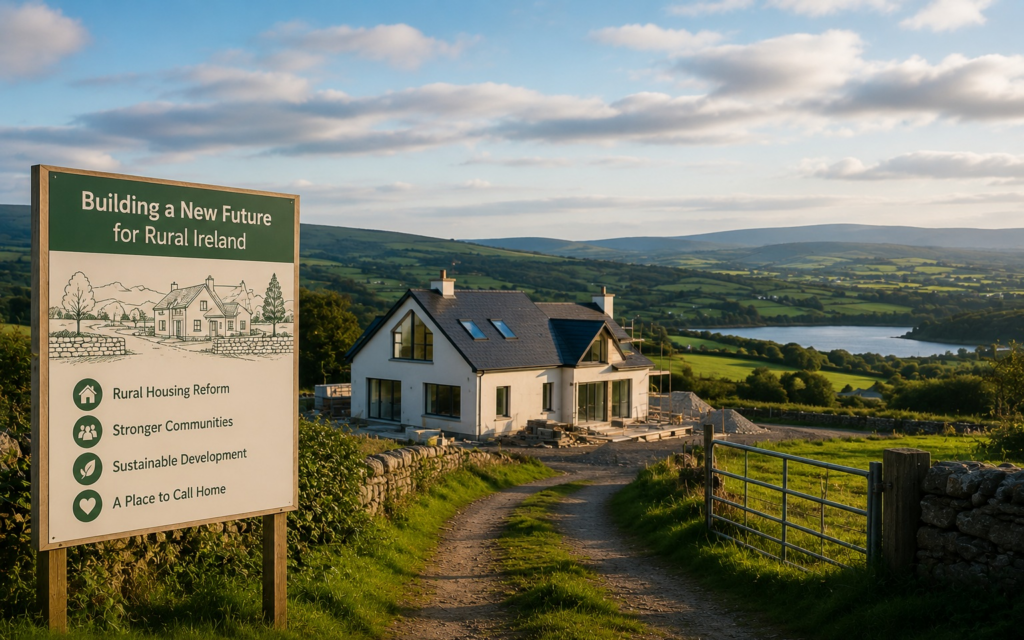
Ireland’s proposed rural planning reforms could make it substantially easier for people with genuine social or economic connections to a locality—including returning emigrants—to build homes in the countryside. Restrictions involving ribbon development, backland construction and narrowly defined local need are expected to be relaxed. The changes may unlock new housing opportunities, but anyone considering a rural property must still investigate planning, wastewater, water supply, access and long-term running costs carefully.
For years, one of the great contradictions of rural Ireland has been visible along almost every regional road. Villages lose population, farmhouses stand empty and younger residents struggle to find homes—yet obtaining permission to build in the countryside can be extraordinarily difficult.
The Government’s new direction on rural housing may alter that balance.
The proposed National Planning Statement is intended to provide greater consistency between local authorities and relax several restrictions applied to one-off rural homes. People able to demonstrate a genuine economic or social connection to an area—including some returning emigrants—could find it easier to obtain permission. The definition of local need is expected to become less dependent on farming or a narrowly defined occupation.
The reforms may also limit refusals based solely on ribbon development or backland development. Government estimates reported in June suggested that the number of one-off homes, currently averaging around 5,000 annually, might increase by as much as 50 per cent.
For relocation clients, this creates possibilities. A person returning from abroad may be able to build near family. A remote-working household may consider a location previously regarded as impractical. Owners of suitable land may discover new development potential.
However, easier planning must not be confused with simple development.
Rural sites require detailed examination. A satisfactory house design is only one element. Buyers must determine whether the land can support an approved wastewater treatment system, whether a reliable water supply exists, whether road access is safe and whether broadband and mobile connectivity meet modern working needs.
Construction costs can also be deceptive. A rural site may appear inexpensive, but groundworks, drainage, electricity connections, wells, landscaping and access roads can add substantially to the final cost.
There are legitimate planning concerns too. Poorly controlled ribbon development can increase car dependency, weaken village centres and place additional pressure on public services. Environmental groups and planners have warned that dispersed development may conflict with climate and sustainable-planning objectives. Concerns have also been raised about whether revised rules will provide adequate protection for Irish-speaking communities in Gaeltacht areas.
The best outcome would not be an unrestricted wave of roadside building. It would be a more intelligent rural housing system—one that allows people with real connections to a place to establish homes while encouraging the reuse of vacant properties, supporting village life and protecting sensitive landscapes.
For purchasers and returning emigrants, the reforms may open doors that have remained closed for decades. But every site must still be assessed individually.
In rural Ireland, the view from the gate may be beautiful. The real value of the property depends on what lies beneath the ground, behind the planning history and beyond the nearest road.