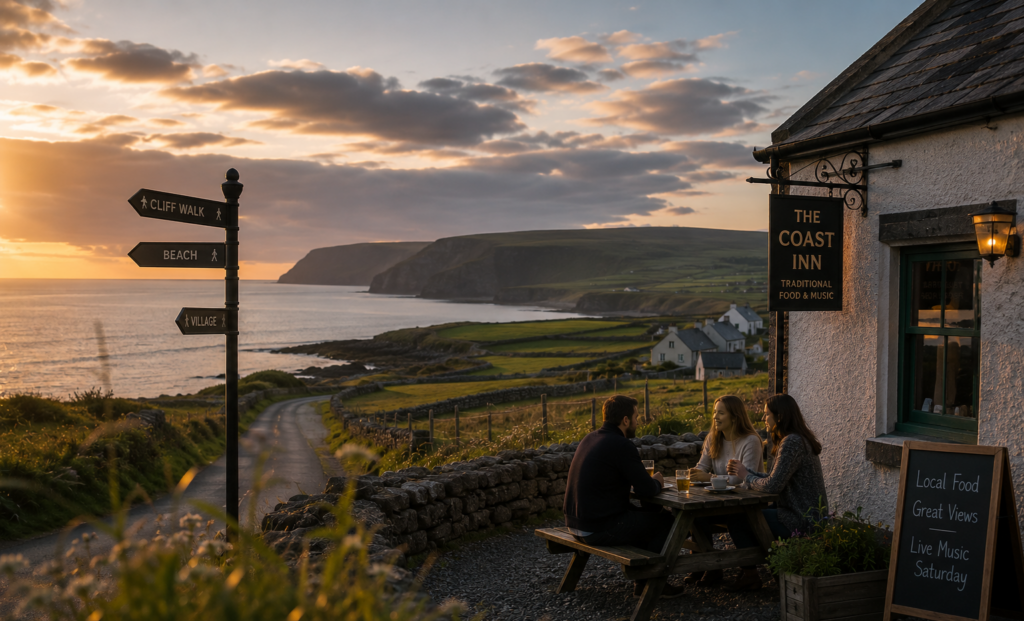
Ireland is experiencing exceptionally strong growth in visitor nights, with international stays and domestic tourism both rising sharply. The recovery is welcome for rural hotels, restaurants and attractions, but it is also changing the atmosphere of places once defined by their quietness. The challenge is to welcome more people without turning Ireland’s landscapes and communities into products stripped of the character that attracted visitors in the first place.
There is a particular moment on an Irish road when the landscape seems to withdraw from the modern world.
The hedges rise. The phone signal disappears. A stone wall follows the curve of a field, and somewhere beyond it the Atlantic is moving under a sky that cannot decide whether it is morning or evening.
For generations, this sense of distance has been part of Ireland’s appeal. Now more people are searching for it.
Recent tourism data show a dramatic rise in nights spent in Irish accommodation. International visitor nights increased strongly, while domestic stays also recorded substantial growth. Ireland has been identified as one of Europe’s fastest-growing tourism destinations, supported by renewed air access, business travel and demand for year-round experiences.
For rural Ireland, the increase can be transformative. A small hotel that once depended on a few summer weeks may extend its season. A café can retain staff for longer. Heritage attractions, walking guides, craft producers and local restaurants all benefit when visitors spend time rather than simply pass through.
But popularity changes a place.
A coastal village cannot absorb unlimited traffic without losing some of its rhythm. A narrow walking trail cannot become a mass attraction without erosion. A community cannot function properly if too many ordinary homes are removed from long-term use and converted into short-stay accommodation.
This does not mean Ireland should resist tourism. It means the country must become more thoughtful about the kind of tourism it encourages.
The visitor who stays several nights, eats locally, visits smaller attractions and travels outside peak season contributes differently from the person who arrives briefly, takes a photograph and leaves behind little except congestion. Ireland’s future tourism strategy should reward depth rather than volume.
There is also an opportunity to introduce visitors to landscapes beyond the familiar routes. The Midlands, inland Connacht, the lakelands, the Blackwater Valley and less-promoted parts of the southeast possess their own atmosphere. They do not need to imitate the Cliffs of Moher or the Ring of Kerry. Their value lies precisely in being different.
Sustainable tourism is sometimes presented as an environmental restriction. In reality, it is a form of cultural protection. It preserves the silence beside a ruined church, the unhurried conversation in a village shop and the ability to encounter Ireland as a living country rather than a staged backdrop.
Tourism can help maintain the places people travel to see. But only when the economy of visiting strengthens the community being visited.
Ireland’s atmosphere has survived centuries of change. The responsibility now is to ensure that success does not make the country less itself.