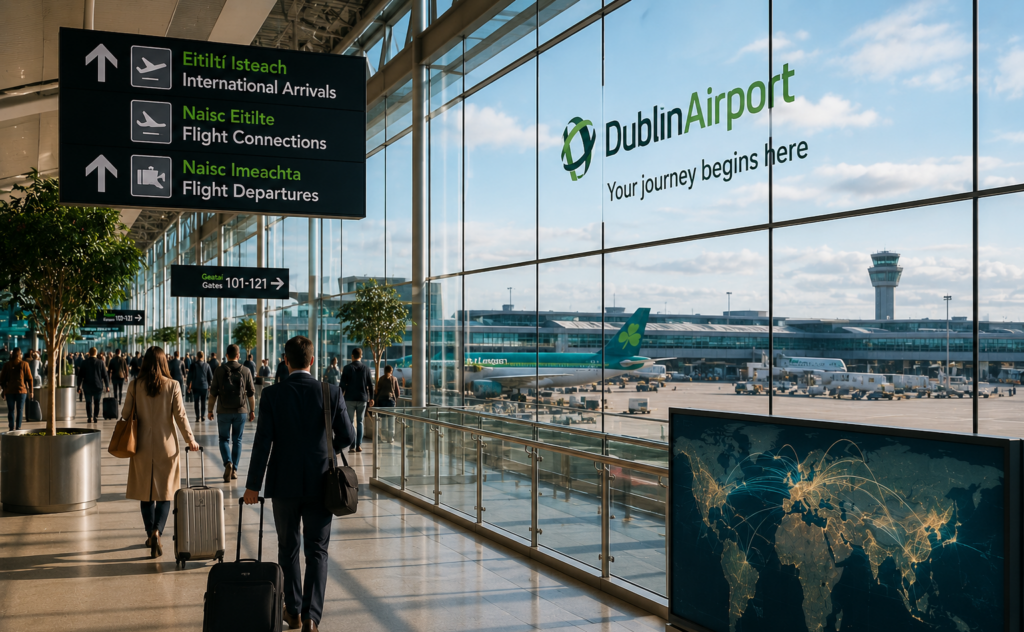
Ireland has enacted legislation intended to remove the long-standing annual passenger limit at Dublin Airport. The decision is strategically important for international investors, exporters, visitors and globally mobile professionals because Dublin handles the overwhelming majority of the country’s air traffic. Greater capacity could strengthen Ireland’s connectivity, but sustainable growth will depend on transport infrastructure, environmental safeguards and a more balanced distribution of visitors across the country.
For an international client assessing Ireland, aviation is not a secondary matter. It influences where executives establish businesses, whether international teams can meet efficiently, how easily investors can visit projects and whether family members consider relocation practical.
Ireland’s island geography makes reliable air access a basic component of economic competitiveness.
The legislation enacted in July 2026 to address Dublin Airport’s annual passenger cap therefore carries significance well beyond the aviation sector. The original limit of 32 million passengers was associated with a planning condition introduced in 2007. Since then, Ireland’s population, tourism economy and international business connections have expanded considerably. Passenger numbers exceeded the limit by several million during 2025, intensifying pressure for a permanent solution.
Airlines and business organisations have argued that an inflexible cap could restrict new routes and weaken Ireland’s economic connections, particularly with Europe and North America. Dublin Airport handles approximately 80 per cent of Irish air traffic, meaning restrictions at a single airport can have national consequences.
For international companies, additional capacity could improve access to headquarters, clients and European markets. For exporters, more routes may strengthen cargo connections and make specialist Irish locations easier to reach. For future residents, improved schedules can reduce the practical distance between Ireland and family or business interests abroad.
Nevertheless, removing a numerical limit does not automatically create an efficient or sustainable gateway. Airport growth requires road capacity, reliable public transport, accommodation for workers and serious consideration of noise and emissions.
The debate also exposes Ireland’s dependence on Dublin. An international visitor arriving through the capital may be travelling onward to Galway, Cork, Donegal, Kerry or the Midlands, yet the country’s aviation system remains highly centralised.
A more resilient strategy would combine Dublin’s global reach with stronger regional airports and better surface connections. Cork, Shannon, Ireland West and other airports can play a larger role in international accessibility, particularly for companies, visitors and relocation clients whose destination is outside the capital.
International clients should therefore interpret the change as a positive signal, but not as the complete answer to Ireland’s connectivity needs. More passenger capacity strengthens Ireland’s openness. The larger opportunity is to use that capacity to connect international activity with the whole country.
The most successful outcome would not simply be a busier Dublin Airport. It would be an Ireland in which international access supports investment, tourism and new residents from the eastern capital to the Atlantic counties.